Assault on Precinct 13 (1976)

Starring: Austin Stoker, Darwin Joston, Laurie Zimmer, Tony Burton
Directed by John Carpenter
Optimum Home Entertainment
October 2008
Lt. Ethan Bishop is assigned to Precinct 13 in Anderson, which is being systematically shut-down and moved elsewhere. Only a skeleton crew of the captain, a desk sergeant and two administration women are in place. Bishop is understandably expecting a quiet night, but chaos is about to descend in a manner he could never have predicted. A handful of dangerous prisoners (including the notorious Napoleon "Got a Smoke" Wilson) are being transported by bus to another location, but when one of their number falls seriously ill they are obliged to divert to the nearest police station - namely, Precinct 13. Meanwhile, a man is driving through the district with a little girl. As he stops to make a phone call, the girl goes to get an ice-cream... just as a street gang member is confronting the driver of the van. Consequentially, she is gunned-down. The distraught man drives after the gunman and kills him, but when the rest of the gang appears he is forced to flee for his life to Precinct 13. What follows is all-night assault on the station. If Bishop and the others are to survive, they will need the help of Napoleon Wilson. But can they trust him...?
This is much more than a straightforward street gang shoot-em-up. Carpenter ideally wanted to make a western in the vein of his hero Howard Hawks, but westerns were beginning to become outdated, and he couldn't afford the sets and costumes. So, he elected to do something rather clever; he wrote a then contemporary reworking of Hawks' Rio Bravo, with a siege situation on a police precinct. It's important for the sake of the story that there is only a handful of people holding out in an essentially disused station. The telephone lines are dead so there's no contact with the outside world, and no back-up support from other units. There is also a limited supply of ammunition for the few guns they have. The gang uses silencers so that their gunshots cannot be heard and attract unwanted attention. The Street Thunder gang created by Carpenter is interracial, raising its status to pure retaliation against the police for its surprise shoot-to-kill attack on the gang at the start of the film.
Assault on Precinct 13 was the first of a number of films he would make with a siege theme. He also incorporated a strong woman character (Leigh, named after Leigh Brackett - the writer of Rio Bravo) which he always felt was very important. Carpenter edited the movie under the pseudonym John T. Chance, which was the name of the sheriff in Rio Bravo. There's an element of wry humour present, especially in the scene when the hot potato game is played to decide who goes into the sewer through a manhole cover to seek escape. This is also John Carpenter's first full music score, and he produces a memorable theme said to be influenced slightly by Led Zeppelin's 'Immigrant Song' and the music from the Dirty Harry film.
Remembering what happened on Dark Star, Assault on Precinct 13 was the first film he had total control over; something he would insist on from this point onward. The film was released to a muted response in America. The MPAA made Carpenter cut out the scene wherein the little girl is shot dead. This he did, but only in the version sent to the MPAA, thereby sneaking the film out intact. He obviously knew that the entire plot pivoted on this moment, because the avenging man is followed to the precinct. It was its release in Europe which proved momentous, particularly its successful presentation at the 1977 London Film Festival. Irwin Yablans of Compass International saw the film and asked Carpenter to make a movie of his idea for babysitter murders set on Halloween. A classic and timeless movie was about to take the industry by storm.
Extras on this disc consist of a Q&A with John Carpenter & Austin 'Bishop' Stoker, a Carpenter Commentary (always worth listening to, believe me), a Photo Gallery, Trailers and the Music Score.
Phantom of Death (1988)

Starring: Michael York, Donald Pleasence and Edgewige Fenech
Directed by Ruggero Deodato
Shameless Screen Entertainment
October 2007
Robert Dominici is a piano virtuoso who, at a young age, is diagnosed with a very rare rapid ageing disease. Within a year he degenerates from a good-looking and musically skilled thirty- year-old with the world at his feet to a slow and sick deranged man of eighty. When he kills to cover his secret, Police Inspector Datti is assigned to investigate. But it proves more difficult than he first thought, because witnesses give completely different descriptions after each incident. As time goes by Dominici becomes increasingly unbalanced and phones the inspector to taunt him. Then he learns that a woman is pregnant with his child, and he is suddenly determined to kill the unborn baby to prevent it suffering his own devastating fate...
Off Balance, aka Phantom of Death, is an early release in the Shameless Screen Entertainment collection, which aims to release a number of violent horror or exploitation films, many of which will not have been seen in the UK before. This film's claim to fame (or should that be infamy?) is that it was helmed by Cannibal Holocaust director Ruggero Deodato. That knowledge doesn't help the first fifteen minutes which is an absolute agony to endure. An overlong mimed piano piece precedes some forced acting and non-linear set pieces which cause you to lose interest before the film has really got going. The curious thing is that I changed my opinion of this movie several times in its duration, but it did gradually grow on me to a certain extent.
I'm not a fan of exploitation or gore-fest movies which have no agenda other than to shock and disgust, I consider them in bad taste. I'm not averse to violent horror, as long as what takes place is conducive to the plot, rather than a series of tedious set-pieces. The Shameless releases are marketed as depraved, vile, disturbing, etc. In this case I was delighted to discover that Phantom doesn't fall into this category. Granted, there are violent murders, but they are over in scant seconds with a small splash of theatre blood and positively no glorification in the acts. This makes you concentrate more on the plot and particularly the characters, which is as it should be.
Donald Pleasence reprises his role of Loomis from John Carpenter's Halloween in all but name, and Michael York appears to grow into his role as he goes along, as if the older his character appears the meatier his acting part should become. When Robert finds out about his rapid-ageing disease, we find out that the film isn't quite linear in its plot. The short scene in which he visits the house of someone with a more advanced stage of the rare disease is the most meaningful of the entire film - and it doesn't last more than a few seconds.
In conclusion, a better film than I was expecting, and worth a look if you can stay awake through the opening scenes.
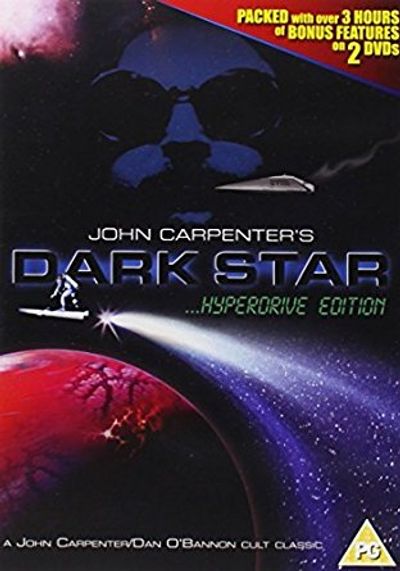
Dark Star (1974) - Hyperdrive Edition
Directed by John carpenter
Screenplay by John Carpenter & Dan O'Bannon
Starring: Brian Narelle, Dan O'Bannan, Dre Pahich & Cal Kuniholm
Fabulous Films
February 2011
Bombed out in space with a spaced out bomb! Talby, Doolittle, Pinback and Boiler comprises the remaining crew of the Dark Star, a deep space craft which clears the way for human colonisation. The mission is to blow-up unstable planets with ‘smart bombs’, of which there are twenty. The men have been together for so long that they are unkempt and pretty much uncaring. Talby dreams of seeing the ultra-rare Phoenix Asteroid, Doolittle misses his surfboard, and Pinback is actually an imposter. When an asteroid storm causes damage to the automated systems, the intelligent Bomb 20 arms itself and begins a countdown to disaster. The answer might lie with Commander Powell, but Commander Powell is dead and in the cryogenic freezer after his seat mechanism exploded. Time is fast running out, but Powell’s memory isn’t what it was when he was alive...
In 2004 the 30th Anniversary Special Edition emerged, nicely packaged and presented on a single disc, but with very little extras. Seven years has passed since then, and so an updated version of Dark Star is well overdue. This release is over two discs, and incorporates more than three hours of additional features. The film has been sourced from a new 16 x 9 35mm transfer, with frame by frame digital restoration of the video master to vastly improve the resulting picture. The soundtrack has also been digitally enhanced and restored to Dolby 5.1.
Sticking with the extras, disc 2 is entirely taken up by Let There Be Light: The Odyssey of Dark Star, an almost 2-hour length documentary which explores the four year journey from conception to theatrical release. With John Carpenter’s main partner on this project, Dan O’Bannon, sadly no longer with us, you would expect there to be a lot of Carpenter material. Although the documentary is very thorough, the vast majority of the reminiscenses and anecdotes are told by O’Bannon’s widow and Brian Narelle, who played Lt Doolittle. There are audio recordings from an old Carpenter interview, but there are no accompanying pictures of the man himself, and the recording is subtitled due to the sub-standard quality. Dark Star was first released in 1974, 37 years ago, so I suppose like any old film it becomes increasingly difficult to find people to dig for recollections. Plus the fact that some people just don’t want to be reminded of their past.
The biggest disappointment, extras-wise, is that there is no audio commentary to accompany the film by John Carpenter. For a huge Carpenter fan like myself this is a major oversight. I find his other film commentaries highly entertaining He is not afraid to be self-deprecating and tell his audience what didn’t work, and there is normally a great deal of insight and information surrounding the process of filmmaking. They really should have made it worth JC’s time, as it would have rounded off an almost perfect release. Having said that, there is a plethora of other extras crammed on to disc 1: A lengthy interview with Brian Narelle (Doolittle); the final interview with Dan O’Bannon; a commentary by super fan Andrew Gilchrist; a 3-D guide to the Dark Star ship; a written intro by Dan O’Bannon; Trivia; the original film trailer; and the highlight for me, a lengthy interview with SF writer Alan Dean Foster. Foster novelised Dark Star whilst still a new writer. He is my personal favourite SF writer, and I have read nearly all of his books. It’s nice to hear him recount how he was invited to the premier of the film, and had a burger across the road afterward with John Carpenter, sharing dreams of success which were literally just around the corner.
And now to the film itself. This should be on every Carpenter/O’Bannon fan or historical film collector’s shopping list. As far as the casual mainstream viewer (or even SF fan) goes, you’ll be sorely disappointed if you’re expecting a big Hollywood production with spectacular stunts and special effects. This began as a student project while John Carpenter was still at film school. With help he was determined to see it through to a theatrical release. Even then it took four years, primarily because he kept running out of money. Consequentially, it was released on a shoestring budget. The film has been described as a parody of Stanley Kubrick’s 2001: A Space Odyssey, but present day parodies are blatant comedies. This is closer to dark humour; it’s quirky but there are no laugh-out-loud moments, except perhaps the celebrated feeding the alien sequence. I tend to regard this as a valuable piece of nostalgia. It’s highly entertaining without being exciting. Of course John Carpenter went on to great things, such as Halloween, Escape From New York, Assault on Precinct 13, The Thing, and many others. But let’s not forget where he came from.
This is the most comprehensive release of Dark Star thus far. The Blu-ray version, released shortly after, sacrifices the excellent Alan Dean Foster interview with an alternative version of the film (so that we have a Director's Cut and the Theatrical Release). The picture is phenominally crisp and there are nice menus.
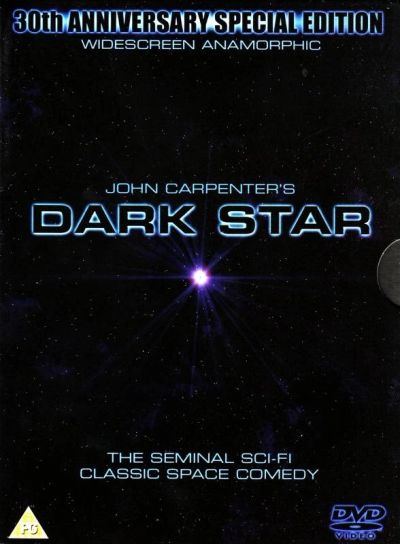
Dark Star (1974) - 30th Anniversary Special Edition
Directed by John Carpenter
Screenplay by John Carpenter & Dan O'Bannon
Starring: Brian Narelle, Dan O'Bannan, Dre Pahich & Cal Kuniholm
Fabulous Films & Fremantle Home Entertainment
April 2004
Four men crew the deep space scout ship Dark Star, their mission to seek out unstable planets and destroy them to prepare the way for future colonisation...
Although they have aged only three years, they have been in space for 20; each man has become unkempt, lethargic and bored. Talby spends all his time in the dome staring at the stars and dreaming about the beauty of the Phoenix Asteroid, which is said to glow with colours; Doolittle was a good surfer back on Earth and misses his board more than anything; and Pinback reveals in his computer diaries that he is really Bill Fruge, a Fuel Maintenance Technician who just happened to try on the other man's suit. Boiler simply keeps his head down and gets on with his job, hoping for better things.
However, a succession of events conspire to spiral out of control and they all go to hell in a handbasket. Communications Lazer No. 7 is damaged when the ship passes through an asteroid storm, causing Bomb 20 to exit its bay on two separate occasions. It is ordered back the first time by the men and subsequently persuaded by the ship's computer. Possessing an individual intelligent personality the Bomb becomes increasingly frustrated. When the crew comes to legitimately drop the bomb it will not release due to an accidental short circuit caused by the escaped alien (more of that in a moment). The countdown begins and, with only 14 minutes remaining, Doolittle visits the cryogenic unit to ask the advice of the dead Commander Powell. However, Powell is isolated and forgetful, so Doolittle is reduced to leaving the ship to argue the great questions of life with the bomb. The forgotten Talby is sucked out into space whilst examining the damaged lazer, resulting in a conclusion which borrows equally from Marvel Comics' The Silver Surfer and Ray Bradbury's Kaleidoscope.
As a long-time admirer of John Carpenter's work, I could bore you within an inch of your life with a multitude of fascinating behind-the-scenes information. But rather than allow you to escape entirely you might be interested to know that he and Dan O'Bannon wrote the script whilst still at film school. The product took well over three years to complete, due to money and distribution problems, but still only cost $60,000. Wigs and false facial hairs were utilised to cover the changes to the actors' appearance over that time. Much of the work was produced by the duo themselves; whilst Carpenter wrote, scored, produced and directed, O'Bannon wrote, handled the film editing, production design and special effects supervision, as well as playing the part of Pinback.
Yes, it looks a little cheap, but aside from the abundance of seventies hair it's not as dated as you might think. Special effects are kept to a minimum, and a sense of apathetic realism is generated by downplaying the acting. None of the characters become excited about anything that happens, even when their very lives are in danger; they are well past emotions and into paranoia.
Anyone who has already seen this film will surely agree that, apart from the finale, the outstanding set piece scene is when Pinback goes to feed the alien. The beachball-like creature with webbed and clawed feet escapes the holding area and leads Pinback a merry dance through the ship and into the lift shaft where it almost succeeds in getting the man killed.
You would have to be a fool not to realise this is a black comedy, but as the trailer on this disc proves Dark Star was incorrectly promoted as a straightforward science fiction action/thriller, inviting inevitable comparisons with 2001: A Space Odyssey when they are as different as chalk and cheese.
Dark Star was obviously a labour of love for Carpenter and O'Bannon. Deep belief in the product and its deserved niche in the marketplace sustained them through nearly four years of trying, when it might have been easier on several occasions to cut their losses and run. But after Carpenter's Academy Award for best short subject won for The Resurrection of Bronco Billy, he might well have gained a reputation as a failure with a short attention span. After all, how could he expect the film executives to have faith in him had he possessed no confidence in his own abilities? Instead of that, Carpenter earned much respect as a genius of the low-budget flick, going from strength to strength with Assault on Precinct 13, Halloween and Escape From New York. O'Bannon himself went on to script Alien and handle the on-screen graphics for Star Wars.
Extras on this disc are sparse. As well as the original theatrical release of the film and the 1974 extended film version (which contains only a couple of additional scenes), there are bibliographies for John Carpenter, Dan O'Bannon, Brian Narelle and Jack Harris, a picture gallery and the aforementioned trailer. A serious omission from the release is a Carpenter commentary, which normally makes for great listening on his other DVDs. As this is called a "Special Edition" we could also have done with some interviews about the making of the production.
In conclusion then: if you have a dark sense of humour you might enjoy this. If you're a fan of Carpenter's early work you'll love it. Red Dwarf years before its time. Bombed-out in space with a spaced-out bomb!
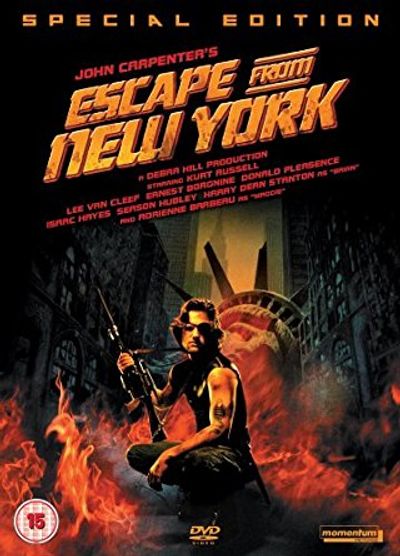
Escape From New York (1981) - Special Edition
Directed by John Carpenter
Written by John Carpenter (With Nick Castle)
Starring Kurt Russell, Donald Pleasence, Lee Van Cleef, Ernest Borgnine & Harry Dean Stanton
October 2005
Snake Plisskin ("I thought you were dead!") is an ex-Special Forces war hero who is currently serving life imprisonment in a maximum security penitentiary for robbing the Federal Reserve Depository. He is offered a complete pardon in exchange for rescuing the President from New York, where his plane has crashed. New York is a walled-off prison where gangs and hardened criminals have made their own hierarchy. To ensure his co-operation Plisskin is injected with two minute capsules; if he doesn't return with the President within 22 hours the capsules will dissolve setting off fatal heat-sensing charges. The President's location tracker proves to be a false lead, and Plisskin eventually discovers via a character called "Brain" that the man has been taken by the Duke of New York, a powerful and ruthless gang leader. But Snake can be pretty ruthless himself, let down by the government he fought for he cares about nothing but his own welfare...
As a bonafide long-time admirer of John Carpenter's work this release would have to be an uncaring straightforward video transfer for me not to rave about this excellent film. Thankfully, it's better than that.
Snake Plisskin is a great character, an anti-hero who sneers at the establishment and whose quiet tones are reminiscent of Clint Eastwood. The plot, settings and lighting are near faultless, and it's amazing we have so many big names (Lee Van Cleef, Ernest Borgnine, Donald Pleasence, Harry Dean Stanton and of course Kurt Russell) in a movie budget of only $5 million.
I could wax lyrical for pages about this film and other Carpenter greats, but this review is supposed to be about the DVD release. There's some good extras, including: two commentaries (Writer/Director John Carpenter and Actor Kurt Russell, and the other is Producer Debra Hill and Production Designer Joe Alves). Carpenter himself is always interesting, entertaining and brutally honest, whereas Russell obviously enjoyed himself immensely, citing Snake Plisskin as his favourite acting part. There's the deleted scene which was to form the original opening of the film. It's the robbery itself, and although it's an exciting piece it doesn't really fit in with the rest of the story. A couple of trailers are accompanied by Snake Bites which is a series of vignettes from throughout the film. To cap off, Return to Escape From New York is a behind the scenes featurette.
This region 2 release has opted for the single-disc, whereas the region 1 version has two. I would advise any Carpenter fanatic like myself to go for the North American region one (if your player can handle it), because the open-out packaging is lovingly assembled and there are additional special features, including the first issue of John Carpenter's Snake Plisskin Chronicles Comic Book, a gallery recording the making of those chronicles, three other photo galleries, and liner notes by Carpenter. Also, although this region 2 release has audio options for Dolby Digital 5.1 and 5.1 DTS, the region 1 discs look and sound remarkably more crisp.
However, having said all that, this is a perfectly fine release for the casual buyer or those watching on a recommendation. We've already been subjected to inferior copies of Carpenter's Assault on Precinct 13 and The Fog, so anyone who hasn't seen this cult movie yet should do so now, before the folklore is damaged by another disappointing and frankly pointless remake.
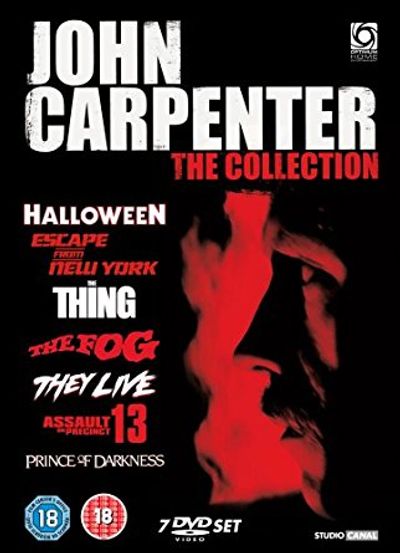
John Carpenter Collection
Written & Directed by John Carpenter
Starring Jamie Lee Curtis, Kurt Russell, Donald Pleasence, Adrienne Barbeau & Others
Optimum Home Entertainment
October 2008
John Carpenter is an accomplished storyteller (writing, directing and composing the music score for the majority of his movies) and a rare talent, so the release of a collection of seven of his best projects is welcome indeed. For anybody interested in delving for the first time into the works of the great man this is a fantastic place to start.
Lt. Ethan Bishop is assigned to Precinct 13 in Anderson, which is being systematically shut- down and moved elsewhere. Only a skeleton crew of the captain, a desk sergeant and two administration women are in place. Bishop is understandably expecting a quiet night, but chaos is about to descend in a manner he could never have predicted. A handful of dangerous prisoners are being transported by bus to another location, but when one of their number falls seriously ill they are obliged to divert to the nearest police station - namely, Precinct 13...
Assault on Precinct 13 (1976) was the first of a number of films Carpenter would make with a siege theme. He also incorporated a strong woman character (Leigh, named after Leigh Brackett - the writer of Rio Bravo) which he always felt was very important.
There's an element of wry humour present, especially in the scene when the hot potato game is played to decide who goes into the sewer through a manhole cover to seek escape. This is also Carpenter's first full music score, and he produces a memorable theme said to be influenced slightly by Led Zeppelin's 'Immigrant Song' and the music from the Dirty Harry film.
This was also the first film Carpenter had total control over; something he would insist on from this point onward. The film was released to a muted response in America. The MPAA made Carpenter cut out the scene wherein the little girl is shot dead. This he did, but only in the version sent to the MPAA, thereby sneaking the film out intact.
Extras on this disc consist of a Q&A with John Carpenter & Austin 'Bishop' Stoker, a Carpenter Commentary (always worth listening to, believe me), a Photo Gallery, Trailers and the Music Score. Verdict: 8 out of 10.
Fifteen years after the young Michael Myers brutally stabbed to death his teenage sister, Judith, Doctor Loomis - who has followed the subject's case and tried to break through to him without success - is on his way with a nurse to the sanatorium from which Myers is due to be transferred. When they arrive the compound gates are open and patients are wandering around. Fearing the worst, Loomis rushes off toward the building. The nurse is attacked and the car stolen. Michael Myers is on the loose...
Halloween (1978) is often referred to as the granddaddy of slasher movies. This title is meant to be complimentary, but in my opinion is a little unkind considering some of the hack 'n' slash, gore-for-gore's-sake excuses for movies which emerged afterward. Admittedly, it did unknowingly set the ground rules for what was to become known as the Teen Horror Flick.
Halloween is a very stylish horror with more creepy than violent moments. There is very good use of lighting, to chilling effect. The idea of a completely silent masked psychotic killer is infinitely more frightening than, for instance, the wise-cracking Freddy Krueger, who came later.
Various in-jokes and names are present, including some in homage to Psycho. Shortage of space prevents me passing-on a hundred and one fascinating facts about this film, suffice to say it's a true classic which opened to mixed reviews. As with most of his films, Carpenter proved to be a man ahead of his time. Word of mouth would make Halloween a sensation, and for twelve years the highest grossing independent film of all time. By the time news of its phenomenal success filtered through to him, Carpenter was well into his next project.
Extras on this disc consist of the Halloween Unmasked 2000 documentary, Trailer and Bios. I'm not certain if the two-disc 25th anniversary edition is incorporated here, but it's a shame if it isn't - leastways for the always entertaining John Carpenter commentary. Verdict: 10 out of 10.
The little town of Antonio Bay is preparing for its centenary celebrations, but it has a dark secret. 100 years before, the Elizabeth Dane ship, lost in a thick bank of fog, crashed on the rocks at Spivey Point, misdirected by a campfire intended to ground the vessel. The vicar of the church discovers the diary of Father Patrick Malone when a brick falls from the wall of the vestry. The writings give credence to the possibility of the fog returning, bringing back the dead crewmen seeking revenge for cold-hearted betrayal...
Keen to follow-up Halloween with another scary tale, Carpenter borrowed a true event from the 1700s when a ship laden with gold was lured on to the rocks by the locals. The crew was drowned and the gold stolen. The Fog (1979) is therefore essentially a supernatural tale of revenge.
Jamie Lee Curtis returns to the Carpenter fold after her debut in Halloween; this time she plays an older character and shares the credits with her mother Janet Leigh of Psycho fame. A couple of other actors from Halloween also return: Nick Castle and Nancy Loomis, and Dan O'Bannon returns from Dark Star. Oscar winner John Houseman is also in the cast, but the biggest plaudits should go to Adrienne Barbeau (Carpenter's then new wife) as the sultry-voiced Stevie Wayne, who manages just the right balance of calmness and urgency - another very strong female character. Many times Carpenter has enjoyed Hitchcock-like cameos in his movies, but in The Fog he has a brief talking park as the church handyman.
The pacing of this movie is spot on, with early shocks and scares being only part of the steady build-up to the church siege conclusion. The dead mariners from the Elizabeth Dane are kept in darkness or backlit in the fog so that they are nearly always seen in silhouette, the active principle being that less is more. Also greatly enhancing the atmosphere is the very impressive music score, easily one of his best.
Extras on this disc include: the documentary Tales From the Mist and trailers. Again, where's the Carpenter commentary (available on the special edition version of The Fog DVD)? Verdict: 9 out of 10.
Snake Plisskin ("I thought you were dead!") is an ex-Special Forces hero who is currently serving life imprisonment in a maximum security penitentiary for robbing the Federal Reserve Depository. He is offered a complete pardon in exchange for rescuing the President from New York, where his plane has crashed. New York is a walled-off prison where gangs and hardened criminals have made their own hierarchy. To ensure his co-operation Plisskin is injected with two minute capsules; if he doesn't return with the President within 22 hours the capsules will dissolve setting off fatal heat-sensing charges. The President's location tracker proves to be a false lead, and Plisskin eventually discovers via a character called "Brain" that the man has been taken by the Duke of New York, a powerful and ruthless gang leader. But Snake can be pretty ruthless himself, let down by the government he fought for he cares about nothing but his own welfare...
Upon its release, Escape From New York (1981) went up against Raiders of the Lost Ark, but was incredibly well-received for a relatively small picture and still made the huge return of $50 million.
Snake Plisskin is a great character, an anti-hero who sneers at the establishment and whose quiet tones are reminiscent of Clint Eastwood. The plot, settings and lighting are once again near faultless, and it's amazing we have so many big names (Lee Van Cleef, Ernest Borgnine, Donald Pleasence, Harry Dean Stanton and of course Kurt Russell from Carpenter's Elvis in his first action figure role - although Avco wanted Charles Bronson) in a movie budget reportedly between 5 and $7 million.
Making another welcome return is Adrienne Barbeau. Nick Castle co-wrote the script with Carpenter and is mainly responsible for the low-key dark humour in the film.
A fascinating fact is that the matte painter of the movie was none other than James Cameron, later director of The Terminator, Aliens, Titanic and others.
Shooting took place through the nights between 9:00pm to 7:00am. It would be Carpenter's and Avco's most ambitious project to date.
Extras on this disc include the Return to Escape From New York documentary, a John Carpenter interview, trailers, a thoroughly entertaining Commentary with John Carpenter and Kurt Russell (Carpenter himself is always interesting, entertaining and brutally honest, whereas Russell obviously enjoyed himself immensely, citing Snake Plisskin as his favourite acting part), and Snake's Crime (the deleted opening scene - the robbery itself, which is an exciting piece but doesn't really fit in with the rest of the story). Verdict: 9.
JR MacReady is a helicopter pilot and part of the crew of a US Antarctic research station. When a Norwegian helicopter mysteriously crashes whilst chasing and trying to kill a dog, the station takes the animal in and allows it to wander. MacReady and others fly to the Norwegian base to find out what took place. They discover it uninhabited, bleak and cold. A huge area in the ice has been cut away to reveal part of what appears to be a spacecraft. A man-sized block of ice is taken back to the US base where it accidentally thaws out. When the dog is placed with the sled dogs they cower in fear as it erupts into a hideous creature. A flame thrower destroys it, but this is in fact a shape-shifting extraterrestrial which can take the form of any living thing. When attacked it reveals its previous forms in a sickening amalgamation of twisted body parts. From that moment on, the station becomes a hotbed of fear, panic and ultra-paranoia, as nobody knows who to trust. MacReady thinks he has the solution, but is he too late...?
Upon its general release, The Thing (1982) bombed. Cinema-goers were apparently appalled and disgusted by the hideous shape-changing scenes - missing the point entirely. E.T. had just been released and the public was not ready for Carpenter's intelligent and well-crafted monster flick after such a popular and benign alien from Spielberg. However, a few years later critics began to reassess the film, and it picked up a huge following retrospectively.
The premise of a shape-shifting creature is said to have inspired the T-100 from Cameron's Terminator 2, particularly the scene when it loses substance and goes through one shape after another. There was also an episode of The X-Files which was heavily influenced by The Thing. Dark Horse comics published a continuation of the story, which also brought a new audience to the film. Carpenter has toyed with the idea of a sequel ever since, but in semi-retirement he's unlikely to get around to it.
The fantastic array of extras on this disc include the 80 minute Terror Takes Shape documentary, the thoroughly entertaining (again) commentary with John Carpenter and Kurt Russell, Production Background Archive, Production Art and Storyboards, Location Design, Outtakes, Production and Post Production Notes, Cast and Filmmakers' Notes, and Cast Production Photos. Phew! Verdict: 10 out of 10.
When the last guardian of the forgotten sect, The Brotherhood of Sleep (a religious organisation kept secret even from the Vatican), dies he leaves a key to a Catholic priest. The key opens a door into the basement of an abandoned church. Inside is a large canister which appears to contain a green sludge. The priest asks a college professor of theoretic physics to investigate, and he agrees, taking along a handful of his students. They discover via an old manuscript that the canister is seven million years old and can only be opened from the inside. The substance it holds is the essence of pure evil - Satan itself, if you like. As the students attempt to study it, the sky begins to change, and hoards of mysteriously psychotic homeless people surround the building, making it a prison. The green substance begins to spread its contagion by spraying in the face of its victims - while the survivors try to barricade themselves in a room - preparatory to bringing through Satan's father, the Anti-God...
Although the eighties was awash with horror films (most of them franchises or inferior copies), thereby losing this one somewhere in the middle, Prince of Darkness (1987) was well- received by the public and most Carpenter fans. A small contingent saw this moment as the beginning of a slide in talent by the director, but I think those people simply saw this as students versus demon, missing the intelligently written script which explores anti-particles, tachyon transmissions, and differential equations - along with questions such as what is Man's place in the universe, and where does he fit in with science?
The important thing here is that Carpenter was making a film that he wanted to see - which is all any writer, director or artist of any kind can do. It is proof of his conviction in this regard to know that he turned down big-money directing jobs on Top Gun and Fatal Attraction.
I'm led to believe there's only a trailer on this disc as extras; so where is the John Carpenter commentary which is freely available on the Momentum region 2 release? 8 out of 10.
John Nada is a homeless and jobless drifter who comes to town looking for labouring work. He finds refuge with a large destitute homeless community, but it is soon mysteriously attacked and destroyed by riot police. Most of the individuals are taken away. When Nada witnesses a similar raid on a nearby building, he waits it out before entering to look for clues as to what the purpose of the raid was. Inside he finds a pair of sunglasses which changes everything around him when he puts them on. A percentage of the population actually consists of aliens with skeletal faces, and just as importantly all advertising and media is subversive brainwashing aimed to instruct the populace with messages such as Consume, Procreate, Submit, Obey, No Independent Thought, and on the money, This Is Your God. When Nada meets Frank he has a hard time convincing him, but a scrawled message, They Live - We Sleep, convinces them that there are others who know the truth. The problem is how does this small band of rebels open the eyes of the world...?
As with Prince of Darkness, the budget for They Live (1988) was only $3 million and the shooting schedule 8 weeks. For the part of Nada Carpenter recruited experienced wrestler "Rowdy" Roddy Piper, whom he had seen at a Wrestlemania event. Taking a chance paid off, because Piper brings much more than brawn to the part.
Keith David (who had appeared in The Thing) was alongside him with Meg Foster. Mind you, Piper's profession did help when Carpenter scripted-in a seven minute alleyway brawl because he wanted to out-do The Quiet Man as the longest on-screen fight.
As with his previous film, Carpenter composed another excellent mood-enhancing music score. Releasing the film just prior to the 1988 elections was either inspired or a very lucky happenstance, because it proved to be a hit at the box office - seemingly the only Carpenter film that audiences 'got' straight away.
An inherent message in the film about not selling-out for big financial success was not lost on Carpenter fans, who know that he has never been close to doing so. There was talk of a sequel to They Live, titled Hypnowar, but it was never made.
Extras on this disc consist of a Making of... featurette, a Commentary with John Carpenter and Roddy Piper, and Carpenter, Piper and Meg Foster profiles. 9 out of 10.
So John Carpenter has enjoyed a successful, but sometimes uncomfortable career. But he has remained resolute and has a formidable arsenal of fine films in his canon.
If I were to choose seven films to represent his finest work, I would select those included in this set. They are strong and diverse achievements. Although the majority of extras available out there in the retail world are here to compliment the films, there are a couple of individual releases which are much more packed with special features, especially on region 1. However, this isn't a huge problem, as most avid Carpenter fans such as myself will already have these remastered films, and for those coming to John Carpenter afresh - as I said at the top of this piece - there's no better place to start than here.
Westworld (1973)
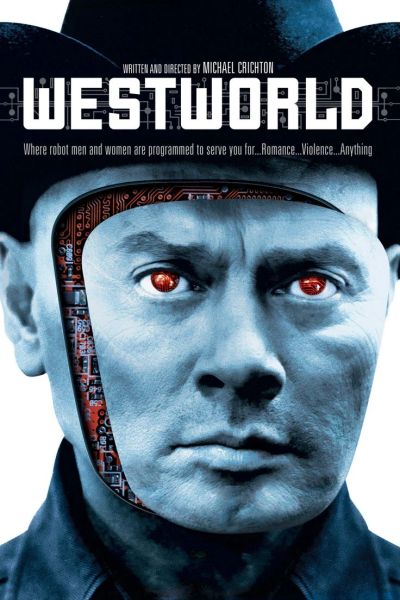
Starring: Yul Brynner, Richard Benjamin, James Brolin
Written & Directed by Michael Crichton
Delos is the ultimate theme park holiday resort. For $1000 a day customers can live out their fantasies in one of three controlled zones: Romanworld, Medieval World or Westworld - interacting with other holidaymaker role-players and state-of-the-art robots. Friends John and Peter live out the dream in Westworld... until things begin to go seriously wrong. When minor technical faults escalate, the resort robots carry out their programming with no thought or consideration to the safety of the guests. For John and Peter that means fleeing for their lives from a relentless killer gunslinger...
Here we have a movie which sets the benchmark, showing every aspiring filmmaker how it should be done. Westworld is in my top dozen films of all time, and it's easy to see why when you examine the inherent structure. It's based on a book by Michael Crichton, bestselling author of The Andromeda Strain, Jurassic Park, The Terminal Man and many others. However, a good book does not necessarily transfer smoothly to the big screen. One of the strongest attributes Westworld possesses is the fact that it works equally successfully as a western, science fiction, technological thriller, disaster movie, action adventure and, in places, feel-good light comedy - whilst maintaining an essentially genreless mainstream stance.
If I only had one word to sum-up Westworld it would be Fun. Right from the off, we're caught up in the enthusiasm of first-timer Peter Martin, reflected in the knowing smile of his experienced friend John Blane. We soak-up the ambience of the old west in the form of course whisky in the saloon, horse riding, a shoot out with a gunfighter, the pleasures of the cathouse, a jailbreak and a bar room brawl. The scientists running operations behind the scenes are shown in brief snippets with no wasted dialogue, so as to not detract from the main events hotting up for our protagonists.
Similarly, we're kept up to speed with some events in Medieval World, and in particular a guest's fatal confrontation with the Black Knight. The escalating tension as we approach the conclusion has the same feel as the film Duel - also from the early seventies. This is not only due to the tight script but exemplary acting. There's not a single bad word to be said about Yul Brynner's portrayal of the black-garbed robot gunslinger. It's just so powerful, and it's this performance alone which turns a good film into an excellent one. I simply cannot sing his praises enough. To paraphrase the movie tagline: Boy, have we got a movie for you.
Verdict: 9 out of 10
(Review originally written by Ty Power for sci-fi-online 2008)
Dr. Strange (1978)

Starring: Peter Hooten, Jessica Walters, Eddie Benton, Clyde Kusatsu, Philip Sterling and John Mills
Directed by Philip DeGuere
Universal Pictures
October 2016
The evil Morgan Le Fay is attempting to open the gates from the dimension she serves to the earth. This will unleash evil and chaos. Only the sorcerer supreme, Thomas Lindmer, can stop her, so she targets him individually. After surviving a duel with her, Lindmer realises he is going to need help. So, he acquires the aid of hospital psychiatrist Dr Strange. However, accepting belief in phenomena outside of his experience does not necessarily mean Strange can learn all he needs to in order to combat Le Fay. Lindmer doesn’t select him randomly though; Strange possesses his own mysterious connection to the magical world...
This is the original 1978 version of the comic book adaptation which was a made for television under the guidance of Marvel legend Stan Lee. It stars John Mills as Thomas Lindmer (the mystic tutor to Dr Strange), Jessica Walter as the villainess of the piece (Morgan Le Fay, the immortal witch), and Stephen Hooten as the title character. Particularly for a made for TV piece it would have been quite a coup to acquire John Mills. Here, the part definitely benefits from someone of a certain stature, and the look and character of Stephen Hooton makes him a natural for Dr Strange. Having said that this is undoubtedly a product of the 1970s. Some films seem to survive all decades without ageing, whereas others are grounded in their origins. One of the things which seems to date a film most is the music, and in this one the music is very jazzy, a la The Streets of San Francisco.
Of course, that’s not to say they hadn't done the best they could do with the resources at hand at the time. You have to appreciate the fact that CGI, so commonly in use now, was a long way from being devised. So, what we have instead is an established set for the other dimension location, taken pretty much from the Marvel comic book panels: what appear to be floating rocks in space, and in particular a place where Le Fay can be chastised and generally threatened by the real bad guy. Strange is lured to the ‘dark side’ just a little too easily for anyone other than the most naïve of villainesses to guess his ultimate motive. The aforementioned effects come in the manner of a handful of cosmic bolts thrown around; pretty basic stuff by today’s standards, but remember we are forty years hence.
It’s no coincidence that this film has been released now, with the brand new effects-laden Dr Strange (starring Sherlock’s Benedict Cumberbatch) having just arrived to pretty good critical acclaim. You might call it cashing-in, but there’s a certain nostalgia to these early examples of on-screen Marvel. For example, we’ve had six (and number seven is pending) big budget Spider-Man movies, but I still hold a deep regard for the quirky 1970s TV series with Nicholas Hammond.
The Incredible Hulk - The Complete TV Collection (1978-1982)

Starring: Bill Bixby, Lou Ferrigno and Jack Colvin
Fabulous Films Ltd / Fremantle Media Enterprises (Marvel)
December 2016
Dr David Bruce Banner is a scientist who explores how selective people have managed to produce great feats of strength in times of emotional stress and panic (particularly as he failed to save his own partner in similar circumstances). Research pinpoints high bombardments of Gamma Rays as being responsible. To test the theory he subjects himself to an intense level of Gamma radiation. There seems to be no effect, but from then on pain, stress or anguish triggers a monstrous metamorphosis as an inner beast is released...
The Incredible Hulk: The Complete Collection boasts all five seasons of the much loved 1970s TV series, based on the Marvel character created by the great Stan Lee. They are all fully restored and upgraded to high definition shiny bright Blu-ray across 16 discs.
This version of the Hulk is quite different from the original comic books. The idea right from the start was for producer Kenneth Johnson to ground the stories in everyday problems; perhaps in doing so inadvertently borrowing from the Spider-Man premise. Of course, with a limited budget and very few effects, it was only sensible to tell ‘people’ stories. Bill Bixby was apparently the only person the producer had in mind to play Banner. Bixby was a successful jobbing guest-star actor before he found fame in the series The Magician. He was seen as a highly competent actor who could pull-off exactly what they had in mind in terms of friendliness, anxiety, anger and touching scenes of emotion. It was decided that the comic book character’s first name of Bruce wasn’t strong enough, so they made that his middle name and called him David instead (go figure!).
Richard Kiel (Jaws in the Bond films Moonraker and The Spy Who Loved Me) was originally cast as the Hulk in the pilot, but it was soon decided he wasn’t right for the part. The programme-makers went after Arnold Schwarzenegger, who was busy filming Conan, but he did suggest his fellow bodybuilder and Mr Universe Lou Ferrigno.
After watching him in action for so long it’s difficult to imagine anyone else in the role – although Johnson did want the skin colour to be red rather than green, to show rage. Thankfully, Stan Lee vetoed the idea. Ferrigno was more than happy to be given the opportunity to act to the show’s requirements that the Hulk should be more than a monster, and display hesitancy, tenderness and sadness when the scripts required it. Another interesting fact about the character of the Hulk is that the growls and grunts for the first two seasons were added in voice over by Ted Cassidy, who was Lurch in The Addams Family. He also narrated the opening titles. Ferrigno was a consummate professional regardless of his hearing disability (he lost 80% of his hearing at the age of three).
The series started with two feature-length stories which are probably the strongest of the show’s run. The Incredible Hulk brilliantly tells the origin story, with the added danger of nosy roving reporter Jack McGee, played by Jack Colvin. However, the basic story is so well-known that the pilot is somewhat overshadowed by Death in the Family, which tells the story of a girl who has lost her father in a suspicious fire, and is being systematically poisoned by her stepmother so that the evil woman can inherit the wealth that would otherwise go to the girl. As a doctor, Banner recognises the signs and intervenes to the point that the stepmother gets her hired thugs to take him out of the picture. Enter our green friend...
As you would expect there is a certain format to the single episodes which follow. Reporter Jack McGee believes the Hulk killed Banner and another scientist, so Banner is forced to keep on the move to be one step ahead in case the inadvertent transformation happens again and the reporter turns up. Thankfully, in many of the episodes he travels to where he believes new scientific research will cure him of his malady – although his ultimate goal is more often than not forgotten in favour of a ‘trouble of the week’ scenario wherein by trying to help people he falls foul of the bad guys. I’m sure that in reality someone with this affliction would stay well out of everyone’s way. But then we wouldn’t have a story and, as I’ve already mentioned, these are very much ‘people’ stories.
I’m certain that prospective viewers currently in their teens or twenties would throw scorn upon this series; after all, the Hulk isn’t all powerful and sometimes darkly humorous like in the Avengers film. In fact, he mostly roars and growls, showing his muscles, and throws objects or people across the room. But that’s the whole point: the idea being that if David (Bruce) Banner wouldn’t kill or intentionally harm them, then his inner ‘Mr Hyde’ would be unwilling to, also. The best way to sum up this show is to say it has heart... a big heart. Accept it in the context of its intention in the era it was made and it’s evident they had a hit on their hands. Although I have seen these episodes probably many times over the years, it didn’t take long for me to be drawn in to its magic. It’s testament to its status that it is enjoying another run on the Horror Channel.
Extras include: Three entertaining featurettes which could have been edited together, as the same people are spoken to in each; a Gag Reel, that is sometimes amusing and so strangely conflicts with the style of the show; a Photo Gallery; a Lou Ferrigno Intro; and a Producer Commentary on the Pilot and two other episodes.
The Incredible Hulk Original Movie Collection (1988-1990)
Starring: Bill Bixby and Lou Ferrigno
Fabulous Films Ltd / Fremantle Media Enterprises
August 2018
Fabulous Films releases for the first time together the trilogy of The Incredible Hulk TV movies, starring Bill Bixby and Lou Ferrigno. The Incredible Hulk: Original Movie Collection contains The Incredible Hulk Returns (1988), The Trial of The Incredible Hulk (1989), and The Death of The Incredible Hulk (1990)...
In The Incredible Hulk Returns, Dr David Bannion has developed a machine called a Gamma Transponder, which will feasibly produce endless energy by removing Gamma Radiation from substances all around us (eh?). He shies away from public recognition – after all, he is really David ‘Bruce’ Banner, and is supposed to be dead. Of course, Banner has an ulterior motive: he has really designed the machine in the hope it will cure him of his anger affliction (and that’s an understatement!), which he is obliged to keep protected from the public. However, unscrupulous businessmen are after stealing the machine by kidnapping the woman Banner loves and blackmailing him into delivering it into their hands. In the meantime, Donald Blake, an ex-student of Banner’s seeks his help with a quite different problem. On a climbing expedition Blake found a body and a hammer, and becomes inextricably linked with Thor – the Norse God of Thunder. Blake can use the hammer to call forth or send back the warrior. Banner teaches Blake to come to terms with this unbreakable partnership, and in return Hulk and Thor go into glorious battle together to put things right.
Bill Bixby was a fine actor, and in turn Lou Ferrigno is perfect in the role of the Hulk – the first ever live-action version of the character. Around six years had passed since the popular TV series had come to an end. The series, whilst perhaps not satisfying the big budget Hulk of the recent Marvel Avengers films, had real heart. The problems were scaled-down, dealing with everyday businessmen villains, as opposed to cosmic power-hungry beings. The TV Movie carries on the trend as if it had never ended. Like the Hulk, the Thor character is lower-key. He doesn’t bring down lightning, but he does want to do the right thing by having a good fight. As you would expect, the modern world leaves him cold. When he asks for beer and food, Blake takes him to a biker’s bar where he fights, drinks a lot and wins a lot of unlikely friends. These scenes are well-handled, making Thor appear more grounded. The Hulk is as good as ever, terrifying people when all he does is a strongman pose, break a few guns and throw a few baddies across the room. He is accused of a murder he didn’t commit, so cannot be seen to do more. He is essentially a good guy, although Banner lives in fear of what the beast in him might do. As if he didn’t have enough of it during the series, reporter Jack McGee is back on his trail, repeatedly just missing out on seeing Banner.
This enjoyable family film is further complimented by a couple of good special features: Very entertaining separate interviews with Lou Ferrigno and Marvel demigod Stan Lee.
In The Trial of The Incredible Hulk, Banner heads to the big city under another pseudonym, and immediately becomes embroiled in trouble after a major jewellery robbery, masterminded by Wilson Fisk, the Kingpin. On a train two of the criminals attempt to assault a woman passenger. When Banner intercedes he is roughed-up. Enter the Hulk. He escapes into the tunnels and reverts to Banner, but he is arrested by police when the woman victim reports he was the aggressor – as it turns out, under duress from the criminal fraternity. Blind lawyer Matt Murdock arrives to take on his case. He believes he is innocent but doesn’t know why. After a particularly ferocious nightmare involving his inner beast, Banner changes and breaks out of prison. A well-known vigilante called the Daredevil seeks him out, ensuring him of his trustworthiness by revealing his identity as Matt Murdock. When the woman witness is kidnapped by the Kingpin’s men, Daredevil goes off in pursuit. However, Banner learns that the vigilante is walking into a trap, and feels obliged to go to his aid.
Although this uses the same last quarter plot strand as the previous film, it’s still enjoyable. Nevertheless, there is no doubt it is a much darker script. The inclusion of Daredevil necessitates this. He is very single-minded about helping the innocent and driving out corruption in the city where he lived as a boy with his dad.
Daredevil is probably the closest superhero in style and theme to Batman. A character in this movie actually borrows from the DC Comics Commissioner Jim Gordon. Gordon is the only member of the police force he can totally rely on, so there is somewhat of an ‘understanding.’ Similarly, in this one there is a high-ranking police officer who openly admits corruption in the ranks.
Again, Daredevil is toned-down for this first live-action appearance. In a family show he cannot be shown exchanging heavy blows with the villains. Although the costume in the comics was dark red, it was changed to black for this outing. It was a choice Stan Lee openly opposed. The comics briefly altered the costume colour to black, before reverting to their original colour. So I’m certain Lee felt vindicated.
Stan Lee has a cameo role in this, a move that was to become more than familiar in the later movies. He plays a juror in a Hulk frenzy set-piece. This could well be Ferrigno’s most lavish scene in the role. It is the nightmare wherein Banner is put on trial and cross-examined to the point he changes into the Hulk and goes on a rampage, throwing people around and famously lifting up the box containing all the jurors (who, I have to say, look back expressionless at him, as if this sort of this was normal!).
The rich voice of John Rhys-Davies makes his portrayal of the Kingpin more convincing, when we are used to substantially bigger actors playing the role. A sad note is that Jack Colvin, who played reporter Jack McGee, suffered a stroke after filming Return, and so was unable to appear in this or the subsequent movie.
In the final film of this collection, Dr Ronald Pratt has a laboratory in a high security building. He is working on a way to quickly heal human injuries, and a ghost is helping him. Every night someone is managing to get around the security, enter the lab and aid his research. The last person he would suspect is the mentally challenged cleaner, David. That is until he lies in wait one night. Dr Pratt chooses not to reveal this breach to officials, and the two work together to aid Banner’s plight. The process is almost certain to rid him of his inner beast, but it is interrupted when a beautiful spy gets in and tries to steal Dr Pratt’s discoveries. Pratt is badly injured in an accident, and the Hulk has to intervene. However, the spy is working under duress, believing her sister is being held hostage – when really she is the leader of the organisation and wants her dead. When Dr Pratt and his wife are kidnapped from the hospital for their knowledge, Banner and the former spy team-up and (forced to put their new emotional attachment to one side) go into action against the bad guys. But it doesn’t end well for our reluctant hero.
With the appearance of Thor in the first film and Daredevil in the second, it was intended to introduce Iron Man into this one, but the idea was abandoned at a late stage. So this film gets to concentrate more on the Banner/Hulk character. Banner finds a new family with Donald Pratt and his wife, he almost gets cured, finds love (and rumpy-pumpy!), and talks of a new life far away. However, nefarious and unscrupulous villains invariably get in the way of these things. The death scene itself isn’t a momentous occasion to feel he has sacrificed himself to the greater good. When the aircraft being flown by the villains Hulk is attempting to stop explodes in mid-air, the Hulk falls in slow motion to the ground. I like the fact that the ground breaks-up when he hits the runway, but the plane hadn’t even reached the clouds. It wasn’t that high, meaning the Hulk should have survived the fall. I suspect the intention here was to give him a good send-off in this format – and Banner a final peace.
There were plans for another follow-up movie, in which the central character is returned to life. It wasn’t to be, however, as shortly after the third movie Bill Bixby (who ably directed all three) fell ill and died. Bixby managed to create a different mood/feel for each of these films, and that is no mean achievement. No matter what modern audiences might think about lack of money, resources, special effects, stunt work and make-up, the films – and indeed the series – were fun, emotional and at times thought-provoking. The bottom line is they had heart. All the money in Hollywood can’t necessarily magic that into a production.
I’m sure the first two films could have been cleaned-up a little, as they are slightly grainy. The two extra features on the first disc are great, but the others contain nothing. Is there no existing behind-the-scenes footage or film of Lou Ferrigno being made-up? Perhaps then a TV historian waxing lyrical about the show and showering us with fascinating facts. But don’t let this turn you off. I watched the series as a kid and enjoyed it very much. These films maintain that same style, and I still enjoy watching it today.
The Thing From Another World (1951)

Starring: Margaret Sheridan, Kenneth Tobey and Robert Cornthwaite
Directed by Christian Nyby (Howard Hawks)
Screenplay by Charles Lederer (From the book 'Who Goes There?' by John W. Campbell)
Universal Pictures
March 2007
Scientists at an arctic research station track an object which deviates in its movements before crashing into the ice. Air Force personnel are called in to investigate the phenomenon. Flying between the station and the site in question, the compasses go haywire and they are forced to navigate by other means. What they discover is a large saucer-shaped alien craft under the ice. Attempting to blast it free proves unsuccessful but does reveal what looks likes a humanoid shape. The biped is flown back to the research station in a large block of ice. However, when the ice melts and the creature disappears, the weather isn't the only problem the personnel have to face. The Thing seems to be constructed of vegetable matter and needs the vitamins in blood to sustain itself. When it is discovered bullets have no affect, more drastic measures are called for...
There is a direct connection between this film and my favourite filmmaker, John Carpenter. Howard Hawks, who was the producer and uncredited director for this film, was a hero and inspiration for Carpenter in his early days. Some years back I attended a John Carpenter Masterclass at the National Film Theatre during which he demonstrated Hawks' film techniques, and included The Thing, which had quite an affect on him as a child in the fifties.
Of course, you would expect me to prefer Carpenter's 1982 remake of The Thing, which was much more true to the John W. Campbell, Jr. short story Who Goes There? - and you'd be right. But the point here is the impact this original had in its day.
The press blurb is correct in stating that it helped kick-start the sci-fi horror boom of the fifties. It's a long way from the many turkeys which followed in its wake. It doesn't play on the effects of the cold war, but just gets on with the story.
By today's standards this isn't going to scare anyone, and there are far too many scenes of group dialogue rather than tension-building. Where it does succeed is in its sheer style.
Some black and white films from the past are lent a certain atmosphere by the sheer lack of colour. The Thing is one of those. Therefore, I can see no sense in offering the alternative colourised version on this two-disc set, and can only imagine the purpose is to remarket the film for a modern day short-sighted viewing public. If you're tempted by this release, stick to the beautifully restored print version, also in this set.
At this point I would have scored the release a 7, but the icing on the cake for me is the optional commentary by none other than John Carpenter himself. Hooray!
Venom (2018)

Starring: Tom Hardy, Michelle Williams, Riz Ahmed, Scott Haze and Reid Scott
Directed by Ruben Fleischer
Screenwriters: Scott Rosenberg, Jeff Pinkner, Kelly Marcel
Distributor: Sony Pictures Home Entertainment
February 2019
Eddie Brock is a journalist with a reputation for upsetting the applecart and getting to the heart of the matter, but when he goes up against a space and research corporation he loses his job, his home and his fiancé. Carlton Drake, the head of the company, wants to protect his assets at all costs, which include three symbiotic organisms – brought back with a crashed shuttlecraft – and has begun illicit human tests, with disastrous and fatal consequences. When a worker asks for Brock’s help in revealing the company’s experiments to the world, Venom, one of the symbiotic creatures bonds successfully with Brock, and they use each other in an unlikely partnership to do the right thing. But they have very different ideas about ‘the right thing’. And they have reckoned without the power and resources of Venom’s counterpart, Riot...
Since its first on-screen release, opinion on Venom has been much divided. One thing which people seemed to agree upon, however, was that Tom Hardy was the right actor to play the role of Eddie Brock, one half of the symbiosis. Very good he is, too; Hardy is a hard-working, hands-on actor. With such a rich and entertaining tapestry from the comic books (Venom was co-created by Todd McFarlane, who created Spawn, and whose company produced many exquisite and very highly-detailed collectables under the banner Movie Maniacs) it would be difficult to satisfy the many fans. The most common complaint seems to be that Venom isn’t sporting the big white spider design on his chest. Indeed, I can sympathise with this view. I grew up (have I grown up?) reading the Spider-Man comic books, and anyone who knows the timeline will argue Venom’s origin story lies with the web-head. The black costume saga ran for around seven years. Venom bonded with Spider-Man but influenced him to the point they fought a long battle for control. When the web-slinger succeeded in separating their bond, Venom bonded with Brock, an enemy of Peter Parker.
The director here wanted to give Venom his own origin story and it sort of works, although I would have preferred he pay tribute to the comic stories, as James Cameron intended to do before the rights were untangled. The most well-known things about the symbiotic creature is its relentlessness and dark humour. There are several instances of this, including the scenes in Mrs Chen’s store and the cameo of demigod Stan Lee walking a little dog. There is also a nice scene involving the homeless woman Maria, who is selling free newspapers.
As you would expect in a Marvel film there are plenty of stunts and CGI-driven segments. The chase through the centre of town at night is particularly exciting, but doesn’t take over the film. Somehow, the movie manages to tell a character story held together by humour and loads of ridiculous situations. There is even a tantalising teaser scene with Woody Harrelson playing Cletus Kasady, who later becomes Carnage. Not the greatest shell in Marvel’s canon, but an enjoyable romp all the same.
Extras include: The Venom video by Eminem (not great), a sneak peek of the animated film Spider-Man: Into the Spider Verse; Venom Mode (hidden references to the comic books throughout the film); The Anti-Hero (the backstory of the Venom character); Deleted & Extended Scenes; The Lethal Protector in Action (film stunts); Venom Vision (how Ruben Fleischer came to the project); Designing Venom (the effects); Symbiote Secrets (references made throughout the film); and 8 Select Scenes Pre-Vis Sequences (comparisons before and after effects).
Memoirs of an Invisible Man (1992) (2018 Re-issue)
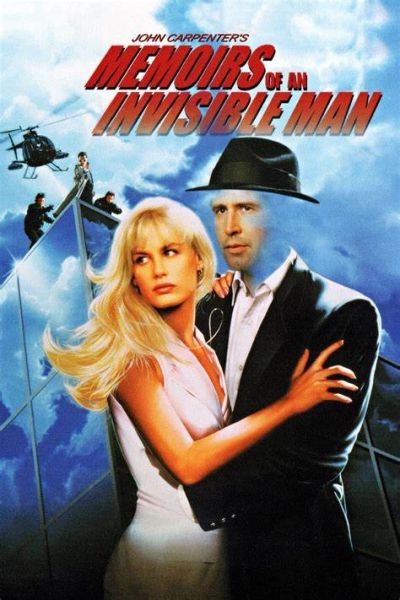
Featuring: Chevy Chase Daryl Hannah Sam Neill Michael McKean Stephen Tobolowsky
Directed by John Carpenter
Distributor: Fabulous Films Ltd / Fremantle Media Enterprises
October 2018
Nick Halloway (Chevy Chase) is a lazy business executive who burns the candle at both ends. Knowing he has an important presentation to attend at a nuclear research facility in the morning, Nick parties with friends, where he meets a beautiful blonde documentary producer (Daryl Hannah). During the presentation he sneaks off for some much-needed rest, wandering around a top secret area (like you do) and finding a quiet place. But there has been a curious nuclear accident and the building is evacuated. All but Nick. As others stare up at a building which has large chunks missing – or at least somehow invisible – they spot a hat moving around. Nick is invisible and suddenly of great military value. He is obliged to go on the run, pursued by the chief of security (Sam Neill). How can he approach his new love without freaking her out and alerting the attention of the man who wants to control him...?
This is a 1992 film based on a book by H. F. Saint. The man did a Norman Greenbaum disappearing act in real life. When he sold his one and only book, his agent secured him $2.5 million in film and book club rights. It’s thought that he moved his family to somewhere in Europe. The film is a showcase for the then revolutionary new special effects revealed by Industrial Light & Magic. Chevy Chase was obliged to wear a skin-tight blue bodysuit, and more time was spent digitally removing images than actually producing them. A sterling job was done – even to the point of removing Chase’s shadow in each scene. But a film is seldom just about the effects.
As a long-time fan, I couldn’t complete this review without mentioning that this is a John Carpenter film. It’s an often overlooked one, mainly because – unlike his brilliant low budget movies from the first half of his directing career – it is a mainstream, big budget affair, with well-known box office-attracting stars, which Carpenter only directed. As opposed to those that he wrote, directed and produced the soundtrack for. His more well known offerings like Halloween, The Fog, They Live, The Thing, Prince of Darkness, and Escape From New York made a statement, and are Carpenter through and through. This was more of a money-making enterprise. Look out for a short piece with Carpenter himself playing a helicopter pilot and speaking into the radio. The sequence is accredited at the end of the film to the pseudonym Rip Haight.
As for the film itself, the special effects seem quaint now but are still impressive. It’s an enjoyable light-hearted action romp, but not the kind of feature you would necessarily wish to watch repeatedly. The aforementioned films I’ve watched so many times I’ve lost count. This one hasn’t really been cleaned-up either, whereas the new prints on the others are quite stunning. That just leads me to believe Memoirs of an Invisible Man has simply been re-released to coincide with the other better releases in order to cash in on them. One thing I can say though, is this is a family film that all ages can watch and enjoy together. Watch Sam Neill in the much better Carpenter film In the Mouth of Madness.
Extras include: How to Become Invisible – The Dawn of Digital Effects; Outtakes; Trailer & Gallery.
John Carpenter's The Thing (1982)
Starring: Kurt Russell, Wilford Brimley, Keith David, Richard Masur, Donald Moffat
Directed by John Carpenter
Arrow Video
October 2008
JR MacReady is a helicopter pilot and part of the crew of a US Antarctic research station. When a Norwegian helicopter mysteriously crashes whilst chasing and trying to kill a dog, the station takes the animal in and allows it to wander. MacReady and others fly to the Norwegian base to find out what took place. They discover it uninhabited, bleak and cold. A huge area in the ice has been cut away to reveal part of what appears to be a spacecraft. A man-sized block of ice is taken back to the US base where it accidentally thaws out. When the dog is placed with the sled dogs they cower in fear as it erupts into a hideous creature. A flame thrower destroys it, but this is in fact a shape-shifting extraterrestrial which can take the form of any living thing. When attacked it reveals its previous forms in a sickening amalgamation of twisted body parts. From that moment on, the station becomes a hotbed of fear, panic and ultra-paranoia, as nobody knows who to trust. MacReady thinks he has the solution, but is he too late...?
This was at face value a remake of the 1951 SF-horror film, The Thing From Another World - directed by Carpenter's hero Howard Hawks. However, Carpenter returned to the original short story, Who Goes There, by John W. Campbell, rather than copy Hawks' version which was radically different.
A young and talented effects man called Rob Bottin convinced him that the multiple shape-shifting of the creature could be realised by hand. He was right; although no video or CGI effects were used, it all holds-up very well even today, aided once again by the excellent lighting.
There is a very claustrophobic feel to The Thing; no doubt coming across from the film crew itself which was snowed-in at a small mining town in British Columbia accessible only by a 27 mile dirt road. The set was built and left for them to return to in the snow covered bitter winter.
This is a film about professional relationships, mistrust and paranoia as much as it is about a monster. The plot and pacing is very finely balanced, and works beyond all expectations. The blood-testing scene is inspired, being edgy, scary and funny. As in Escape From New York, Kurt Russell slips easily into the role, whilst ensuring the characterisation is completely different.
Upon its general release, The Thing bombed. Cinema-goers were apparently appalled and disgusted by the hideous shape-changing scenes - missing the point entirely. E.T. had just been released and the public was not ready for Carpenter's intelligent and well-crafted monster flick after such a popular and benign alien from Spielberg. However, a few years later critics began to reassess the film, and it picked up a huge following retrospectively.
The premise of a shape-shifting creature is said to have inspired the T-100 from Cameron's Terminator 2, particularly the scene when it loses substance and goes through one shape after another. There was also an episode of The X-Files which was heavily influenced by The Thing. Dark Horse comics published a continuation of the story, which also brought a new audience to the film. Carpenter has toyed with the idea of a sequel ever since, but in semi retirement he's unlikely to get around to it.
The fantastic array of extras on the the original DVD releaase disc include the 80 minute Terror Takes Shape documentary, the thoroughly entertaining (again) commentary with John Carpenter and Kurt Russell, Production Background Archive, Production Art and Storyboards, Location Design, Outtakes, Production and Post Production Notes, Cast and Filmmakers' Notes, and Cast Production Photos. Phew! This subsequent Blu-ray release has additional new extras, whilst keeping the originals.
Note: There is now a sought after 4K edition. If you have a 4K TV and player you need to purchase this. It's absolutely stunning.
The Incredible Hulk: The Complete Collection (1977 - 1990)

Featuring: Bill Bixby, Lou Ferrigno and Jack Colvin
Directed by Various
Fabulous Films Ltd / Fremantle Media Enterprises
June 2021
Fabulous Films releases The Incredible Hulk: The Complete Collection – a 26 DVD boxset incorporating all 80 episodes from the five TV seasons which ran between 1977 and 1982, the two original feature-length TV films, and for the first time together with the episodes we get the three later TV Movies: The Incredible Hulk Returns (1988), The Trial of the Incredible Hulk (1989), and The Death of the Incredible Hulk (1990) – which were originally packaged in a separate boxset. This much-loved and fondly remembered series starred Bill Bixby as David ‘Bruce’ Banner and Mr Universe body builder Lou Ferrigno as the Hulk...
I reviewed the Blu-ray release of the series back in 2016, and the TV Movie DVD Trilogy boxset in 2018. For much more detailed reviews please read those. All the extras appear to be the same; the only difference is this set contains all DVDs, whereas my review for the series was Blu-rays. This brings me on to the quality which some people have reported as poor. Certainly, I remember the Blu-rays as being slightly higher quality, but the restored DVDs are fine. They bear close scrutiny and, ironically, it is the distance shots which are occasionally grainy. Nevertheless, this was a great series, and I challenge anyone not to be drawn into this at times tense and emotional world which is not out of place in a comic book setting.
Pan's Labyrinth (2006)

Starring: Ivana Baquero, Sergi Lopez, Mirabel Verd·, Doug Jones and Ariadna Gil
Directed by Guillermo del Toro
Optimum Home Entertainment/Studio Canal
March 2007
It's Spain 1944. Young Ofelia is being brought by her pregnant mother to where her new 'father' is stationed. The captain turns out to be a cruel and sadistic man. The civil war is over, and elsewhere in the world the Normandy landings are taking place, but bands of rebels to Franco's dictatorship are loose in the hills. Close to the camp Ofelia is visited by a fairy who leads her to an ancient labyrinth. A faun tells her she is the lost daughter of the king of the Underworld, and that she must complete three tasks to prove she has not become too mortal. But the only ally she has is suffering dangerous problems of her own...
I've seen some surreal films in my time, but this pretty much beats them all. Director Guillermo Del Toro has an impressive track record already, with Cronos, The Devil's Backbone, Hellboy, Crimson Peak, and The Shape of Water to his name. This time he's excelled himself big-time. In fact, I am a big fan of most of del Toro's work and think of him as a successor to the great John Carpenter's crown.
Pan's Labyrinth is plainly a parable for many things, but mainly the coming of age. There are loose connections to Little Red Riding Hood, The Wizard of Oz, any number of Grimm's Tales, and even his own The Devil's Backbone. But this is not one for the little kiddy-winks. It's brutally and graphically violent, and eerie, as well as emotional and fantastical.
You realise after viewing it in its entirety that the entire movie is an allegory for life. The brutality of adulthood versus the innocence of youth. As one of her three trials, Ofelia enters the tree of womanhood (the entrance resembles a vagina opening, and the branches above are curled round like fallopian tubes) whilst being reluctant to put away childish thoughts. The Giant Toad is a metaphor for greed and the wealth of the world, the Pale Man represents the evil of the world feeding on the helpless. Pan, the faun is neither good nor evil, but it has its own motives.
It is ambiguous as to whether these fantasies are real or simply the girl's way of dealing with the harsh realities of life - specifically, the evil vindictiveness of her despised new stepfather, Captain Vidal, the ruthless dictator. As adults, we can only assume the latter. The film also explores selfishness against sacrifice. There's the irony of performing an adult selfless act when Ofelia still inhabits a fantasy world - presumably of her own making.
This is the most weird clash of genres I've ever come across, but the fact that they don't really fit together makes the concept all the more significant. This film spans the gamut of emotions, and is fantasy based in a harsh reality. Only when you reach the end do you begin to change your view of what has just taken place. Ambiguity in an ending is nearly always a good thing. It leaves you thinking. It leaves you thinking you have witnessed something rather special.
Extras on this excellent 2-disc set include a commentary by Director Guillermo Del Toro; a National Film Theatre Interview with Del Toro (hosted by Mark Kermode, in my opinion the best film critic around - apart from me, that is!); a prologue by the director; The Power of Myth short, DVD Comic Sketches: The Pale, The Fairies, The Giant Toad and Pan; El Fauno Y Las Hadas; The Colour and the Shape; Storyboard/Thumbnail Comparisons; VFX Plate Compare: Guillermo Del Toro and the Green Fairy; Director's Notebook; The Melody Echoes the Fairy Tale; Mercedes' Lullaby; Poster Gallery & Trailer, and much more.
Phew! If you've always shied away from subtitled films before, remove those blinkers open those eyes, and use this as your starting point. You won't be sorry. I've just discovered that there is now a Ultra HD 4K version of this masterpiece. I'll be picking that one up.
(Review originally written by Ty Power for reviewgraveyard 2007 - updated 2021)
Duel (1971) - 50th Anniversary Edition

Starring: Dennis Weaver
Directed by Steven Spielberg (based on the novelette by Richard Matheson)
Fabulous Films Ltd / Fremantle Media Enterprises
May 2021
This 50th Anniversary Edition Blu-Ray release from Fabulous Films Ltd/Fremantle Media Enterprises couldn’t be more timely, as far as I’m concerned. Duel is one of my favourite movies of all time – certainly registering high in my top dozen – and I’ve only recently been searching for a Blu-ray or 4K version to replace my old and well-worn DVD. I couldn’t be happier to finally view this amazing film from 1971 in HD.
Dennis Weaver – best known for the 1970s police series McCloud, which first aired from 1970 until 1977 – plays David Mann, a travelling salesman on his way to California to meet a client for a lucrative deal. At one point he overtakes a slow-moving 40 ton truck, which shortly afterwards overtakes him and slows right down again. Concerned that he might be late for his appointment, Mann makes a risky movement to get past the truck. Thereafter, he is singled-out as prey for the super-charged huge truck, and Mann is caught in a desperate down-spiralling game of cat and mouse for survival.
It doesn’t sound like much, does it? But believe me, this movie is packed full of nail-biting, edge-of-the-seat suspense. It’s as though a proverbial ratchet is steadily clicking up the tension. Several factors come together to make this work in synergy. The first is the choice of actor. Dennis Weaver was chosen based on his impressive performance in Touch of Evil (1958), and achieves the impossible by carrying this portrayal alone. There are around fifteen or so peripheral characters whose cameos Mann has only the briefest interaction with (his wife on the phone, a roadside café’s handful of patrons, a petrol pump attendant and a school bus driver and some kids. For ninety percent of the running time it’s simply the man, his car and the terrifying truck. This works really well, as the viewer sub-consciously bonds and sympathises with Mann to the point that they replace him in the car and experience many of the emotions he very clearly feels: humour, impatience, annoyance, fear, terror, the edge of madness, and an underlying survival instinct. Weaver also performed many of his own stunts.
The second factor is the source material. Duel originated as a novelette tale by master storyteller Richard Matheson, which was printed in Playboy magazine only a short time before it was optioned for the screen. Legendary filmmaker Stephen Spielberg was to be the director. Yes, him. But I’ll come to that. Matheson was a master of his art and had countless novels and shorts adapted for TV or the big screen – many of which he also wrote the script/screenplay for. Among his many successes you might recognise are The Shrinking Man (it had the word ‘Incredible’ added for the film), I Am Legend (adapted into at least three different film versions), Hell House (The Legend of…) , A Stir of Echoes, The Button, What Dreams May Come, Somewhere in Time, and of course Nightmare at 20,000 Feet (the classic Twilight Zone episode, starring William Shatner).
A young Stephen Spielberg was shown the Playboy story of Duel by his assistant, as she felt it would be of interest. Spielberg had worked in television, so the original idea was to film it as a TV movie, but ultimately after editing it the rare decision was made to film additional scenes for a theatrical release. As a fan of silent movies he wanted to make the truck a sinister character rather than simply an object. Spielberg auditioned seven different trucks as if they were actors, deciding on a 1955 Peterbilt 281 because the front resembled a face. In doing so, he created one of the most unusual and menacing characters in a movie. The filming is very low and contact-based, giving the feeling you are not just witnessing events but are actually a part of them. He also achieved a number of ‘firsts’ with the professional aid of Stunt Co-ordinator Carey Loftin, who arranged the timeless car chases in Vanishing Point (another favourite of mine), Bullitt, and The French Connection. Loftin drove the truck. First person-effective low shots of the road create a sense of speed and panic, which has subsequently been copied in multiple films. Also, rogue trucks and cars with faceless unseen drivers have been used many a time but to much lesser effect. Spielberg proved to the producer that he could film the entire script on location (the director fought against using soundstage sequences) in little over ten days. It was well worth the fact he went two or three days over on the shoot, otherwise we might have ended-up with back projection and Steven Spielberg might not have been given the leeway to achieve the impressive career he has.
You would think that the roadside café scene would be utilised as a breather – a break in the pace – but there is no downtime here, as Weaver's character silently scrutinises the patrons and their boots, attempting to discover which, if any, is the driver of the truck. We hear his thoughts, and frantic reasoning. There are some amazing set-pieces, and also some red herrings in that certain other things are made to sound like the truck as we experience Mann’s shaken psyche. Spielberg even incorporated a primeval monster roar at the conclusion. The camerawork is amazing, with unusual shots and angles which enhance the off-kilter reality of events. The striking sound score (not really music) accompanies the picture well, making the truck even more menacing. I played the film through my new home cinema system and the loud rumble each time the truck approaches is both exhilarating and unnerving.
The entertaining extras include A Conversation with Director Steven Spielberg; Steven Spielberg and the small screen; Richard Matheson: Writing of Duel; Trailer; Photograph and Poster Gallery; and an all new (and quite excellent) Graham Humphrey artwork sleeve. If you like road movies and buckets of suspense, I can’t urge you enough to add this to your collection.
(Review originally written by Ty Power for reviewgraveyard 2021)
V For Vendetta (2006)
Featuring: Natalie Portman, Hugo Weaving, Stephen Rea, Stephen Fry and John Hurt
Directed by James McTeigue
Warner Bros. Home Entertainment
November 2020
Against a backdrop of a future totalitarian Britain, a young woman called Evey has her whole interpretation of society changed when she is rescued from thugs by a charismatic vigilante wearing a stylish Guy Fawkes mask. Known only as “V” the figure is viewed by the establishment as a terrorist, but V is a freedom fighter skilled in the art of combat and deception, who detonates London landmarks and takes over the government-controlled airwaves. As Evey learns more about herself she also discovers there are multi-facets to her new companion...
Let me say from the outset that V For Vendetta is a genuine classic. Like synergy, all the planets are in alignment for this one. This is a movie that can never be experienced again for the first time. As obvious as this sounds, I mean it can never have as profound an effect on the viewer on subsequent revisits. That doesn’t mean you won’t want to re-run the movie. Believe me, you will! This is a film which has everything. There is mystery, action, intrigue, love, politics, deception and truth. This is essentially about people, belief and being true to ourselves. It teaches us that we are the future – not governments, societies, establishments and symbols of power. More definitively, the film has ‘heart’. It’s ultimately a feelgood concept, too; the age-old fight against oppression, but told in an exciting and refreshing way.
There hasn’t been too many stories – either documentary or dramatic in content – depicting Guy Fawkes. The film opens with a scene depicting his capture and public hanging at the time of the infamous Gunpowder Plot to blow-up the Houses of Parliament. Although the film proper is set in a fictitious future Britain, our anti-hero utilises a costume and very striking mask to portray the essence of Fawkes, representing a fight against corruption. It is not giving too much away to reveal that the face behind the mask is never unveiled, though there are clues as to what he may have looked like many years before. This is very clever, as we all accept that the unknown is far more frightening or intriguing. Once something or somebody is seen and understood, it loses much of its power. V himself is articulate and literate, quoting not only the ‘Remember, Remember the 5th of November’ rhyme, but relevant Shakespeare and the odd bit of French (for some reason).
There is a veritable plethora of notable British actors on show here. Aside from the peerless John Hurt, there is Natalie Portman, Tim Pigott-Smith, Stephen Fry, Hugo Weaving, Stephen Rea, and many others spotted in cameo roles. It is good to see Roger Allam (Endeavour’s Inspector Thursday) and Ben Miles from the excellent sitcom Coupling, too. V For Vendetta is based on the outstanding graphic novel written by Alan Moore, illustrated by David Lloyd and published by Vertigo/DC Comics. The film was written and produced by the Wachowskis, who made The Matrix trilogy, and directed by James McTeigue.
This set contains a 4K Ultra HD and High Dynamic Range version of the film for the first time. Being that a new scan has been produced using the original film negatives, the picture looks fantastic – crystal clear and sharp, with a wider colour spectrum allowing deeper shades to be clearer. For those who have the appropriate speaker systems, the disc features a Dolby Atmos soundtrack. This doesn’t mean you can’t enjoy the soundtrack without that equipment, but you will need a 4K TV and a 4K player – essential, I think, for the seasoned film buff. New special features on this disc include V For Vendetta Unmasked (a Behind-the-Scenes making-of featurette), James McTeigue & Lana Wachowski in Conversation, and Natalie Portman’s Audition.
There is also an HD Blu-ray included in this set, the previously released extras of which are made available again here. They include: Freedom! Forever! – Making V For Vendetta featurette; Designing the Near Future featurette; Remember, Remember – Guy Fawkes and the Gunpowder Plot; England Prevails – V For Vendetta and the New Wave in Comics; Cat Power (good surname!) Montage – the song played against images from the film; and an Easter Egg Hidden Bonus of a Saturday Night Live Short. Additionally, there is a Digital Download copy of the movie.
An excellent film, brilliantly presented, and in three formats… How could you go wrong? Take my word for it: Add this to your collection. You won’t be sorry.
Westworld (1973 - 2013 Re-issue)

Starring: Yul Brynner, Richard Benjamin and James Brolin
Written & Directed by Michael Crichton
Delos is the ultimate theme park holiday resort. For $1000 a day customers can live out their fantasies in one of three controlled zones: Romanworld, Medieval World or Westworld - interacting with other holidaymaker role-players and state-of-the-art robots. Friends John and Peter live out the dream in Westworld... until things begin to go seriously wrong. When minor technical faults escalate, the resort robots carry out their programming with no thought or consideration to the safety of the guests. For John and Peter that means fleeing for their lives from a relentless killer gunslinger...
Here we have a movie which sets the benchmark, showing every aspiring filmmaker how it should be done. Westworld is in my top dozen films of all time, and it's easy to see why when you examine the inherent structure. It's based on a book by Michael Crichton, bestselling author of The Andromeda Strain, Jurassic Park, The Terminal Man and many others. However, a good book does not necessarily transfer smoothly to the big screen. One of the strongest attributes Westworld possesses is the fact that it works equally successfully as a western, science fiction, technological thriller, disaster movie, action adventure and, in places, feel good light comedy - whilst maintaining an essentially genreless mainstream stance.
If I only had one word to sum-up Westworld it would be Fun. Right from the off, we're caught up in the enthusiasm of first-timer Peter Martin, reflected in the knowing smile of his experienced friend John Blane. We soak-up the ambience of the old west in the form of course whisky in the saloon, horse riding, a shoot-out with a gunfighter, the pleasures of the cathouse, a jailbreak and a bar room brawl. The scientists running operations behind the scenes are shown in brief snippets with no wasted dialogue, so as to not detract from the main events hotting up for our protagonists.
Similarly, we're kept up to speed with some events in Medieval World, and in particular a guest's fatal confrontation with the Black Knight. The escalating tension as we approach the conclusion has the same feel as the film Duel – also from the early seventies. This is not only due to the tight script but exemplary acting. There's not a single bad word to be said about Yul Brynner's portrayal of the black-garbed robot gunslinger. It's just so powerful, and it's this performance alone which turns a good film into an excellent one. I simply cannot sing his praises enough.
As you would expect, the 2013 Blu-ray release of this film supersedes the DVD version in terms of quality of sound and picture. Special Features include a featurette, the 1980 TV pilot Beyond Westword, and a Trailer. Of coarse, there was an original sequel to Westworld, called Futureworld. However, despite having Peter Fonda in the line-up, it possessed none of the humour, thrills, acting prowess, style or presence of its predecessor. Yul Brynner appears, but is woefully underutilised in a brief dream sequence. So, where is the much-anticipated 4K version of Westworld? I guess we'll just have to wait. In the meantime, pick yourself up a copy of the Blu-ray. You won't be disappointed.
To paraphrase the movie tagline: Boy, have we got a movie for you.
(Review originally written by Ty Power for sci-fi-online 2002 - Updated 2021)