The Day the Earth Stood Still (1951)
The Day the Earth Stood Still (1951)
The Day the Earth Stood Still (1951)
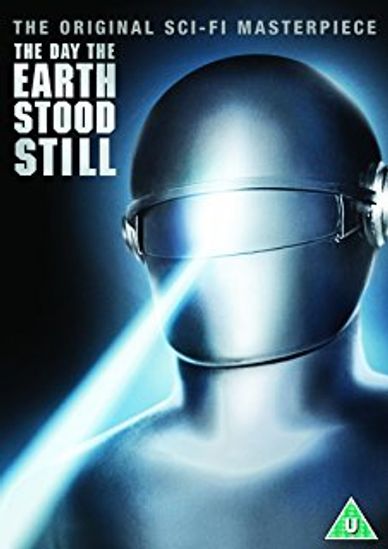
Starring: Michael Rennie, Patricia Neal, Hugh Marlowe.
Directed by Robert Wise
In Black & White
An unidentified object is detected over the Earth. It’s path is monitored across America and it lands in a public area. The police and military surround the craft with heavy artillery, and the public crowd around a cordon eager for a glimpse of the occupants. Eventually, a ramp appears and a helmeted humanoid approaches the on-lookers with a gift. An itchy-fingered soldier mistakes it for a weapon and shoots the newcomer. Before things get out of hand a large robot emerges from the craft. A visor opens and a beam vaporises the military’s guns and tanks.
The injured humanoid, who is called Klaatu, is treated privately and his wounds heal quickly. He needs to gather all of the world’s nations together to impart to them knowledge of the utmost importance to the future of the human race. A government representative explains that there is a huge amount of distrust. The Russians won’t attend unless it takes place in Moscow; the Americans insist it’s in the USA, etc. Although he is locked in his room, the alien Klaatu decides to vanish into normal society to discover what the average person is saying about the situation.
Using the name Mr Carpenter, Klaatu rents a room in a boarding house where he meets a friendly young woman and her son. The boy, Tommy, shows Carpenter around the town. This includes a military cemetery, a look at the spaceship and a visit to the foremost scientist in the country. It is arranged that scientists will be brought together to hear Klaatu’s message. The visitor arranges a show of power by making all the electricity die, causing a temporary worldwide blackout. Tommy becomes attached to Carpenter and follows him one night as he returns to his craft to give instructions to the nine foot robot, Gort, and set the demonstration in order.
Tommy tells his mother and boyfriend what he saw, and Klaatu comes clean to Tommy’s mother. The electricity is neutralised worldwide, except for hospitals and planes in flight – but only for thirty minutes. The jealous and selfish boyfriend contacts the military and the hunt is on for the spaceman. Tommy’s mother warns Klaatu and they escape in a taxi. Klaatu issues her instructions to go to Gort and say the words 'Klaatu barada nikto' if anything happens to him. Klaatu is shot in the street by the military and declared dead. Tommy’s mother rushes to the spacecraft where Gort has just become active and killed two guards with the beam from its visor. Gort has the power to destroy the world, but she recalls in her fear to relay the remembered phrase. Gort takes her inside the craft and then leaves to recover the body of Klaatu, which returns to life using a machine in the ship.
As the collected scientists are being asked to leave, Klaatu emerges from the craft to address the people. He explains that Earth’s experimentation with atomic power and weapons threatens the stability and peace of the other planets. They do not tolerate aggression and so have developed a race of robots like Gort to police the worlds, and given them complete power to wipe out any sign of outward aggression. The message is simple: choose to live in peace, or suffer the consequences. With a smile of appreciation to Tommy’s mother, who has returned to the crowd of stunned onlookers, Klaatu and Gort re-enter the spacecraft and it takes off.
This is the film which set the bar for science fiction movies in the 1950s. It was a bar that, as far as I’m concerned, was seldom if ever reached by other films (although a handful came close). This is not only an outstanding film for the period, but an all-time science fiction classic which fully deserves its cult classic status.
Director Robert Wise – who also directed many other movies, such as The Haunting, The Sound of Music, West Side Story, and many others – utilises nice use of light and shadow which other directors from this era should really have learnt from. There is also tight editing, a flowing pace and a progressive ratcheting-up of tension and atmosphere. Michael Rennie is the perfect choice for Klaatu. I don’t really see how this film could have been improved. Do yourself a favour; make a copy your own – and avoid at all costs the dire remake.
Verdict: 10 out of 10
(Original Review Ty Power 2018)
Night of the Demon (1957)
The Day the Earth Stood Still (1951)
The Day the Earth Stood Still (1951)

Starring: Dana Andrews, Peggy Cummins, Niall MacGinnis and Athene Seyler.
Directed by Jacques Tourneur
In Black & White
Screenplay by Charles Bennett & Hal E. Chester (from Casting the Runes, by M.R. James)
Produced by Frank Bevis & Hal E. Chester
Psychologist John Holden arrives in England from America, only to be informed that his contact, Professor Harrington has been killed in an accident. As part of his investigation into the occult, Harrington had been about to expose the eminent Doctor Karswell as a Devil-worshipping black magic cultist. Harrington’s daughter, Joanna, is convinced that Karswell had her father killed by summoning a demon. A practical man, Holden is wholly unconvinced. However, he does intend to continue Harrington’s work, and that includes looking into the affairs of Doctor Karswell. Unsurprisingly, he is warned off, but Holden is not easily scared. That is until he is passed a paper depicting runic symbols and told he only has three days to live. As the deadline fast approaches, he is finally forced to concede there are more things in hell and earth... But is there a way out...?
Fully restored, and for the first time on DVD, comes this black and white classic from the 1950’s. Jacques Tourneur’s film must have made quite an impression upon its first release, because it still resonates with intensity today.
The appearance of the demon is almost secondary to everything that comes before and after. Not many movies around this time played the supernatural story for real, with scientists, psychologists, hypnotism, and a strict, learned approach. Consequentially, it works very well as a psychological thriller, throwing ambiguity into the mix, and a sense of impending doom - of time running out.
The villain of the piece, Karswell, is gentlemanly, as most great perpetrators are; he is even seen entertaining local children as a clown of sorts on the grounds of his large estate. The plot motors along, using audience-shocking sound and vision tricks of the trade that have become almost commonplace now.
The DVD disc from 2006 carries the original uncut UK film (95 minutes), and also the cut US version (82 minutes) which debuted under the title Curse of the Demon in 1958 as a double-bill alongside Revenge of Frankenstein. There is also a stills gallery. Only a small percentage of the horror and science fiction output of the 1950s worked; those that did became film classics, and Night of the Demon is most assuredly one of them.
The Indicator 2-Disc Blu-ray Edition (released in 2018) has a phenomenal amount of special features: Night of the Demon – the original full-length pre-release version (96 mins); Curse of the Demon – the US reissue version (96 mins); 2K BFI restoration presentations at 1.75:1; High Definition remaster presentations at 1.66:1; Original mono audio; Audio commentary with film historian Tony Earnshaw, author of Beating the Devil: The Making of ‘Night of the Demon’; Night of the Demon – the original UK theatrical cut (82 mins); Curse of the Demon – the original US theatrical cut (82 mins); High Definition remasters at 1.66:1; Original mono audio; Speak of the Devil: The Making of ‘Night of the Demon’ (2007, 20 mins): a documentary featuring actor Peggy Cummins and production designer Ken Adam; Cloven in Two (2018, 23 mins): a video essay exploring the different versions; Hal E Chester at the Manchester Festival of Fantastic Films (1996, 51 mins): a rare archival video interview with the producer; Dana Andrews on ‘Night of the Demon’ (1972, 10 mins): a rare audio interview with the actor conducted by film historian and preservationist Scott MacQueen; The Devil’s in the Detail (2018, 36 mins): Christopher Frayling discusses the film and Ken Adam; Horrors Unseen (2018, 27 mins): an interview with Chris Fujiwara, author of Jacques Tourneur: The Cinema of Nightfall; Sinister Signs (2018, 21 mins): an analysis by Kim Newman, author of Nightmare Movies; Under the Spell (2018, 19 mins): a personal appreciation by horror writer Ramsey Campbell; The Devil Gets His Due (2018, 23 mins): Scott MacQueen details the film’s release history; The Truth of Alchemy (2018, 22 mins): a discussion of M R James by author Roger Clarke; The Devil in Music (2018, 11 mins): David Huckvale on composer Clifton Parker; A Note of Fear (2018, 10 mins): Scott MacQueen discusses aspects of the film’s score; Casting the Runes (1984, 53 mins): an audio recording of Michael Hordern reading M R James’ original story; Escape: ‘Casting the Runes’ (1947, 30 mins): a radio adaptation of the story; Super 8 version (7 mins): original cut-down home cinema presentation; Isolated music & effects track; Original theatrical trailer; Image gallery: promotional and production material; New and improved English subtitles for the deaf and hard-of-hearing.
... and breathe!
Verdict: 9 out of 10
(Review originally written by Ty Power for sci-fi-online 2006 - Updated 2026)
Devil Girl From Mars (1954)
The Day the Earth Stood Still (1951)
Devil Girl From Mars (1954)

Starring: Patricia Laffan, Hazel Court, Adrienne Corri, Hugh McDermott, Joseph Tomelty.
Directed by David MacDonald
In Black & White
Screenplay by James Eastwood (From the Play by John C. Mather & James Eastwood
Produced by Edward J. Danziger & Harry Lee Danziger
A remote Scottish inn is rudely awakened by the arrival of an escaped prisoner, who killed his wife. Doris at the inn is his ex-lover and protects him by announcing the man as a stranger. Other guests include Miss Preswick, a model hiding from a stalking ex-partner, and a journalist who, with a professor, is on the trail of a meteor which is supposed to have landed nearby. The latter two attempt to leave for a telephone in the next village (the inn's one is currently out of order), but the car refuses to start.
There is a strange loud noise and they all go outside to see what appears to be a flying saucer land (the simple model looks smooth in the first shot and positively shaky in the next; a little bit of editing wouldn't have gone amiss here). The flying saucer is red hot and no one can approach it. Bizarrely, they all go back inside, as if the excitement is over. The on-the-run villain, is recognised by the reporter. He runs away, but Doris hides the man in a storeroom.
A woman dressed in black PVC emerges from the spaceship and kills the inn's handyman with a ray gun. Doris appears to be in a catatonic state of shock. The woman from the craft appears in the doorway of the inn and announces herself as Nyah, from Mars. She removes Doris from her hypnotism, and explains all too freely that this is her first visit to Earth. She was on a course for London, but a collision with a meteorite sent her off-course and to an unscheduled landing in the Highlands of Scotland.
There was a devastating war on Mars between the sexes, culminating in the development of the Perpetual Motion Chain Reaction Beam (eh?). Women became the rulers of Mars, but the men fell into decline - and now Nyah has come to take back some strong men to perpetuate the species. She threatens to prevent objection by freezing movement over a large area, in the same way she had frozen Doris.
Nyah returns to her ship, raising an invisible wall behind her. She then returns, taking the handful of people from the inn to just outside her spacecraft to perform a demonstration of power. It is a robot - and a pretty naff and clunky-looking one at that. It zaps a tree, making it disintegrate, and does the same with a truck. Our villain has climbed out of the storeroom window and is watching from the barn. He just manages to run before the robot disintegrates the barn, too.
Nyah hypnotises him, and uses the opportunity to kidnap a young boy from the inn. The professor is invited to the ship to see wonders and powers beyond the imagination. But all she does is explain how her spaceship works. "We've done enough talking," says the reporter at the inn. Never a truer word spoken! He offers to exchange himself for the little boy. Nyah returns to the ship with the journalist , but when he attempts to control the robot, she threatens to kill them all. She decides to take a guide who can help her when the ship has repaired itself and travels to London. They draw lots to decide who is going. It falls to the reporter, but the prisoner goes instead. The ship takes off but explodes at high altitude. The professor had described the power source and the prisoner had sacrificed his life to save everyone else's, by causing the propulsion system to explode.
This is the one with the dominatrix; it's not just the attire, it's the whole demeanor. Had she placed a foot on a male character's chest, it would have sealed the deal. She portrays a very domineering Martian with very little to back it up. Her ray gun essentially does away with the need for a robot that pretty much achieves the same effect. But who doesn't like a silly robot in these films?
Devil Girl From Mars is a London Films (International) release from British Lion Films. It's clear that there is very little budget at play, as the story is very talky, and everything takes place in the inn (mostly in one room), and a few steps outside - like an Agatha Christie novel wherein the killer is among the potential victims. Rather than creating atmosphere through claustrophobia, however, this simply dulls-down the proceedings to the point of repetition . Nyah arrives at the inn, goes back to her ship, returns to the inn, goes back to her ship, returns to the inn, and goes back to her ship. Did I mention that she returns to the inn? And she does this many more times than I can do it justice here. Presumably, it keeps her fit, though. Each time, she appears dramatically framed in the open French windows, with the weird logic that if it looks good the first time, it will look even better after a dozen times. All that the guests at the inn had to do was lock the French windows and Nyah would have been stymied!
However, you can't apply logic to most 1950s Monster B-Movies. If Nyah had remained in her spacecraft until it had repaired itself, she could have carried on to London and bored them all to death. Instead, rather than taking the two young men at the inn and returning home, she chooses to tell them everything - thereby giving them information enough to defeat her.
Although placed straight, there are a couple of genuinely funny lines: "Come on. While we're still alive we might as well have a cup of tea." And particularly, "Mrs Jamieson, may I introduce our latest guest, Miss Nyah. She comes from Mars." "Och! That'll mean another bed."
Verdict: 5 out of 10
(Original Review Ty Power 2020)
X The Unknown (1956)
Creature Triple Feature (2003/2004/2004) 2006 DVD Release
The Trollenberg Terror (1958)
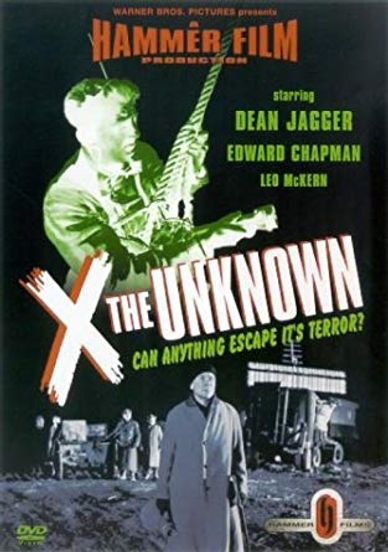
Starring: Dean Jagger, Edward Chapman, Leo McKern.
Directed by Leslie Norman
Story & Screenplay by Jimmy Sangster
In Black & White
An army platoon is carrying out radiation detection exercises when they encounter a powerful source. The ground opens up and something unseen escapes. A scientist from a nearby atomic research facility travels to the site to find that an extraordinarily deep fissure has opened in the ground. Two local boys creeping about in the woods at night encounter a frightening presence. One of them suffers first degree burns and ends up in hospital. The scientist goes to the area where the boys were. He finds a hidden dwelling and, inside, an empty radiation container stolen from his own laboratory. The unexplainable fact is there’s not a trace of radiation on or in the pot, and that’s impossible.
Something gets into the radiation lab of the hospital where the boy has just died. Again, uranium is taken, but a doctor sees something terrifying before all of the flesh melts from his face. From a protected room a nurse witnesses the event, but is so traumatised it is considered she will never talk or be the same again. At the site of the fissure two soldiers are killed by the menace. Two scientists and the Atomic Commission investigator consider what they are dealing with. The scientist theorises about an intelligence formed in the Earth’s crust when compressed gases helped form the world.
A volunteer is lowered by winch into the fissure, and sees not only the body of a burnt soldier but something from a nightmare. The volunteer is quickly brought back up and put into a car with the scientist. The military officer orders explosives detonated at the fissure, with instructions above to concrete it over (!). The menace breaks through easily, melting four people in a car nearby. The scientist maps its previous attacks and realises it is making for the Atomic Centre. They try to transport out the cobalt but their adversary is already there. The primal attacker is a huge mass of mud and slime moving quickly to the laboratories. The defenders know it will return to the fissure, so they arrange to quickly evacuate its path of people – who are shepherded to the church in true horror fashion.
There’s no help from the outside, as the radiation of the primordial ooze turns all communication to static. They come to realise if they don’t stop the thing at the fissure it will make for the experimental nuclear station (why didn’t it go there first?). The scientist tests a new process of passing irradiated material through a field which neutralises it. It’s successful but causes an explosion. They have no choice but to try it on the fast-moving mud. A full-scale version of the trial is set-up at the fissure, with the cobalt as the lure. The fissure begins to glow as the mud emerges. The neutralising fields are turned on, producing a high-pitch noise and an explosion. It worked. The sentient energy mud creature is no more.
On screen thanks are given to the War Office in the production of the film. It’s a British venture set in Scotland, wherein most of the characters speak with educated middle class accents. This is to all intents and purposes a Quatermass-like story. The science is solid but exaggerated, aside from the science fiction element of the sentient mud (you’ve got to have a monster, after all).
This is a Hammer Films production; subsequently, Hammer would almost exclusively stick to horror once they had huge commercial and critical success with The Curse of Frankenstein, The Horror of Dracula and The Mummy. It’s nice to see Michael Ripper, who was in more Hammer films than any other actor – including Peter Cushing and Christopher Lee. Of course, many of them were small roles: policeman, innkeeper, villager, etc. Here he plays the army sergeant. While we’re playing ‘Spot the Actor’ the surviving boy is played by Fraser Hines, who would pop up ten years later as Jamie McCrimmon alongside Patrick Troughton in Doctor Who.
The latter part of the film has a similar structure to The Monolith Monsters; essentially, a town standing in the way of a seemingly unstoppable horror. In a way, what has been done here is what was more recently achieved in the aforementioned Doctor Who. Robert Holmes’ shop window dummies coming to life, and Stephen Moffat’s Weeping Angels – statues which move when you are not looking at them – are both examples of making the mundane frightening. This is no different, with a primordial ooze (mud) moving with a purpose, pretty much filling the same role. A very solid if not outstanding piece.
Verdict: 7 out of 10
(Original Review Ty Power 2018)
The Trollenberg Terror (1958)
Creature Triple Feature (2003/2004/2004) 2006 DVD Release
The Trollenberg Terror (1958)
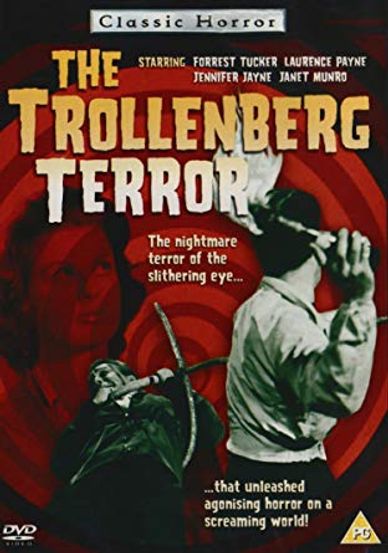
Starring: Forrest Tucker, Laurence Payne, Jennifer Jayne, Janet Munro, Warren Mitchell.
Directed by Quentin Lawrence
Screenplay by Jimmy Sangster, Story by Peter Key
In Black & White
Three men are mountain climbing in Trollenberg. One is higher than the other two and shouts down that there is a thick mist and he can’t see a thing. Then he suddenly calls down that someone or something is moving towards him. This is followed by a hideous scream. The body falls past them. The two men grab the rope and begin to haul the inert body back up. One of them sees the man’s face, causing him to let go of the rope in shock and terror. The rope rubs on the rock and frays to breaking point. The body is lost.
In a train carriage is a man travelling alone, and there are two women who are sisters. One seems excitable and at times a little frail. When the guard announces the next stop to be Trollenberg the man, Alan Brooks, says he is getting off. The excitable sister, Anne Pilgrim, claims they have to get off here, too. Even though they are supposed to be travelling straight through to Geneva. She tells her sister, Sarah, they can stay at the Europa Hotel, though she has never heard of or been to the place before. In the car from the station she suddenly asks the driver if there has been an accident with climbers on the mountain. Brooks looks at her strangely. She seems to instinctively know a lot about the place.
Brooks goes to meet his friend the professor at the Observatory, who is studying cosmic rays. The professor tells him there is a cloud over one region of the mountain, and that it never moves. What’s more, it’s radioactive. It turns out a similar phenomenon occurred at the Andes. As there was no evidence it was to blame for people going missing, Brooks was practically accused of making up the whole thing.
The two sisters perform a mind reading act for the entertainment of a handful of people at the hotel. When the object described is a snow globe with a mountain and a hut inside, Anne turns trance-like and describes two climbers in the hut. One of them is compelled to go outside, and when the other wakes there is no sign of him. Brooks telephones the cabin and tells the second man to stay inside. A report from the Observatory states that the radioactive cloud has moved down the mountain to the hut. Brooks phones again to warn the climber but hears the man scream in terror. The cloud moves back to where it had been.
Brooks and a rescue party of locals climb the mountain to the hut, which is locked from the inside. Forcing the door, they find the second climber’s body; the head has been torn off. The Professor tries to instruct the Pilgrim sisters to leave Trollenberg. He tells Sarah that Anne has a telepathy and can pick up other people’s thoughts, but that there is a more powerful and manipulative mind out there which could prove dangerous to Anne. But Anne sneaks away from the place she has been taken to for safety. The rescue party find the missing man’s rucksack. The first man to it finds a severed head inside. The head of the man in the hut. The missing man shows up and attacks him with an ice axe. Another man arriving on the scene also gets attacked.
The aggressor turns up at the hotel looking dazed and uncoordinated. As soon as he sees Anne – who has been brought back down from the Observatory – he tries to attack her with a knife. Brooks gives him a good old bunch of fives. When the man later tries for Anne again he is shot dead. It seems that whatever is on the Trollenberg is afraid of the mental abilities of Anne.
The cloud moves down towards the town. Everyone is evacuated to the Observatory, but they barely make it to the top after the cloud freezes the cable mechanism. Three other clouds converge with the first at the Observatory. Inside each cloud is a gigantic alien eye with far-reaching tentacles. Brooks and others use fire bombs in bottles to throw at the creatures. The weapon against them is heat. As a fire bombing raid is arranged with the air force, the creatures attack through the wall of the Observatory. However, the attack by the air force is successful and the creatures burn.
This is another solid home-grown science fiction horror from the 1950s, but with Forrest Tucker in the lead role. Ironically, he’s quite convincing even though Brooks seems to spend most of his time leaning and smoking. Laurence Payne plays Truscott, and there’s an early role for Warren Mitchell as Crevett. In America this film was released under the name The Crawling Eye, which rather gives the game away from the start. The screenplay is by Hammer Films stalwart Jimmy (‘Do you want it Tuesday, or do you want it good?’) Sangster.
The plot thread of Anne’s mental abilities isn’t really played through. I would have expected the character to be utilised in the last ditch battle with the creatures, but instead she is just used as an excuse for the creatures to attack and is otherwise forgotten. It doesn’t matter though. This is a very enjoyable film which deserves its cult status.
Verdict: 7 out of 10
(Original Review Ty Power 2018)
Creature Triple Feature (2003/2004/2004) 2006 DVD Release
Creature Triple Feature (2003/2004/2004) 2006 DVD Release
Creature Triple Feature (2003/2004/2004) 2006 DVD Release
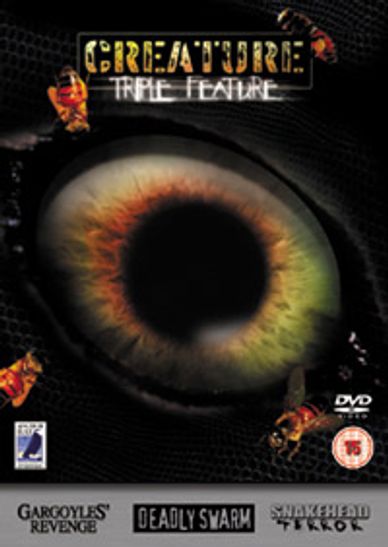
Starring: Michael Paré, Shane Brolly, Bruce Boxleitner, William B. Davis.
Directed by Paul Ziller, Jim Wynorski, Paul Andresen
In Colour
Distributed by Anchor Bay
In Gargoyles' Revenge, 16th century Romanian villagers go after the last gargoyle. A priest shoots it with a crossbow arrow anointed with the blood of Christ (from the priest), and it's sealed beneath the ground with a huge boulder and an incantation. We then jump forward to the present as two American FBI agents (Ty "Griff" Griffin and Christina Durant) are making a kidnap exchange. A gunman is chased to a rooftop where he simply disappears leaving only blood and money. Meanwhile a church is undergoing study and modernisation. An ancient painting depicting the gargoyle hunt is discovered hidden behind another. A recent earthquake has revealed a giant cavern beneath the graveyard. Inside are dozens of eggs waiting to hatch. The gargoyle is free and it wants the crossbow...
I must say, I expected the worst here... and didn't get it. It's not exactly Shakespeare, and it is leagues below the likes of The Exorcist and Halloween in terms of style and content, but it is a fun fantasy-horror (very much in the vein of Hammer) which rattles along at a fair pace. Just don't expect too much from it.
The cavern of eggs is straight out of Alien (even the same design), and the expression on the faces of those using machine guns against the newly hatched gargoyles is completely blank (no determination, no fear, nothing) making it all too plain to the viewer that the special effects were added later.
The male FBI agent is somewhat smarmy and self-assured (what do you mean, no wonder he's got my name!?), but maybe that's just how the character is written. One other point of interest: I wonder how many people have noticed that most of the character names are connected with horror or fantasy - Griffin, Soren, Durant, Lex, Aslan, Gogol, Gregor, Boris and Yuri.
In Deadly Swarm, Jacob Schroeder, a bio-prospector working for an American pharmaceutical company, tracks a medical breakthrough to a small Indian village deep in the Mexican jungle. Forcing the locals to reveal its location, he comes away with a huge nest of deadly wasps known as "black fire". He pays a truck driver to smuggle the cargo over the border, but when the vehicle turns over the massive cloud of killers is freed. In a nearby Mexican town entomologist Daniel Lang is working to reduce an outbreak of malaria. The mayor tells him his work is done, but he is recruited by the sheriff to examine the body of the truck driver. A series of deaths and the knowledge that human hosts can be used to lay eggs, means the race is on to track the swarm and kill the queen. But Lang and the sheriff haven't reckoned on the ruthless determination of Schroeder...
Before watching this film I was immediately reminded of my review of The Swarm (people still occasionally mention it to me now). So, I was expecting a lot of running around, screaming and windmilling of arms. Thankfully it didn't happen. Yes, it was mainly cheap effects-driven, with lots of black dots whizzing around in the air, but at least they tried to build a believable story around the b-movie scenario.
I would say that the character of the female reporter is completely superfluous to events, and seems to exist only to look good; and like many horror stories this one reduces its effectiveness by eluding to the past, in this case with the ancient journal kept by the priest which is a centuries old hand-written account of the swarm.
In Snakehead Terror, we are told over the opening credits about a new species of fish discovered called Snakehead. It is viscous and has no predator. Eventually the authorities were forced to poison Cultus Lake and kill them all to prevent the possibility of any spreading elsewhere. Now, when a few mutilated bodies turn up (including his daughter's boyfriend) the sheriff tries to get the lake closed to tourists. But local business is bad, culminating in human growth hormones being dumped in the lake to increase the size of the fish. The surviving Snakeheads are multiplying at a phenomenal rate and are mutating into monsters which leave the lake to look for prey...
Fans of Babylon 5 and The X-Files might recognise Bruce Boxleitner and William B. Davis, and there's no prizes for guessing who plays the hero and who the villain. Judging by the synopsis above (pretty much Piranha/Alligator/Lake Placid) this one has got to be cringeworthy, yes. You might think so but it's rather fun in its own way.
Unfortunately, these people will always step over the line. There's the Jaws-like music, and then one depiction of a Snakehead. I have to tell you first that the fish creatures are very well realised... all except one. A glove puppet fish has hold of the daughter's arm and instead of chewing it off like you might expect, simply hangs on long enough for the girl to dangle it in front of a boat's propeller. There are no ill after-affects, not even a bite mark.
Anchor Bay, who always seem to care about their releases, have made a shrewd move here. What do you do when you have three average creature flicks to put out? Why, you simply package them together as a box set to make it a more attractive purchase. None of these films will rock the genre, but together they're worth twenty quid of anyone's money.
Note: New copies of this set are now going for upwards of £40, but you'll be able to pick-up a good second-hand copy for around a tenner. Or, if you're lucky, for much less at a boot fair.
Verdict: 7 out of 10
(Review originally written by Ty Power for sci-fi-online 2006 - Updated 2026)
The Mysterians (1957)
The Beast with a Million Eyes (1955)
Creature Triple Feature (2003/2004/2004) 2006 DVD Release
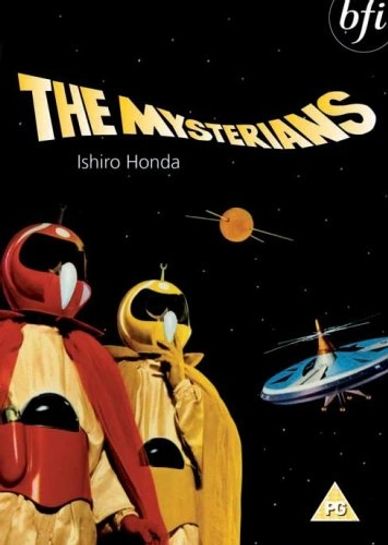
Starring: Kenji Sahara, Yumi Shirakawa & Momoko Kôchi.
Directed by Ishiro Honda
In Colour
Japanese with English Subtitles
After suffering raging fires, landslides and a heavy radioactive presence in the rivers, the villages of Mount Fuji are systematically destroyed by a giant robot. It is finally incapacitated when the army plants explosives on a bridge to bring it down. This, it turns out, is a show of strength by the Mysterians, an alien race whose planet has been ruined by a war of H-bombs. They tell five prominent Japanese officials they want two or three kilometres of land. But they also want Earth women, as their own are sterile as a result of war. The men refuse, but the aliens abduct them anyway. Now the battle is on. The army throws everything it has at the grounded enemy craft, but nothing appears to damage it and the ship emits its own deathly rays. It is now down to the scientists to try something new.
This is a Japanese film with English subtitles, directed by Ishiro Honda. The fact it was made by Toho International who made Godzilla, you kind of expect a reasonably high standard. Toho stated this film was far superior. Although I wouldn’t go that far (Godzilla was original and fun, and has spawned the largest amount of sequels of any franchise) I will admit they pulled out all the stops with this one. Subsequently described as a cautionary tale for the atomic age, there is mention of H-bombs in the script to the extent of not resorting to using them at any cost.
The Alien show of power involves an early stomp through some villages by a giant robot which appears to possess flippers rather than arms, and a head that resembles the outcome of an uneasy coupling between a Clanger and a Fingerbob. It’s great fun. I was very sorry to see it meet its end – although it does unsuccessfully attempt to revive itself and crawl out from below ground at the conclusion of the story. The fact it instantly falls back and disappears when the ground gives way makes for a fittingly humorous sayonara.
This was Toho’s first full colour widescreen offering, and makes full use of the medium. The Mysterians never remove their helmets, and stride around purposefully in rank-related primary colours and flowing capes. The sets and modelwork are practically beautiful to behold. There is great attention to detail. I would go as far as to say exemplary. Having said that the attack on the spacecraft does outstay its welcome a little.
Additionally, some events are less than logical, like the requirement of the Mysterians of only five women – all of which just so happen to be connected to the five men to which they make their demands. Three they already have hostage; so, knowing the other two are in danger what do the great Earth brains do? They leave them unprotected!
Admittedly, far from being a classic The Mysterians does remain as an example of one of the better serious attempts at science fiction from the golden 1950s period. Certainly, the British Film Institute believed it worthy of remastering and presenting with a fantastic booklet of informative text and excellent studio set photographs and design drawings.
Verdict: 7 out of 10
(Original Review Ty Power 2018)
The Beast with a Million Eyes (1955)
The Beast with a Million Eyes (1955)
The Beast with a Million Eyes (1955)
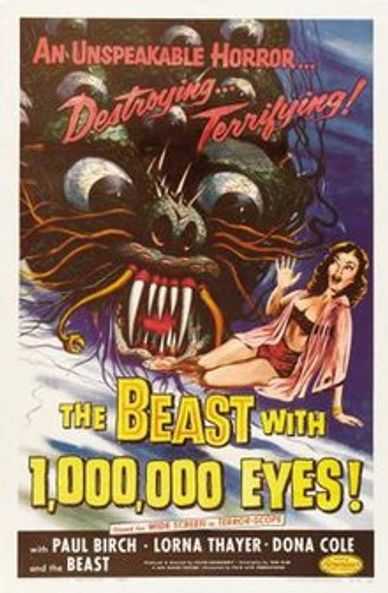
Starring: Paul Birch, Lorna Thayer, Dona Cole.
Directed by David Kramarsky (& Roger Corman)
In Black & White
Screenplay by Tom Filer
We are introduced to this film with a deep-voiced narration from an unseen alien (‘Probably the best alien invader in the world…’) which informs us that everything we do is watched with a million eyes. We then get another narrative from the main character, Allan Kelley, a rancher who lives with his wife Carol and daughter Sandy. The ranch has made a loss three years running, Carol is perpetually bad tempered, and Sandy is going to be sent away to school to ‘give her a chance’.
The movie begins properly when a loud droning noise passes over the area. Most of the glass in the house shatters, and Allan is inexplicably attacked by birds. A neighbouring farmer is assaulted whilst carrying out his morning milking duties, although attempting to milk a bull probably goes some way to explaining why it was so angry! Something in the desert is luring things closer. It starts when Sandy’s German Shepherd dog wanders too close and returns to attack Carol, who kills it off-screen with an axe (although in reality the dog looks as fierce as a Buddhist monk at prayer).
It seems that the minds of animals are easier for the device in the desert to control. However, Carl (or ‘Him’), the ranch hand who lives in the shed, is another matter. He is not only mentally challenged but is somewhat creepy, too. There are several lines of dialogue early in the film when Allan and Sandy call the man harmless. You just know then he won’t turn out to be so. It transpires the poor man is divided. He carries out the instructions of the device but ultimately doesn’t hurt anyone because his own mind periodically takes control.
The film loses its way in the final third of the running time. And that’s exactly what the cast do: run around a lot. With the car out of action and birds attacking them at home, they finally decide to do what they should have done in the first place: go into the desert and confront the device. It turns out to be a spacecraft with one occupant. The Beast was added to the movie as an afterthought, as it was suspected the cinema audience would feel short-changed with no monster.
It tries to take control of Sandy’s mind, but the family stands strong against it. It is suddenly introduced that the Beast can take over a lesser body; thus the Beast falls like a puppet with its strings cut and a desert rat runs from the crater. Allan is about to shoot it when a bird of prey swoops down and scoops it up for its dinner. For all the effect it has it’s tantamount to a child’s balloon trying to take over the world.
I always like to think about what might happen after the conclusion of these films. In this case, the family might have been brought closer together by events but the ranch is still losing money. Perhaps they should publish a book, sell the movie rights (hopefully, a bigger budget) and conduct tours for nosy rubberneckers.
This example of the period avoids the blame of atomic war on events. Not much happens over-all but it remains eminently watchable. Ideas and money seem to have evaporated by the final scenes which consist of characters wandering into the desert and back to the house. And into the desert and … well, you get the picture. There’s a deputy sheriff as a potential love interest for the daughter Sandy, but he doesn’t do anything significant.
Verdict: 4 out of 10
(Original Review Ty Power 2018)
The Leech Woman (1959)
The Beast with a Million Eyes (1955)
The Beast with a Million Eyes (1955)
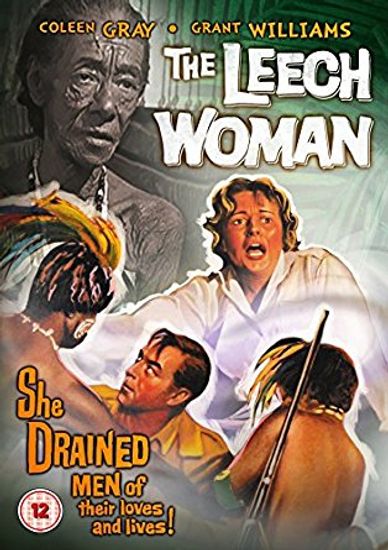
Starring: Coleen Gray, Grant Williams, Phillip Terry, Gloria Talbott.
Directed by Edward Dein
In Black & White
Written by Ben Pivar & Screenplay by David Duncan
Let me first say no leeches were harmed in the making of this film. In fact, there aren’t any! The first ten minutes are taken up with experimental chemist Dr Paul Talbot arguing with his wife June at his workplace. She is ten years his senior and doesn’t feel she has her looks anymore. He certainly feels the same way, as he treats her with contempt, driving her to drink. Ironically, his research involves finding a way to slow the ageing process.
When an ancient-looking woman enters his office and offers a powder to temporarily halt the natural ageing of the body in exchange for the money to return her to her homeland African tribe, he not only snatches the opportunity with both hands, but takes his estranged (and strange!) wife and a guide to Africa. So suddenly, with a montage of stock footage set pieces of lions, crocodiles, monkeys, hippos, elephants and hyenas, etc. (which made me think I had somehow switched channels to a National Geographic wildlife film), we are in Africa – or a set made to resemble it!
Dr Talbot allows them to be captured by the old woman’s tribe, as he is after stealing the secret ingredient which makes a person young again. They witness the stick-thin and emaciated tribeswoman returned to voluptuous young health when a pointed ring is jabbed into the back of a warrior’s head, killing him but extracting melatonin from the Pineal Gland, also known as The Third Eye.
Obviously, very little research was conducted for the film; or a great deal of poetic licence was used. The Pineal Gland is situated at the centre of the brain between the two hemispheres and is the size of a small pine cone (hence the name), so the chances of striking lucky with the ring in such a haphazard manner is practically impossible. In this film everyone’s an expert in the art! June, our anti-heroine, even manages it whilst being strangled.
The unloved wife is returned to her former beauty but is told to choose the person to die in the process. It’s no shock when she logically selects her husband Paul. Although informed they can never leave the village, the guide steals some powder and the ring, and the two escape in the confusion caused by some thrown sticks of dynamite. The tribal warriors all run around in little circles like confused ants.
The youth is short-lived (so to speak) so it isn’t long before the guide goes the same way as her husband. After returning home June periodically plays herself (older) or her own fictitious niece (younger, after killing someone). Luring Neil Foster away from his fiance, she ends up killing the competition and sticking the body in the wardrobe (like you do!). Then the police arrive and June Talbot ages to death, falling out of the window.
All so suddenly it’s over and I’m no longer distracted by the possibility of the kettle being on or a plug being in which should possibly be removed. I’d never noticed that there is a subtle pattern in my carpet before watching The Leech Woman. Having said that, at least the film attempts to engage our human faults such as greed and vanity. Grant Williams from The Incredible Shrinking Man, The Monolith Monsters, and others returns here as Neil Foster.
Verdict: 5 out of 10
(Original Review Ty Power 2018)
The Mole People (1956)
The Killer Shrews (1959)
The Killer Shrews (1959)
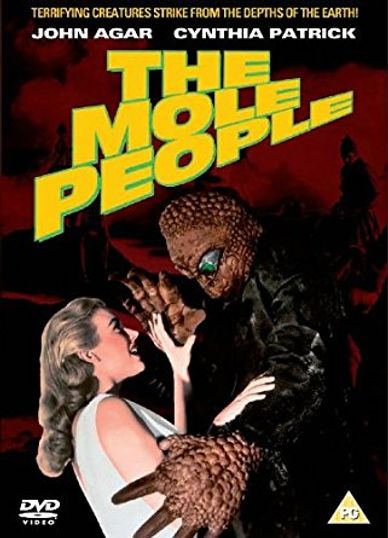
Starring: John Agar, Cynthia Patrick, Hugh Beaumont, Alan Napier.
Directed by Virgil Vogel
In Black & White
Written by Laszlo Gorog
At a dig in Asia a stone tablet is discovered with a Sumerian hieroglyphic inscription. After it is deciphered as a warning, a distant earthquake reveals clues to an ancient civilisation high on a mountain. When a member of the expedition falls through the earth into a great abyss, the others lower themselves down on ropes. They accidentally trigger a rock fall and become trapped below ground. They find the lost city for which they have been searching but are pulled into the ground by bipedal Mole Men.
In a lovely example of bad editing one of the party announces, “Look!” a few seconds before a rock wall moves aside to reveal two guards who take them to a temple. When they are sentenced to death by the king our heroes, Dr Roger Bentley and Dr Jud Bellamin, are none-too pleased. They make their escape, pulling over two huge candle holders for some guards to theatrically fall over. When they use a torch on the priest and king they are said to possess the Light of Ishtar.
One of our two surviving men is given a female slave called Adad and she learns of the world above. The city people create beautiful and aesthetic crafts, but they keep many of the Mole People as slaves. When our two men from above intervene in the bad treatment and torture of the slave Mole Men, it culminates in the reduction of food available for the city people. The king sacrifices three women to the outside Light of Ishtar. During the ceremony another woman throws herself around in a mad dance as if she has ants in her pants.
The priest soon persuades the king that the outsiders are mortal, like them. Bentley and Bellamin are poisoned with mushrooms and taken away, and the woman ex-slave, Adad, makes her escape. The Mole Men pull her down into the loose earth and all disappear, leaving the guards with no one to whip. With our heroes pushed out into Ishtar’s Light, Adad leads the Mole People in a rebellion attack on the king and his subjects. These are dispatched all too easily which makes you wonder why they didn’t think of doing that a long time ago.
They help break through the door to Ishtar’s Light, before doing a collective ‘runner’ from the glare. Our female ex-slave doesn’t even get a tan. “Beautiful,” she remarks. It turns out Adad is the ‘Marked One’ – a sort of link between the surface dwellers and those below. Our two men are none the worse for wear and so it all ends happily ever after – except that after their climb to the surface there is an earthquake tremor and Adad inexplicably throws herself under a collapsing pillar.
A word about the Mole Men. They have long, clawed hands and a larger than human, mottled head and bulbous eyes… oh and a hunchback. They look just different enough without coming across as totally ridiculous. As the monsters of the piece, they are Frankenstein’s creature-like benign innocents. In other words, misunderstood. This has elements of The Time Machine about it – only not as good. It’s great to see Alan Napier here as Elinu from the ancient city. He, of course, was Alfred in the classic 1960s Batman TV series. The Mole People is not actually that bad… but it’s not particularly good either, and far too predictable. Even so, it would spawn a sequel.
Verdict: 4 out of 10
(Original Review Ty Power 2018)
The Killer Shrews (1959)
The Killer Shrews (1959)
The Killer Shrews (1959)
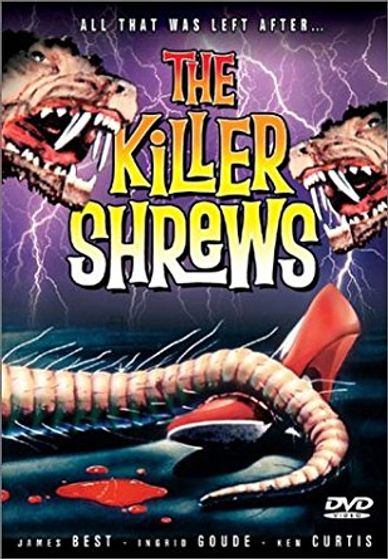
Starring: James Best, Ingrid Goude, Ken Curtis & Gordon McLendon.
Directed by Ray Kellogg
In Black & White
Written by Jay Simms
Thorne Sherman and his one-man crew, Griswold, shore-up on a remote island to ride out a storm. Sherman returns to a house with two doctors (one of whom has a beautiful daughter, of course!) and two other men. One of these men is our resident cowardly villain, and we know what ultimately happens to them… The others are keen for him to leave, storm or no storm, but Ann Gragis (played by Ingrid Gonde – who, incidentally, is one of the worst actors I’ve seen for a long time) has a reason for keeping him close – apart from the obvious!
The doctors have been participating in dodgy scientific experiments resulting in giant shrews the size of dogs. In fact, they are dogs except they’re wearing ratty-looking shaggy coats. First we see poor Griswold (who it seems everyone has forgotten) get attacked. The story is they have to eat five times their weight every day to survive, and that includes humans. One of the creatures manages to get into the cellar and bite the ‘help’ Mario, after which we learn their saliva contains a deadly poison.
Sherman takes a rather pointless daytime walk down to the beach just so that villain Jerry Farrel can try to kill him twice and the two can partake in a little fisticuffs. We then enjoy an all-out siege as the killer shrews break through the thin walls and kill another peripheral character, Dr Radford Baines.
Sherman is automatically accepted as their leader by everyone except the villain. As luck would have it he finds some cylindrical metal tanks and ties them together with rope. In a matter of mere seconds he uses a cutting torch to put eye slots in them. They secrete themselves inside and shuffle along like Siamese Dalek triplets. In close-up shots of them inside we see them wiggle their heads in exaggerated movements to make out they are walking. To me this is more humorous than watching the dogs charge around in their shaggy coats.
They make it to the sea where the shrews can’t follow. Jerry refuses to go with them. Instead he decides to walk around on the roof for a while, and then come down just long enough to be eaten by the pack of killer shrews. He gets his just desserts, as we knew he would. And so we leave the island where it is assumed the shrews will eat each other and the last one starve to death. Ann, who is supposed to be a professional scientist, melts in the arms of Sherman who she has only just met, and we are subjected to one of the corniest final lines in movie history.
People often cite the dog-shrews as being hilarious, and they are good fun. But in truth the night scenes are quite dark and the daytime scenes are carefully shot at a distance, so that we can’t really scrutinise their shortcomings. Any close-ups of the heads are shown through small holes where they are trying to break through into the house. What is seen in these cases is an artificial head with large beady eyes, sharp teeth and even a sabre-tooth addition!
The Killer Shrews was directed by Ray Kellogg, which inspires the question why didn’t we get Killer Shrews: The Serial? A considerably worse sequel called Return of the Killer Shrews emerged in 2012. Whereas this film is fun-bad, the sequel is just bad-bad.
Verdict: 6 out of 10
(Original Review Ty Power 2018)
Return of the Fly (1959)
The Killer Shrews (1959)
The Monster that Challenged the World (1957)
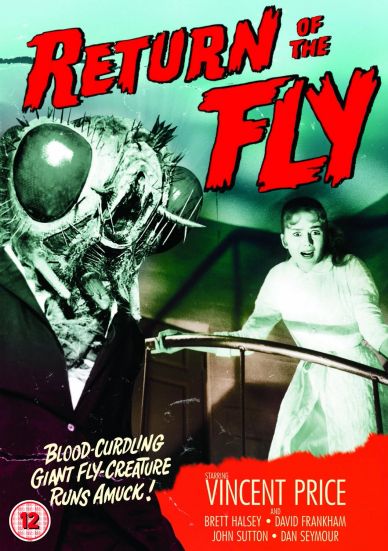
Starring: Vincent Price, Brett Halsey, David Frankham.
Scripted & Directed by Edward Bernds
In Black & White
It is several years after the ill-advised experiments and death of scientist, Andre Delambre. His widow has now passed away, and their son, Philippe, is an educated scientist himself. Philippe asks his uncle Francois (Vincent Price) about his father’s work and, after a lot of persuasion, is finally given access to the man’s laboratory.
With the help of an assistant he continues his father’s experiments with matter transference. They break down the atoms of a live gineau pig, agreeing to bring it back the next day to see if a delay in the process causes any problems. However, a policeman discovers the assistant copying the machine’s plans and, in an attempt to arrest him, gets himself transferred – resulting in an amalgamation of atoms with the gineau pig.
When Philippe finds out what a dirty rotten scoundrel his assistant is, a game of roly-poly rough and tumble ensues. Philippe is incapacitated and put through the matter transmitter with a fly. Mr bobble-head emerges and makes his escape. It is left to Price’s Francois to explain to the police what needs to be done.
Why the head and one arm is affected in exactly the same way as the first film is anyone’s guess. This time one leg is mutilated too, and the fly head is significantly larger than before. He walks through the woods dragging one leg and trying to keep his head straight (in more ways than one!).
While the human-headed fly is caught, the fly-headed human dispatches the villainous fiend who betrayed him, as well as the man’s partner in crime. This neatly wraps-up the loose ends. Francois and the police detective justify the matter by saying it was the fly that killed them, not Philippe. This statement, however, defies all logic as Philippe remembers where he had last seen his former friend and kills him as retribution, which proves human cognitive thought. I don’t blame him though; if someone turned me into Mr Fly Bobblehead, I’d want to kill him, too.
All ends on a positive note when Philippe instinctively returns to his house and is led into the laboratory’s matter transmitter by a half-delirious Francois, who is recovering from a gunshot wound. With Francois’ vision of the controls blurring, you feel sure something will go wrong. But the human-headed fly is thrown in with Philippe and he emerges fully intact and none-the-worse for his ordeal.
Of course, this outcome defies all scientific logic, but it’s fun all-the-same. Everyone seems to forget that the fly was in the transmitter, as well. Surely, as a scientist you would have to prevent the fly from escaping and carefully check it over. Philippe’s fiancé, screaming like a banshee only moments before, now holds him close. You just long for her to hit him with a rolled-up newspaper!
Obviously, the film production had less faith in this sequel, as they proffered much less money and as a result it was made in black and white. In truth, the script is predictable but not too bad – the only glaring mistake being the gigantic head of the fly. Vincent Price is the only returning actor from the first film. There’s a rumour that he actually preferred the script of this sequel to the original… that’s outrageous! Let’s send in the SWAT team.
Verdict: 6 out of 10
(Original Review Ty Power 2017)
The Monster that Challenged the World (1957)
The Monster that Challenged the World (1957)
The Monster that Challenged the World (1957)
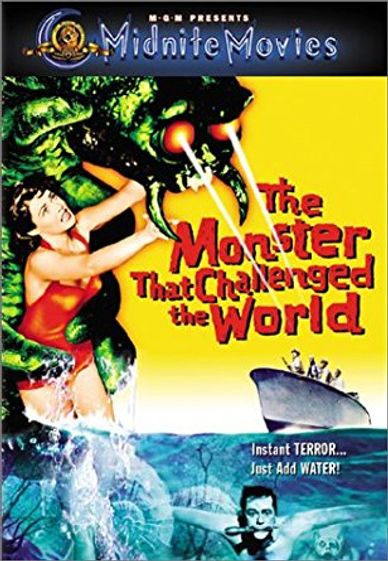
Starring: Tom Holt, Audrey Dalton, Hans Conried.
Directed by Arnold Laven
In Black & White
Story by David Duncan, Screenplay by Pat Fielder
Instant Terror. Just Add Water!
After some atomic testing by the US Navy over the sea, an earthquake is felt up to ten miles away. When things return to normal, a routine parachute drop and pick-up over the sea goes wrong when the jumper is not found – only his parachute. One of the two men on the pick-up boat dives in but fails to surface. The sole remaining man recoils in horror as something emerges from the sea.
An investigation reveals only a thick slime on the side of the boat. It’s analysed by Dr Jess Rogers in Intelligence, and Lieutenant Commander John Twillinger, the investigating officer, gets to meet the attractive receptionist Gail MacKenzie and her young daughter. The body of the parachutist is recovered and found to be drained of blood and water via puncture marks. The slime is discovered to be radioactive.
A young couple go missing whilst swimming in the sea, so the beaches are closed-off and the navy send down divers to check the seabed. Two divers find a body, and that’s not all … There’s what appears to be a large semi-transparent object outside a cave. It looks like a balloon to me, but another good guess would be an egg. It’s lifted onto the boat just as a giant slug-like sea monster emerges from the cave and kills one of the divers. The other makes it to the boat, but is followed. The monster erupts from the water. The navy men attempt to fight it off. One of them manages to spear an eye and it sinks back into the sea.
The experts believe the creature to be some sort of mollusc. They have the egg in the laboratory at a constant temperature so that it doesn’t hatch. Of course, that translates to 'something is going to go horribly wrong and it will hatch!' Depth charges are set off in the region in order to destroy any other creatures or eggs, but they can’t assume success, so coastal patrols are organised. However, the monster uses underground waterways to escape via the canal system. Not only does a mollusc monster emerge at one of the canal locks, but the egg in the laboratory hatches (told you so!) when the little girl – who really shouldn’t be wandering around Naval Intelligence – turns up the heating because she thinks the test rabbits are cold.
An old map of the canal system is revealed, showing well holes created by the Red Indians. This is where the creatures are congregating. Our hero goes down with another diver and places charges. One of the creatures (in reality, the only one!) simply watches them do this and only makes a move when they are leaving. The charges detonate and the mollusc monsters are destroyed. All but one, of course. Commander John Twillinger returns to the Navy Intelligence lab to find Gail and her little girl hiding, terrified, in a storage room. The monster hatched from the egg is breaking in. Twillinger uses a fire extinguisher and a broken heating pipe on the creature, before two men burst in with guns and end its ambitions.
So our monster of the piece didn’t exactly challenge the world; however, for the viewer it’s very enjoyable all the same. The film has structure and pace, as well as identifiable characters – which is all anyone can hope for. This one’s fun.
Verdict: 7 out of 10
(Original Review Ty Power 2018)
The Angry Red Planet (1959)
The Monster that Challenged the World (1957)
The Angry Red Planet (1959)
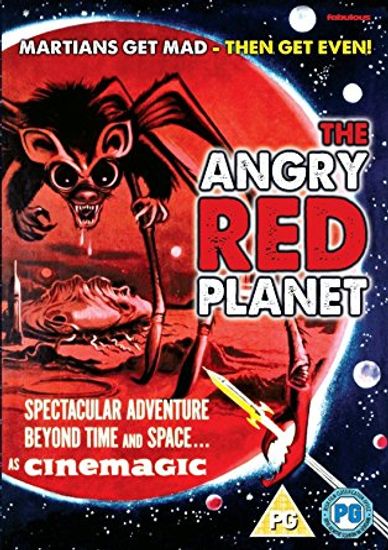
Starring: Gerald Mohr, Nora Hayden, Les Tremayne, Jack Kruschen.
Directed by Ib Melchior
In Colour
Screenplay by Sid Pink & Ib Melchior
Produced by Sid Pink & Norman Maurer
The one with the Rat-Bat-Crab-Spider!
The MR-1 rocket ship to Mars has been out of contact for a considerable number of days. Now it has been picked-up by Earth and remotely brought back. There are only two survivors out of the four. Colonel Tom O'Bannion is very ill with a spreading skin infection, and Doctor Iris Ryan is suffering from exhaustion and also taken to hospital. To understand what they are dealing with and save the Colonel's life, the doctors need to know what took place on the Red Planet.
Many of the scenes take place on the set of the rocket ship interior. Then, for the Martian surface walks, everything is tinted a vivid red and yellow. The backdrops of rock formations and vegetation are basically drawn and pretty cheap-looking - only the heavy tinting saving us from looking too closely.
Most films from this era only feature one monster or alien for budgetary reasons, but this one makes certain we get our monster fix when Tom and Iris - along with Professor Theodore Gettel and Warrant Officer Sam Jacobs - get attacked by, consecutively, a man-eating plant, the infamous Rat-Bat-Crab-Spider (if you haven't seen this creature in action then you really need to), a humongous ameboid creature, and a three-eyed peeping tom Martian.
Our heroes, sans Sam Jacobs (easily the most interesting character) who dies trying to defend the others, attempt a take-off to flee the planet. However, the ameboid prevents this by attempting to absorb the ship. A plan is devised to electrocute the mass through the outer hull. When this begins to work, they make their escape. But the consequences of a rapid take-off is the death of the Professor, who it turns out has a weak heart. You mean, savage attacks by three bizarre monsters didn't do the trick?
Predictably, this just leaves our hero the Colonel and his love interest the Doctor, which isn't unusual in these flicks. With a reported budget of only $200,000 and a deadline of just nine days, I believe this is a remarkable final product. Okay, it looks cheap and a bit Heath Robinson, but the tinting works well in covering-up the flaws. Most of all, it's great fun, and in hindsight that's the main objective for me.
Verdict: 6 out of 10
(Original Review Ty Power 2020)
The Tingler (1959)
The Monster that Challenged the World (1957)
The Angry Red Planet (1959)
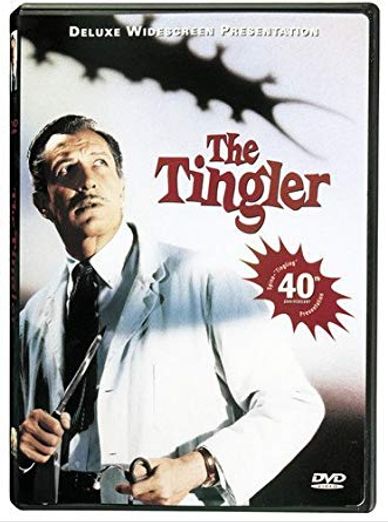
Starring: Vincent Price, Darryl Hickman, Judith Evelyn, Patricia Cutts.
Directed by William Castle
In Black & White
Written by Rob White
Dr Warren Chapin is performing a post mortem. He explains to Oli, a relative of the deceased that part of the vertebrae is cracked and separated, which he has seen before in victims of severe terror. The relative runs a cinema. Chapin, the pathologist, returns with him to meet the man’s wife. She is a deaf mute with an obsession for hygiene. When Chapin cuts his hand on a broken saucer the woman is struck with intense fear and passes out.
Chapin carries on his own experiments on ‘the Tingler’ – a tangible effect of fear with David Morris, his assistant and love interest to his wife’s younger sister. Chapin’s wife is selfish, nasty and a cheater. When she returns from one such liaison, Chapin offers her an ultimatum to change her ways or ‘commit suicide’ when he changes the scene to make it look like she took her own life. She is terrified at the point he shoots her with a blank. While she is out cold he takes some x-rays of her spine. It is all an experiment. The x-rays reveal a substance or organism along the spine, which appears to be very strong and causes the spine to go rigid.
Chapin speculates with David about how to combat it, and suggests screaming might incapacitate or remove it, which is why the mute woman went into shock and fell unconscious. They need to find someone who can withstand the terror and pain without screaming; that might produce a specimen they can remove. Chapin wants to experience the sensation of the tingler, but nothing scares him. So he administers a solution which induces nightmares. He begins to experience fear but at the height of terror he can’t resist screaming. He realises the ideal candidate is the deaf mute woman, so he visits her under the pretence of calming her so she can sleep. He injects her with the same solution and leaves. She experiences some haunted house-like phenomena and a ghoul appears to stalk her. She runs to another room, only for similar events to happen – including a hairy hand appearing from the closet to throw an axe at her. The fear is becoming palpable.
In the bathroom red blood is pouring from the sink tap (remember, this film is in black and white, so the appearance of red blood is very striking). The bath now is full of red blood, and a hand slowly emerges from beneath the surface. The woman’s husband brings her to Chapin’s lab, after he finds her on the floor, but Chapin declares her dead. In shadow puppet style behind a screen, Warren Chapin pulls a living tingler from her back. After it tries to attack him, he secures it in a box. His wife steals the nightmare-inducing solution and puts it in a drink for him. When he passes out she opens the box and leaves the tingler to attack him. As its pincers attempt to strangle him, his wife’s sister arrives home and screams, rendering it motionless.
It is secured in the box again. However, it seems nothing will kill it, so Chapin has the idea of returning it to the dead woman’s body in the hope it will reduce to microscopic size (it’s original state before the fear set in). But Oli killed his wife himself by frightening her to death. The tingler breaks free from the box and disappears into the theatre below through a broken floorboard. As the patrons watch a silent movie the tingler moves down the aisle. A woman screams and it moves on to the projection booth, and the cinema blacks out to the announcement: ‘Scream. Scream for your lives!’ The tingler is secured again and returned to the woman’s body. After Chapin leaves, Oli experiences his own fear when his dead wife’s body rises and comes for him – probably brought on by his fear of going to the electric chair for her murder.
Science Fiction master storyteller, Robert Heinlein wrote a book called The Puppet Masters. This featured the parasitic creature attaching itself to the spinal column and thereby controlling that person to integrate into positions of power. This was probably best realised in the original 1960s version of The Outer Limits, as The Invisibles. The Tingler’s shape and general purpose is a variation on this theme, except that the creature is already there. Other films and TV shows have also touched on this idea. The Tingler itself is well-realised, except the remastering has further revealed the strings. The jerky movement of the strings does, however, produce an otherworldly feel.
Vincent Price is excellent, as he is in almost every horror film in which he appears. This is a William Castle film, who had a tradition of trying to increase the suspense by introducing his films and virtually telling the audience to be scared before the film had started. Castle even had selected cinemas with vibrating seats and a Tingler moving down the aisle, to match the scene on the screen.
Verdict: 8 out of 10
(Original Review Ty Power 2018)
The Monolith Monsters (1957)
20 Million Miles to Earth (1957)
Plan 9 From Outer Space (1958)
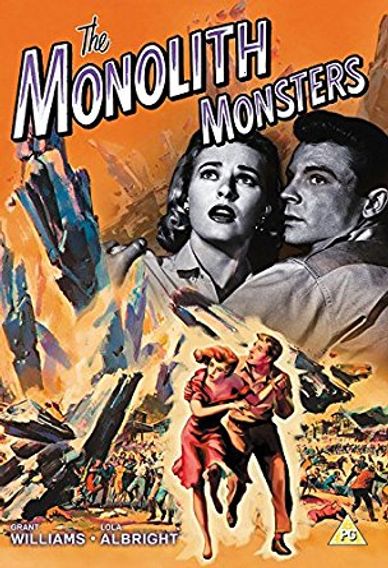
Starring: Grant Williams, Lola Albright, Les Tremayne, Trevor Bardette & Linda Scheley.
Directed by John Sherwood
In Black & White
Story by Jack Arnold
Screenplay by Norman Jolley & Robert M Fresco
A meteor falls to Earth, somehow failing to attract anyone's attention. When a geologist working for the Department of the Interior finds a glassy rock he returns to his office in the town of San Angelo to study it in the lab. The next day his colleague Dave Miller arrives to find his partner has been turned to stone (with no Medusa in sight!). Furthermore, the lab is half-wrecked and there are fragments of the rock everywhere.
Dave’s love interest is teacher Cathy Barrett. When she takes a group of small children on a field trip in the area of the meteor crater, Ginny, one of her charges, takes a fragment of the rock home. Afterward, the farmstead is found wrecked and two stone-like bodies discovered. Their child, Ginny, is in a catatonic state of deep shock. A specialist doctor puts her on an iron lung, as she is dying and the stone-effect spreading up her arm. The race is on to find an antidote or cure. Dave teams-up with Professor Flanders and between them they learn that silicone has been drained from the bodies.
But how are the rocks becoming animate? Well, it seems to make a Monolith you just add water, and to make matters worse (isn’t it always the case?) there just happens to be torrential rain outside. The rocks absorb the water and grow in mere moments into great monoliths, which then topple over and smash into a thousand pieces, starting the cycle yet again. Thus the movement of the Monoliths comes from the widespread fragments growing and shattering – and they’re heading for the town.
As the little girl is injected with silicone and begins to recover, the new problem is to find a way to halt the progress of the Monoliths before the town is destroyed. A series of experiments reveals that salt in a saline solution renders them inert. Dave has this plan to blow-up a nearby dam, allowing the escaping water to flow across the path of the encroaching Monoliths. The only worry is that there is enough salt present to do the job. It works; the Monoliths topple and fragment but cannot grow again. The town – and probably the world – is saved.
The logic is far from airtight but, nevertheless, this is a solid science fiction story, which gains credence by avoiding the organic alien invasion trap. These are just rocks which have a very different nature; there is no preconceived plan. The Monolith Monsters is a film which tries to do something different with this period’s subject matter. Many of the same names – from both in front of and behind the camera – returned several times to the Science Fiction Monster B-Movies of the 1950s and beyond. Jack Arnold was involved in many films from this era, either in a writing or directorial role. Grant Williams was a regular leading actor, his most famous role being The Incredible Shrinking Man.
Verdict: 7 out of 10
(Original Review Ty Power 2018)
Plan 9 From Outer Space (1958)
20 Million Miles to Earth (1957)
Plan 9 From Outer Space (1958)
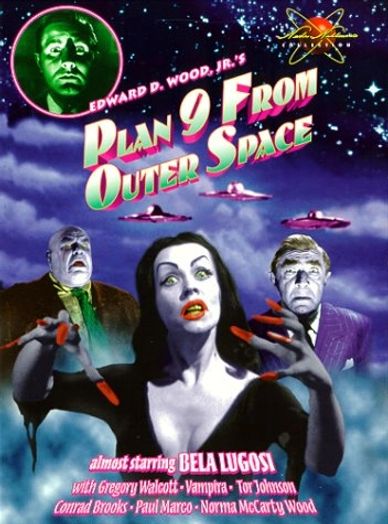
Starring: Bela Lugosi, Vampira, Tor Johnson, Gregory Walcott, Tom Keene, Mona McKinnon, Duke Moore.
In Black & White (or Colour)
Written, Produced & Directed by Ed Wood
An old man’s wife has died and he is so grief-stricken that he walks out into the road and is killed himself. Two grave diggers are found dead and deformed. The police arrive at the graveyard to investigate, but Inspector Clay is killed when a strange dark haired woman with extremely long fingernails and the risen old man converge on him. Airline pilot Jeff Trent has his own close encounter with a UFO, both in the air and at home. More UFOs are being seen over major cities around the world. The military fire rockets at them and send jet fighters, to no avail. We learn that the alien objective is to use electrode guns to stimulate the pituitary glands of the recent dead to return them to a semblance of life (essentially zombie-like).
Paula Trent, wife of pilot Jeff, lives next to the graveyard (now there’s a coincidence), and when the dead old man gets into the house she runs, screaming, into the graveyard only to be pursued by the long-fingered woman and the newly-risen Inspector Clay (who at least looks a little scary). Paula is rescued by a passing motorist. Police, led by Lieutenant Harper, return to the graveyard to discover that Inspector Clay’s grave is empty. The military develop a machine which can translate recorded messages from the aliens, and send Colonel Edwards to the little town and graveyard where much of the activity is taking place.
The aliens lure Jeff and Paula Trent, Lieutenant Harper and Colonel Edwards to a flying saucer where a representative explains they are having to take drastic action to make the people of Earth listen to them, because messages have been ignored and saucer sightings covered-up. Now that Earth has developed the Atom and Hydrogen Bombs it is only a matter of time before it produces the Sol Bomb that explodes light itself, and that could destroy the universe (surely only the solar system?). The humanoid aliens plan to raise many more dead and have them overrun the cities. A fight breaks out inside the saucer and all of our heroes escape, leaving the flying saucer to take off in flames and explode in the air. It’s a victory of sorts, as the aliens have more spacecraft at their disposal. The logical speculation is they will be back at some time.
Plan 9 From Outer Space is generally known as being not only the worst example from this era, but one of the worst films of all time. There is certainly a problem with continuity and knowing when it’s day or night (even in the same scenes). Tor Johnson is one of the worst stilted actors when he has to speak normally as Inspector Clay, but is actually pretty impressive as an undead zombie – mainly down to his heavy build. Bela Lugosi (famous for his 1930s portrayal of Dracula) died during the making of this film, and was reportedly replaced by his wife’s doctor or psychiatrist who was quite a bit taller than Lugosi and, let’s face it, looked nothing like him. So the replacement is forced to walk around with a stoop and holding a cloak half over his face. Due to the order in which the scenes were shot, the ‘old man’ changes back and forth between Lugosi and his ‘double’.
Narration in the film is cringeworthy and, frankly, awful. The flying saucers each hang by a single string and wobble crazily, almost totally out of control. The alien space station décor and uniforms are reminiscent of 1930s Flash Gordon. The ‘old man’ quite illogically looks and acts like Dracula. The list of oddities goes on. The dialogue is also worth a mention, with some unintentionally hilarious moments like: ‘He’s dead. Murdered. And one thing’s for certain … Someone’s responsible!’
This film was, of course, written, produced and directed by Ed Wood, who became known for making mostly rubbish films. Vampira plays (believe it or not) the Vampire Girl, who wanders around the graveyard with her fingers extended as if imploring someone to cut her nails. The appearance of Bela Lugosi essentially reprising his Dracula role is both funny and sad. It demeans him and the character.
I’m not a fan of colourising films which were made in black and white, but I have to say my copy of the film has both options and the colour version is quite good. Is it the worst of the 1950s Sci-Fi Monster B-Movies? Almost certainly not, although it does suffer from countless shortcomings, so there is plenty to talk and laugh about.
Verdict: 3 out of 10
(Original Review Ty Power 2018)
20 Million Miles to Earth (1957)
20 Million Miles to Earth (1957)
20 Million Miles to Earth (1957)
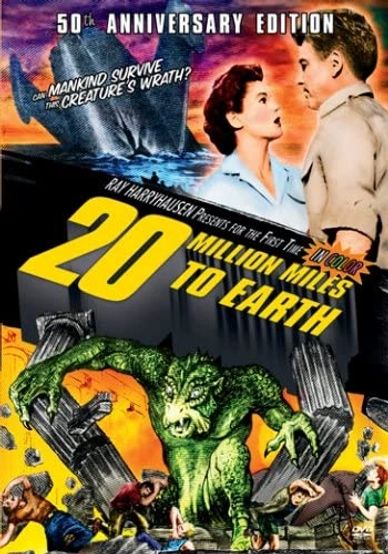
Starring: William Hopper, Joan Taylor, Thomas Browne Henry, Frank Puglia.
Directed by Nathan Juran (Story by Charlotte Knight)
In Black & White (or Colour)
Screenplay by Ray Harryhausen, Charlotte Knight, Christopher Knopf, Robert Creighton Williams
Produced by Charles H. Schneer (Technical Effects by Ray Harryhausen)
"Why is it always so costly for man to move from the present to the future?"
The U.S. XY21 spacecraft to Venus crash lands upon its return to Earth. It hits the sea near a village off the south coast of Sicily. Fishermen witness the event. One of them checks-out an opening in the craft. There is a dead man inside, but two others are still alive and are removed before the spacecraft sinks. One of them dies from his injuries but the other - Colonel Robert Calder - survives.
Meanwhile, a young boy from the village finds a glass cylinder with something inside washed-up on the beach, and sells it to a local zoologist, Dr Leonardo and his beautiful daughter Marisa. It turns out to be a gelatinous form of egg which soon hatches into a tiny lizard-like creature standing upright on two legs, and with a semi-human-like torso. It is placed in a cage on the back of a truck, and by the next morning has more than doubled in size.
Military officials arrive to talk to the survivor of their clandestine trip to Venus. They tell the local Secretary of State the tale, and request his cooperation in supplying divers to search for the missing cylinder. The boy informs them about the sale of the cylinder's contents to the zoologist, who is on his way to Rome with his daughter. When the tarpaulin comes loose from the back of the truck they stop to refasten it - only to stand in amazement as the even larger creature easily destroys the bars of the cage and escapes.
After scaring some horses and a flock of sheep the creature (Ymir) approaches a farm. In the barn two stallions rear-up and flee, and a number of live chickens are quite obviously thrown into the scene. While it is searching for food it is attacked by a dog. After a scuffle the dog is left badly injured but not dead. Calder and the other military catch-up with the farmer as he discovers the dog. As they are all attempting to coax the creature into a cart, the farmer stabs a pitchfork into its back and is in turn killed for his trouble. An attempt is made to lock it in the barn, but it breaks out through the side.
It is learned that the creature's main diet is sulphur, so they plan to search for the creature at the base of Mount Etna. Calder intends to drop an electrified net over the beast in order to capture it alive. Sacks of sulphur are dropped as bait, and the creature begins to eat. It is captured in the net and electrocuted to a state of unconsciousness. The creature is transported to a zoo in Rome, where it is studied by scientists. A press statement is released, and selected people are permitted to see the Venusian creature, which - due to the Earth's effects on its metabolism - is now 20 feet tall and continuing to increase in size.
While the creature is being scientifically tested, an accident causes it to regain consciousness and break free. There is mass panic from the public, particularly when the creature is confronted by an elephant. After a fight the elephant is left bloodied but alive. The creature escapes into the city. As the military tracks it down, it bursts forth from the river, destroying a bridge, and heads for the Colosseum. It is attacked by soldiers and flame-throwing tanks. Bazookers and field guns are brought into play. The creature is harried to the highest point of the ancient ruins, and is finally brought down by destroying the stone structure to which it is left clinging. A sad end to a magnificent being.
Another early offering by stop-motion effects maestro Ray Harryhausen. This one is at least as impressive as The Beast From 20,000 Fathoms in terms of magnificent set-pieces. He injects otherworldly movements into his Ymir creature, and ensures it has its own look and identity. Make no mistake, Harryhausen was a genius; a master of his craft. Many monster movie film fans, such as myself, actually prefer the look of these painstakingly-filmed model creations than the coldness and at times cartoony look of CGI.
This is another film which, although perfectly fine, was greatly enhanced by Ray Harryhausen's loving labours. Having said that, the creature in 20 Million Miles to Earth is an innocent victim of events beyond its control. It is very much like Frankenstein's monster and King Kong in that respect and, as with those movies, you can't help having sympathy with its plight. The makers are very careful not to make this creature the aggressor. Therefore, it only fights when it is attacked first. With the instances of the dog and the elephant, it defeats them but leaves them alive.
This is an entertaining film, and the amount of extras make it even better. There is a Commentary with Ray Harryhausen; Remembering 20 Million Miles to Earth; Tim Burton sits down with Ray Harryhausen; Interview with Joan Taylor; David Schecter on the Film Music; Photo Galleries and Artwork; and the 20 Million Miles More Comic Book. The movie was made in black and white, but there is a choice to select whether to watch it in its original format or as a colourised version (black and white every time!).
Verdict: 8 out of 10
(Original Review Ty Power 2020)
The Deadly Mantis (1957)
Tremors (1990) 2020 4K Limited Edition Boxset Release
20 Million Miles to Earth (1957)
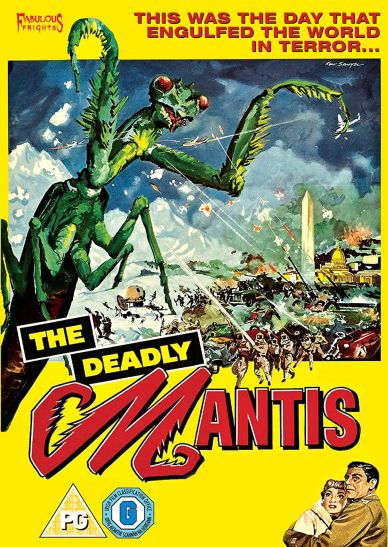
Starring: Craig Stevens, William Hopper, Alix Talton, Donald Randolph, Pat Conway.
Directed by Nathan Juran
In Black & White
Screenplay by Martin Berkeley (Story by William Alland)
Produced by Willian Alland
There is a volcanic explosion at the Antarctic which somehow causes an iceberg to break up at the opposite end of the earth at the North Pole - releasing a gigantic creature. North of the border between Canada and North America, tracking stations monitor changes and, when contact is lost with one of these, Colonel Joe Parkman investigates. Strange long tracks are found which don't match any aircraft, and the place has been trashed. What appears to be a large claw is found, and it is taken to renowned paleontologist Dr Ned Jackson and his beautiful assistant Marge Blaine. The claw-like piece is identified as belonging to a praying mantis, but one which has to be of extraordinary size.
A plane is attacked in flight, and an Eskimo village is menaced, resulting in a comical scene wherein a slightly accelerated bit of film shows loads of Eskimos grabbing boats and frantically paddling out to sea. The giant insect is heading south and eventually arrives (surprise, surprise) at Washington D.C. After landing merely to turn over a train and a bus, and to peer in through a window at a couple of stunned security guards, it takes to the skies again - only to be shot at by a couple of US fighter planes. One of the aircraft collides with the flying mantis. The pilot ejects, and the injured creature takes refuge in the Manhattan Tunnel.
The tunnel is filled with smoke and sealed-off at both ends. Joe Parkman suits-up and, wearing masks, leads soldiers into the tunnel. They throw gas bombs at the mantis, and eventually it succumbs to the gas and dies. Marge is allowed in after the gas clears to take her headlining photograph of the astounding creature. However, she is nearly killed by the autonomic muscle reaction of the dead insect.
Some of the model work - particularly in the tunnel, on the monument and at the tracking station - is pretty good, but for a monster movie the scenes featuring the subject of the title are very few and far between. Most of the images of the mantis feature a sorry-looking fluttering, buzzing thing on a backdrop of stock footage. And talking of stock footage, there is a lot of it. I realise that a concerted effort was made to reduce the budget by this method, but I would venture to say at least fifty percent of this movie is incorporated stock film, and thereby at times dull and preachy.
There is a comical moment during the attack on the tracking station. Our heroes are inside and having a polite conversation whilst, unbeknown to the characters (who must have had their blinkers on), the mantis looks in through the window. Marge walks past the window at least three times before seeing it, and her associates are all facing in that direction.
Ray Bradbury's and Ray Harryhausen's The Beast From 20,000 Fathoms has a lot to answer for. In the same way that John Carpenter's Halloween (1978) set the template for subsequent horror slasher films, Beast (1953) set the standard for giant monster/creature flicks. This film has exactly the same plot and direction as Beast. Therefore, we have the military officer hero, the professor and his beautiful assistant (who is the love interest for our hero), the giant animal or insect heading towards what would have been its natural environment in prehistoric times and causing havoc all along the way.
Verdict: 5 out of 10
(Original Review Ty Power 2020)
Robot Monster (1953)
Tremors (1990) 2020 4K Limited Edition Boxset Release
Tremors (1990) 2020 4K Limited Edition Boxset Release
Starring: George Nader, Claudia Barrett, Selena Royle, and George Barrows as Ro-Man.
Directed by Phil Tucker
In Black & White
Produced by Al Zimbalist & Phil Tucker
In a plot so ludicrous it makes many of the other lacklustre 1950s sci-fi monster movies seem like works of art, Ro-Man, an alien in a gorilla suit with a deep sea diver helmet and antennae so big he might just pick up Channel 5, destroys all life on Earth. Only a handful survive: a professor’s family and a work colleague who has designs on his daughter. They avoid detection by surrounding their refuge with an electrical field. But it is the professor’s vaccine against all illness which inexplicably makes them impervious to Ro-Man’s death ray.
In his cave he has a nice futuristic flat screen viewer by which he communicates with his identical-looking commander. His boss is understandably getting a little irate. He wants to know why Ro-Man can’t kill the remaining pocket of humans when they have wiped out the rest of the human race within what is assumed to be a few days. I want to know the same.
He spends most of the film’s running time walking up and down ravines or canyons, or quarries… or whatever the hell they are, and then returning to the cave in a kaleidoscope of pretty washing-up bubbles. You have to feel for the alien though; he must be losing half his body weight in that gorilla suit, and his brain has obviously become fried in that goldfish bowl on his head. The character’s IQ and powers of reasoning have melted away (if they were ever there in the first place), because when the heroine is kidnapped and asks Ro-Man where he gets his strength he actually tells her it’s a machine housed in the cave.
The continuity is fantastically non-existent. The best example is when Ro-Man is attempting to tie-up the heroine when a communication comes through. So he knocks her out with a sweep of his hand and she falls to the ground. After a short message he turns back to find that she is not only conscious and standing-up, but securely tied-up!
When the source of his power is destroyed, Ro-Man simply falls to the ground. For some reason he could not bring himself to kill our heroine, so his boss arrives to take care of business himself – moving menacingly towards the camera in a sequence which is repeated twice to take advantage of the new 3-D techniques.
And suddenly the whole family’s alive again as we discover the spaceman-obsessed little boy dreamt the whole thing. Poor kid; it must have seemed like the worst nightmare ever!
The DVD I watched comes courtesy of Cheesy Flicks, who seek out the most cringeworthy examples of the silver screen. They must have been easily distracted during one of Ro-Man’s many country walks, because on the rear of the case they mistakenly promote the film as Monster Robot.
You may be interested to know (or not) there is a successful stage play version of the film playing to audiences in Los Angeles, USA. There is also a behind-the-scenes-of-the-film book available. Sometimes the longevity of a notoriously bad film is greater than that of a good one...
Verdict: 3 out of 10
(Original Review Ty Power 2017)
Tremors (1990) 2020 4K Limited Edition Boxset Release
Tremors (1990) 2020 4K Limited Edition Boxset Release
Tremors (1990) 2020 4K Limited Edition Boxset Release
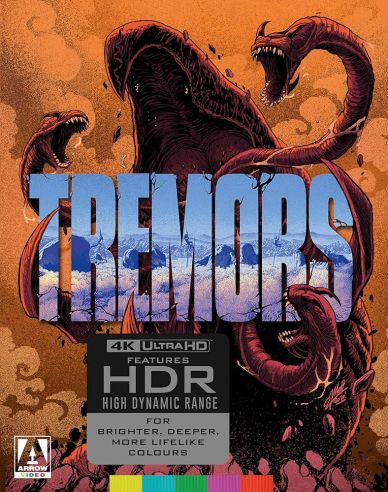
Starring: Kevin Bacon, Fred Ward, Michael Gross, Finn Carter.
Directed by Ron Underwood
Arrow Video
December 2020
A Monster Movie That Breaks New Ground!
Kevin Bacon and Fred Ward star as handymen Val McKee and Earl Bassett, who are looking for work. When leaving the tiny Nevada Desert town of Perfection they come across an attractive seismology student who is taking some unusual readings. Before they know what has happened they, and the handful of inhabitants of Perfection - including the gun-toting survivalist Burt Gummer - are fighting for their lives against huge underground man-eating worms that move like lightening and are attracted to sound.
As well as being one of my top dozen favourite films of all time, Tremors is easily and by far the best Retro Monster B-Movie of all time. Director Ron Underwood set out to make a film in the tradition of the 1950s B-Movie greats Them! and The Beast From 20,000 Fathoms but with 1990s sensibilities. He succeeds with spades. Like everything else, a movie is the sum of its parts, and Tremors has so many things going for it.
Set in a small desert town in the middle of nowhere, we have two jobbing handimen who long to escape to the big city, as they feel with no prospects their lives are going nowhere. Having just set out on their journey of discovery, they come across a young female seismologist who informs them there are large, patterned movements under the earth. Val (Bacon) takes a liking to Rhonda LeBeck (Finn Carter), much to the subtle amusement of his friend and work partner Earl (Ward). When they endure their first experience of a Graboid - a huge and terrifying subterranean earth-dweller, they race back to Perfection to warn the inhabitants (who, in typical 1950s B-Movie style), initially don't believe them) and plan a defence.
Plot and characterisation are undoubtedly the two paramount aspects of any storytelling. Here, the characters are spot on. Val and Earl form the best 'buddy' pairing I have ever seen committed to film. You would think that Kevin Bacon and Fred Ward have known each other for years, rather than being thrown together for one project not expected to sell that well. Instead, the pairing is so natural that the humour comes across subtly in glances or low-key dry ribbing. When Rhonda becomes a potential love interest, Val's stilted advances cause some priceless body language exchanges between the two chums. Gummer (Michael Gross) and his wife come across as stereotyped rednecks, but their preparation for 'the big one' proves timely against the Graboids which use sound and movement to seek their prey, ultimately coming up in the town itself.
There are some lovely scenes, such as when a group of the main characters are seemingly easy prey for the Graboids, caught as they are in the desert. A plan is devised to fashion wooden staffs which they use to polevault between rock formations, where the giant carnivorous worms can't come up. Another is where the town's inhabitants are forced up onto their roofs and the Graboids seek to bring down the foundations by breaking-up the ground beneath.
The interaction between the characters is spot-on, and none of them break 'type' - which is a downfall of many a low budget movie, particularly in 'group under seige' scenarios. This is both a horror and a comedy, but the humour materialises in the dialogue between the characters: often dry, never sensationalist or slapstick, and never sending-up the monsters or the peril. The balance of the film couldn't be better, making certain it is essentially about the people and how they come together to tackle adversity. This film doesn't need to throw blood at the screen for effect (although there is some icky goo), because it has real substance; everything happens for a reason and moves the plot forwards.
As with the first Friday the 13th movie, this is an early outing for Kevin Bacon. Both he and Fred Ward are excellent. It's a shame that Bacon isn't around for the sequel to this film, but he had then gone on to bigger projects. It is just that he looks quite plainly relaxed and comfortable on this one. In reality, he reportedly had two major changes of attitude. He apparently was happy to do the film, but when it didn't do well at the box office - due to the film company not knowing how to market it - he was seen to rant as to why he was reduced to doing a film about worms. But the film has built-up a huge cult following over the years, and since then Bacon has said that it was one of the best experiences he has had on a film. Whatever the truth, I could wax lyrical much more about Tremors but it has spawned a number of sequels and, suffice to say, you need to see this movie (preferably in 4K or Blu-ray. Enjoy!
This boxset is outstanding, incorporating: New 4K restoration from the original negative by Arrow Films, approved by director Ron Underwood and director of photography Alexander Gruszynski; a hard slipcase; 60-page perfect-bound book featuring new writing by (writer & film critic) Kim Newman and Jonathan Melville and selected archive materials; Large fold-out double-sided poster featuring original and newly commissioned artwork by Matt Frank; Small fold-out double-sided poster featuring new Graboid X-ray art by Matt Frank; Six double-sided, postcard-sized lobby card reproduction artcards; Limited Edition packaging with reversible sleeve featuring original and newly commissioned artwork by Matt Frank.
There is an absolute wealth of extra features, and very excellent they are too - particularly the Making Perfection documentary with interviews of the main cast and crew, and the three short films on the second disc.
DISC 1 FEATURE & EXTRAS (4K UHD BLU-RAY); 4K (2160p) UHD Blu-ray presentation in Dolby Vision (HDR10 compatible); Restored DTS-HD MA original theatrical 2.0 stereo, 4.0 surround, and remixed 5.1 surround audio options; Optional English subtitles for the deaf and hard of hearing; New audio commentary by director Ron Underwood and writers/producers Brent Maddock & S.S. Wilson; New audio commentary by Jonathan Melville, author of Seeking Perfection: The Unofficial Guide to Tremors; Making Perfection, a brand new documentary by Universal Pictures interviewing key cast and crew from the franchise (including Kevin Bacon, Michael Gross, Ariana Richards, Ron Underwood, Brent Maddock & S.S. Wilson, among many others) and revisiting the original locations; The Truth About Tremors, a newly filmed interview with co-producer Nancy Roberts on the film s rocky road to the screen; Bad Vibrations, a newly filmed interview with director of photography Alexander Gruszynski; Aftershocks and Other Rumblings, newly filmed on-set stories from associate producer Ellen Collett; Digging in the Dirt, a new featurette interviewing the crews behind the film's extensive visual effects; Music for Graboids, a new featurette on the film's music with composers Ernest Troost and Robert Folk; Pardon My French!, a newly assembled compilation of overdubs from the edited-for television version; Archive documentary, archive featurettes, deleted scenes, trailers, image galleries and more!
DISC 2 INTERVIEWS & SHORT FILMS (BLU-RAY - LIMITED EDITION EXCLUSIVE): Extended hour-long interviews from Making Perfection with Ron Underwood, Brent Maddock, S.S. Wilson, Nancy Roberts and creature designer Alec Gillis; Outtakes with optional introduction and commentary by S.S. Wilson; Three early short films by the makers of Tremors, remastered in high definition, including S.S. Wilson s stop-motion horror/comedy classic Recorded Live (1975).
Verdict: 10 out of 10
(Original Review Ty Power 2026)
The Amazing Colossal Man (1957)
The Thing From Another World (1951)
Starring: Glen Langan, Cathy Downs, William Hudson, Larry Thor, James Seay.
In Black & White
Produced and Directed by Bert I. Gordon
Screenplay by Mark Hanna & Bert I. Gordon
A Samuel Z. Arkoff & James Nicholson Production
A plutonium bomb explosion has been rigged by the military, but the test detonation doesn’t occur after the allotted countdown. Everyone is instructed to remain at their positions behind protected lines. The bomb will still explode; they will just have to wait it out. A light aircraft approaches the area, clearly in difficulty and attempting to land. It flips over upon touchdown. Fearing the occupant may still be alive, Colonel Glenn Manning takes a chance, leaving safety and running towards the plane. The plutonium device explodes and he catches the full force of the blast.
Manning is rushed to hospital, his fiance Carol Forest naturally frantic and awaiting news. He has third-degree burns all over his body and is not expected to last the night. However, when bandages are removed the next day, he has mysteriously and rather miraculously grown new skin, which doesn’t even display any scars. The experts can’t explain what has happened, only speculating at some unknown property or element in the plutonium blast.
A soldier goes to the home of Carol Forest and informs her that she won’t be able to visit the injured man for a while due to security reasons. Security isn’t very good at the hospital though, as she sneaks into the building to see what’s what. Manning’s room is empty, and suddenly no one has heard of him. Carol tracks down Doctor Linstrom, the doctor who treated him, to an army rehabilitation and research centre in Nevada. She is given the brush-off here, too, but manages to find the appropriate room. She screams (don’t they always!) in shock at the sight of an 18 feet tall Manning under sedation.
Linstrom explains that Glenn Manning is growing at the rate of several feet per day, due to the fact his body is producing all the new cells required for normal healing but the old ones refuse to die. He says the man will continue to grow until he dies (sounds technical to me!).
Colonel Manning is dreaming about the horrors of when he fought in Korea, and then the more recent experiences. He wakes to find everything in his room is tiny, like in a dolls-house. At 22 feet he now barely fits in the room. He also realises for the first time that he is completely bald. His resentment is growing too, through bitterness and cynicism. That’s not the worst problem, as it’s discovered that Manning’s heart is growing at a much slower rate and will soon be unable to take the strain.
Finally, a cure is found: an injection into the bone marrow and stimulation of the pituitary gland. The only thing is Manning has gone walkabout. The search is on (wouldn’t a helicopter find him in two minutes flat?). He is seen heading towards Las Vegas. When he is shot at he retaliates, before heading for the Boulder Dam. Carol and Doctor Linstrom land a helicopter and manage to administer the vaccine using a giant hypodermic syringe. Manning picks up Carol (like in the King Kong and Fay Wray scene), but is persuaded to put her down when he has a moment of clarity. The moment he does the now 60 foot Manning is shot by a mortar rocket and falls from the top of the dam into the rushing waters below.
Although Attack of the 50 Foot Woman is the more well known film, The Amazing Colossal Man did the giant human being concept a year earlier, and is much the better project. Whereas as the former is a simple revenge film of a woman scorned, this one actually explores the concept of how the victim is affected, not only physically but mentally. At every stage of growth his state of mind changes. First he is unwell, then he rages at the world with resentment and hurtful sarcasm, before finally losing touch with his identity and barely understanding who or what he is. This grounds what is to all intents and purposes an outrageous monster movie. Look at it as an examination of the human condition. What makes us who we are? And do we lose touch with who we are if only one thing about us is changed. Of course, I’m sure Samuel Z Arkoff was just trying to make a cheap and entertaining film. However, it’s success would ensure a sequel, which was not common in this genre and era. This film has heart; we can actually identify with the monster.
Verdict: 7 out of 10
(original review Ty Power 2018)
The Thing From Another World (1951)
The Thing From Another World (1951)
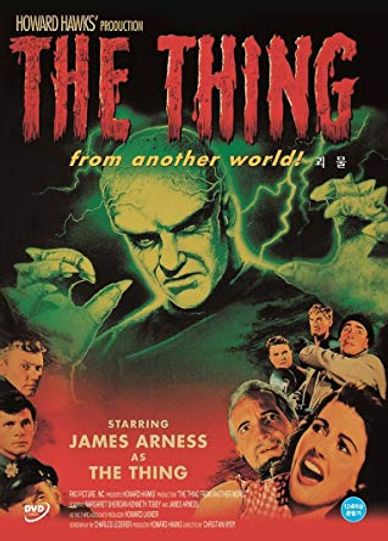
Starring: Kenneth Tobey, Robert Cornthwaite, Douglas Spencer, Margaret Sheridan, James Arness.
In Black & White
Produced by Howard Hawks & Directed by Christian Nyby
Screenplay by Charles Lederer (based on the novel 'Who Goes There' by John W Campbell, Jr)
An American scientific exploration team in the Antarctic discovers a crater in the ice which they first believe to be a meteor strike. However, there is what appears to be an aircraft fin protruding from the ice. They attempt to free it, but only succeed in destroying what they come to believe is a flying saucer.
A figure is found in the ice, so they remove it in a block. It’s brought back to the cold storage room and assigned a guard while they attempt to contact the Airforce authorities for further instructions. The watchman is creeped-out by the figure’s appearance, so he covers it with a blanket, forgetting the fact it is an electric blanket. The ice melts, and the guard is confronted by the unseen figure. He shoots at it, but the bullets have no effect. By the time the others arrive the creature has gone outside. Through blizzard conditions they can just discern the figure fighting with the sled dogs. When the men get outside the creature has moved on, but they find its arm.
Under examination it is determined the alien is made up of vegetable matter. The arm has skin pods, so it is estimated it can grow a new arm. Captain Hendry orders a search of the camp. In the controlled room where fruit and vegetables are grown, Dr Carrington discovers one of the sled dogs drained of blood. Against orders, he conspires to meet and learn from the creature. Carrington also tries to grow pods from the severed arm, using human blood plasma. The men are confronted again by the large humanoid creature, who is after blood. The figure is incredibly strong and impervious to normal firepower. They manage to drive it out and block the door.
Hendry uses an idea from one of the men to attempt to destroy the alien. They set up an electric field under the walkway, but when the Thing appears Carrington sabotages the trap. The scientist tries to talk to the creature, but is batted away by one sweep of its arm and badly injured. The trap is quickly repaired; however, the figure is standing alongside the walkway. A thrown implement causes the alien to jump to one side and onto the electrified walkway. The Thing is electrocuted and all traces of it incinerated – along with the growing seed pods.
The base finally establishes radio contact with the Airforce and the outside world. The journalist, Scotty gets to tell his story to the media, stressing: “Keep Watching the Skies!”
John Carpenter’s The Thing is not only an infinitely better film than this one, but closer in content to the book upon which they are based: the novella ‘Who Goes There?’ By W. John Campbell. However, the truth of the matter is John Carpenter was a huge fan of Howard Hawks, who was more known for directing cowboy films, but also made this one (albeit directed under a pseudonym). The simple fact is, if The Thing From Another World hadn’t existed we would almost certainly not have had The Thing and countless copies – including an episode from The X-Files.
Ironically, making James Arness as the alien simple and humanoid helps make the situation more convincing in the era of pre-CGI and ultra-low budgets. It was a ground-breaking film for this sub-genre, along with The Day the Earth Stood Still, forming the template for 1950s Science Fiction Monster B-Movies. What really helped is the script was based on material from an acclaimed serious science fiction writer, whereas the vast majority were made-up on the spot – hence some pretty zany films followed.
There have been a few releases of this film over the years: DVD, a Collector's DVD, and a Blu-ray - but not a huge about in the way of extras. It is seriously overdue a 4K release incorporating a multitude of special features, as it deserves.
Verdict: 8 out of 10
(original review Ty Power 2019 - Updated 2026)
Fiend Without a Face (1957)
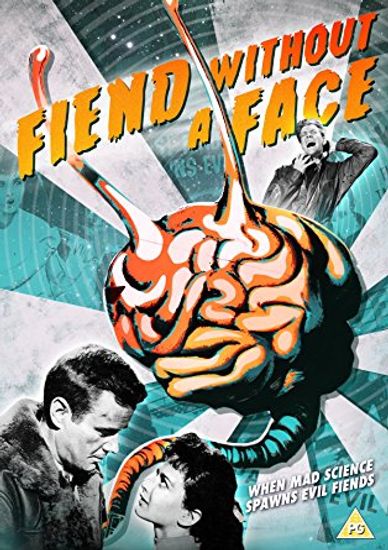
Starring: Marshall Thompson, Terry Kilburn, Kim Parker and Kynaston Reeves.
In Black & White
Directed by Arthur Crabtree
Written by Herbert J. Ledger (Based on 'The Thought Monster' by Amelia Reynolds Long)
The film tagline for this one is: When Mad Science Spawns Evil.
When a body is discovered near the grounds of a US Air Force base in Canada it is easy to blame the atomic powered radar project. But the body turns out to have no brain and spinal cord. More deaths follow, causing folks from the nearby town (who curiously all seem to be young angry blokes) to get out of their tree and protest against the presence of the base.
Major Jeff Cummings has other ideas. He believes that Professor Walgate and his psychic research experiments might have something to do with it. With this hunch his first course of action is to search the graveyard at night (eh?). He gets locked into a mausoleum by a fleeing figure, because this will use up some of the running time. The group of angry young townsmen search the woods for an assailant, but simply manage to lose one of their number. However, he later turns up looking dishevelled and uttering ‘Urrg!’ like a local ordering his tenth pint. This, as opposed to ‘Argghh!’ screamed by the victims of a seemingly invisible attacker.
They finally get around to questioning the professor, who tells them about his work spent trying to separate human thought from the conscious mind so that it can move objects and perform tasks with just a will. The radar atomic testing at the base has given the professor’s equipment a jolt of power (with the help of some less than atmospheric lightning) which not only makes the experiment a success but turns the thought monster into an invisible assassin.
Just as the house comes under attack, and the siege victims wonder just how they can fight invisible creatures (shouldn’t there just be one?), one of the things gets into the atomic plant and turns up the power, rendering itself visible. Obviously, the creature can’t be very intelligent! It now resembles a large brain with a spinal cord and – strangely – two antennae. They move themselves along using the spinal column, and somehow manage to propel themselves through the air when attacking.
The movement is achieved via a stop-motion animation, and looks okay – providing you’re not expecting modern day CGI. This sequence is amusing and a great deal of fun. A brain even uses a hammer to free a boarded-up window.
As the others (including Barbara, the professor’s young secretary and love interest to the Major) are assaulted by flying brains, Jeff is on his way to blow-up the control room of the atomic plant with dynamite in order to remove the power source of the thought monsters. As he lights the fuse and leaves, it’s a nice touch to have a gunshot-wounded brain trying to reach the fuse to extinguish it, before collapsing dead. The explosion renders the brains inactive, and they all immediately decompose.
Of course, there was a much easier way to remove their power: Make the professor watch this film and his IQ would have instantly reduced by half!
Verdict: 6 out of 10
(original review Ty Power 2017)
Savage (2009) 2011 DVD Release
One Million Years B.C. (1966) 2016 Blu-ray Release
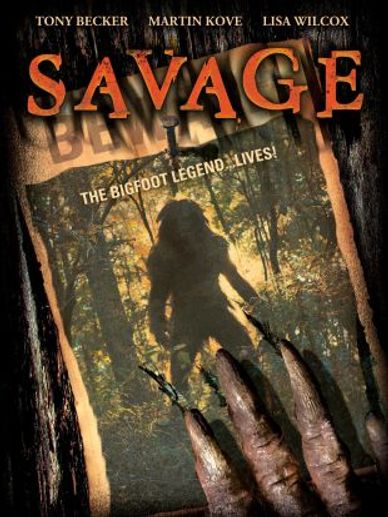
Starring: Martin Kove, Tony Becker, Lisa Wilcox and Shane Callahan.
Directed by Jordan Blum
MTI Home Entertainment
September 2011
A fire is raging through a section of Bear Valley National Park, but the mayor and the new sheriff are reluctant to close the park because, providing the wind doesn’t drastically change direction, the tourists will be safe. Besides, many of the holidaymakers are leaving of their own accord and demanding their money back. However, the blaze is driving the wildlife out of its natural habitat, making it easy for illicit poachers. A dominating man brings his wife to the area hoping to make money by shooting something; he has no idea that he will soon become the prey. A young scientist has paid a local hunter to accompany him in tracking down and studying the legend that is Bigfoot, after years of attempting to prove its existence. When some bodies are discovered, the indication is a bear attack. The only one who knows for a fact what they are facing is the hunter, because he has seen it before...
The opening scene contains some of the worst acting I have ever seen. In the foreground of the shot the fire chief is exclaiming, “Oh!” and “Ah!”, bending over and mopping his brow unconvincingly with a soot-stained handkerchief. In the background, a line of fire fighters are using axes to dig a trench. They appear choreographed, all moving in unison like a dance, and hitting the same point at their feet with little force or effort. This doesn’t bode well for the film but, thankfully, it does improve.
The characters are somewhat stereotypical: we have the town newcomer, who is the sheriff; there is the rugged, no-nonsense hunter; the naive but determined young scientist; and the weak female who learns to fend for herself.
I must say that all sightings of the beast are mere glimpses, with only one full-on face shot which I’m pleased to say doesn’t disappoint. The director even has enough sense not to linger on its features. I particularly enjoyed the chase sequence where you see the creature running sporadically on two legs and four. The interaction between the players is predictable but nevertheless engaging, although it’s inevitable in this film, as with many other creature features, that practically the entire cast is cannon fodder, so to speak. The attacks are well-handled for the most part, edited in cutaways so that your mind fills in the gaps as per your requirements.
I couldn’t help feeling I was watching Jurassic Park, without the children and with the dinosaurs replaced by a Bigfoot. So, aside from the points I’ve mentioned, Savage proves an enjoyable 87 minutes of nonsense.
Verdict: 6 out of 10
(Review originally written by Ty Power for sci-fi-online 2011)
One Million Years B.C. (1966) 2016 Blu-ray Release
One Million Years B.C. (1966) 2016 Blu-ray Release
One Million Years B.C. (1966) 2016 Blu-ray Release
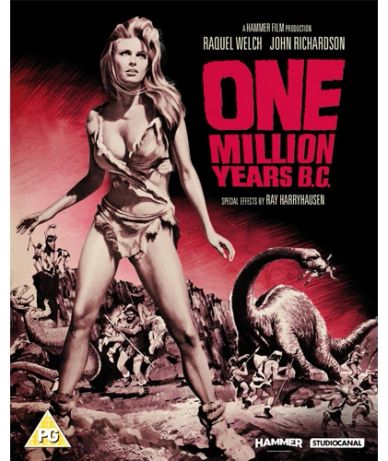
Starring: Raquel Welch, John Richardson and Martine Beswick.
Directed by Don Chaffey
StudioCanal
October 2016
After a confrontation with the tribe’s leader, a man is made outcast from the Stone People. His life is later saved by a beautiful blonde woman from the Shell People. They make an instant connection, but their ways are different. The Shell People are more civilised, and when they cross paths with the Stone People a battle ensues. However, with strange predatory creatures all around them in an ever-changing dangerous environment, they have a greater, common enemy...
It’s a number of years since I last saw One Million Years B.C. It’s one of those films where the public conception lives on in your memory, rather than the actual plot, characters and movie itself. So, this is the one in which Raquel Welch runs around for an hour and a half in a furry bikini! It’s a misconception, because there is no great parading of her sexuality – any more than you would find in other examples from this era. The movie poster is actually a publicity photograph of her, and this is what has ended up in everyone’s subconscious mind: Bikini woman runs screaming from plastic dinosaurs!
In more than a few aspects this does the film a great disservice. Okay, so the plot isn’t brilliant; but what do you expect from prehistoric man: soliloquys from Shakespeare? A set-in-their-ways tribe meets a more mentally and socially advanced tribe. They clash, before coming together towards a greater goal. You could argue that this is a ‘rites of passage’ for mankind, and certainly for the more backward tribe. However, essentially it’s a bit of fun, as most people will be aware that man and prehistoric dinosaurs did not co-exist. I say ‘prehistoric’ because otherwise some overly pedantic wise-guy is going to argue that some dinosaurs exist today (turtles, rhinos, etc.)!
The costumes are actually very well made. Faux animal skins which look like they have been knife-scraped of fur. Though it’s more logical to assume they would have wrapped themselves entirely in animal skins for warmth, and shrugged them off to hunt naked. But that would be a totally different film! The sound effects are a little monotonous at times, like a pensioner clicking his false teeth, or an old fashioned typewriter clacking away incessantly. There is one particular sound reminiscent of a locomotive… The music score is iconic in contrast, and I wouldn’t be surprised if John Williams said it had influenced his incidental music on Star Wars.
The most outstanding aspect of this film is Ray Harryhausen’s brilliant stop motion effects. During the course of the movie we are entertained by a giant lizard, turtle and spider. We also get a Brontosaurus (yes, yes, I know they now say it never existed) and a Triceratops fighting, a Ceratosaurus, an Allosaurus and a flying Pteranodon. Phew! It is these sequences in particular which have made One Million Years B.C. so famous. Let’s face it, Ray Harryhausen was a special effects genius in the days before CGI, with a career spanning from the original Mighty Joe Young right up to Clash of the Titans in the 1980s. This movie was Hammer Films’ biggest commercial success, which was a fine way to celebrate their 100th production.
This 50th anniversary release features a 4K restoration, along with interviews with Raquel Welch, bond girl Martine Beswick, storyboards and artwork from Harryhausen’s extensive collection, plus for the first time storyboards depicting an unfilmed Brontosaurus sequence.
Verdict: 7 out of 10
(Review originally written by Ty Power for sci-fi-online 2016)
The Reptile (1966) 2012 Blu-ray Release
One Million Years B.C. (1966) 2016 Blu-ray Release
One Million Years B.C. (1966) 2016 Blu-ray Release
Starring: Noel Willman, Jennifer Daniel, Ray Barrett, Jacqueline Pearce and Michael Ripper.
Directed by John Gilling
StudioCanal
June 2012
After the mysterious death of his brother, Harry Spalding and his wife Valerie inherit a cottage in a small Cornish village called Clagmoor Heath. Despite a couple of veiled warnings they decide to make it their new home. However, people are dying from what locals are calling the Black Death, but on closer inspection appear to be large reptile bite marks. The couple soon encounter Anna, a beautiful and exotic young woman who lives with her unpleasant father, Doctor Franklyn, in a large manor house not far away. But Franklyn has a valid reason to be over-protective towards his daughter, for she endures a powerful and evil curse, and both are in the thrall of the only man who can help but is the least likely to...
As a money saving experiment Hammer Films made four movies back to back in 1965 at Bray Studios and on location in Cornwall. As it turned out only one came in under budget. However, what it means is that these Seven Arts productions were paired-up and as a consequence shared some of the same actors, sets and locations - particularly on The Plague of Zombies and The Reptile.
It’s always great to see Hammer main-stay Michael Ripper, who actually appeared in more titles than either Christopher Lee or Peter Cushing. Jacqueline Pearce also acted in both films; in this one she balances the personality of a woman who just wants to have a normal life, with an alluring but inaccessible quality which is rather beguiling. Her reptilian make-up for the snake sequences are well-handled with quick cuts and good (subdued) lighting. There is only one scene wherein the camera lingers and the suspension of disbelief times-out.
Whilst not reaching the heights in terms of quality and script of The Plague of Zombies, The Reptile remains an interesting chapter in the Hammer historic library. There is much to enjoy, and for film buffs many talking points, such the sexual intensity of the Sitar playing scene, and the origins of the Snake Cult.
Again, the restoration work for this Blu-ray release is exemplary. Other extras include another episode of World of Hammer (this time about Wicked Women), a trailer, and the excellent making of... featurette The Serpent’s Tale, which includes Jacqueline Pearce, film historian Marcus Hearn and the suitably enthusiastic horror fan, actor, writer and presenter Mark Gatiss.
Verdict: 7 out of 10
(Review originally written by Ty Power for sci-fi-online 2012)
Forbidden Planet (1958)
The Man Who Could Cheat Death (1959) 2015 Blu-ray Release
The Man Who Could Cheat Death (1959) 2015 Blu-ray Release
Starring: Walter Pidgeon, Anne Francis, Leslie Nielsen, Warren Stevens.
In Colour
Produced by Nicholas Nayfack
Directed by Fred McLeod Wilcox
Screenplay by Cyril Hume (Story by Irving Block, Allen Adler & William Shakespeare)
United Planets Cruiser C-57D is visiting the planet Altair IV to search for survivors from a previous mission. As they enter the atmosphere the crew register that they are being scanned. A human voice comes through. It is Morbius of the prior mission but, even though he requires no assistance, they land anyway. A low dust cloud arrives; it is a vehicle of sorts, driven by a robot with a domed head, referred to as Robby. Crewmembers Commander Adams, Lieutenant Farman and Doctor Ostrow are driven to a lush, colourful dome where they are met by Morbius. He demonstrates Robby's abilities and obedience, as well as the fact he cannot harm a human, because it conflicts with his programming causing damage to his circuits. Also, steel shutters click into place around the abode to prove security.
The crew wish to talk to the other survivors, but there are none. They all succumbed to a dark planetary force. Only he and his wife survived because they wanted to remain on the planet when the others wished to leave. His wife died subsequently. Morbius's daughter Altaira enters. She is beautiful and has not been schooled in the ways of Earth. She also has a strange calming influence over some wild beasts, such as deer and a tiger.
That night something invisible enters the ship and sabotages some of the equipment. Commander Adams discovers that Morbius's daughter - although educated in many subjects - is incredibly naiive about sex appeal, love and attraction. While they are kissing a tiger appears. It is her friend but it leaps to attack them. Adams is forced to evaporate it with his gun.
They wait for Morbius to emerge from his study; he assures them the sabotage was not him but the remnants of a mighty but benevolent race called the Krell. He takes them through a series of tunnels and into a huge laboratory wherein they are demonstrated some of the technology. Robby is a product of the tech. A shuttle car takes them to even greater science and technology. There are 7800 levels harnessing power and energy which incorporates one machine. There are 9200 thermonuclear reactors.
Back at the ship, an electrical perimeter is set up to prevent another sabotage attempt. When an electrical charge is tripped the men believe it to be a malfunction, but something large and invisible has broken through and, again, entered the ship. A man has been violently murdered. Morbius refuses to release the technology, and goes as far as to say there will be another devastating attack. Something moves towards the ship, but this time the men have weapons set up. When the perimeter is triggered the weapons are concentrated and the electrical charges show the outlines of a huge invisible creature. It kills a few men before moving back and disappearing.
Adams and the Doc attempt to persuade Morbius and his daughter to leave the planet with them. The Doc uses a Krell machine to boost his I.Q. but he dies after muttering that the Krell didn't account for monsters from the Id. It's something Morbius had not considered; that the Krell subconscious had inadvertently created a monster with their minds. Minds with free reign and constant activity had to create a 'darkside'. It was the power that destroyed them. But the race died out countless centuries ago.
As the creature approaches Morbius's home, Adams stresses a truth the scientist could never realise: that the Id monster is Morbius. The crazed scientist orders Robby the Robot to kill it. This causes a serious programming conflict, as Robbie knows the creature is Morbius's other self. The creature breaks through the metal plating, and the three flee into the tunnels, shutting themselves into the Krell laboratory. Adams know that when Morbius had managed to raise his I.Q. with the alien machine it had also greatly enlarged his Id. The endless Krell power is fuelling his Id to the point it burns through a 26" titanium door. Morbius pleads to be killed, but Adams can't do it. He instructs the commander to trip a destruction switch, before dying.
Adams and Altaira have 24 hours to return to the ship and be far out into space before the explosion. Robby the Robot joins the remaining crew as the new navigator.
Forbidden Planet is not only one of the best 1950s monster movies, and not only one of the greatest science fiction films of all time, but a very powerful film in its own right. It stars a thoroughly convincing Walter Pidgeon as Morbius, and a pre-Airplane Leslie Nielsen as Commander Adams. It's also notable as being the first movie robot with a personality; a character that is almost on a level with the rest of the cast. The robot prop/costume (voiced by Marvin Miller) cost $125,000 - a huge chunk of the $1.9m budget. But its appearance and voice is iconic; so much so that it also appeared in the film The Invisible Boy, and countless TV serials, including The Twilight Zone and Columbo.
The film has close connections to William Shakespeare's The Tempest, upon which it is said to be based - although Shakespeare is uncredited on the movie. It also inspired the Tom Baker era Doctor Who story Planet of Evil, with an anti-matter creature resembling that of the invisible creature from the Id, and similar situations. This is a SF classic which comes highly recommended. My copy comes with extras, including: Deleted Scenes; Lost Footage; Thin Man - Robot Client TV Episode; and Theatrical Trailers.
There is also a long-overdue 4K release scheduled for later in 2026.
Verdict: 10 out of 10
(original review Ty Power 2020)
The Man Who Could Cheat Death (1959) 2015 Blu-ray Release
The Man Who Could Cheat Death (1959) 2015 Blu-ray Release
The Man Who Could Cheat Death (1959) 2015 Blu-ray Release
Starring: Anton Diffring, Hazel Court and Christopher Lee.
In Colour
Directed by Terence Fisher
Screenplay by Jimmy Sangster
Produced by Michael Carreras
Georges Bonnet is a doctor and skilled sculptor in Paris. His masterpieces are busts (yes, in both senses of the word) of young women which he refuses to sell. In fact, his basement contains many of them. The truth is Georges harbours a dark secret. He sends for a professor colleague to perform an operation to replace a gland. In doing so, it will further prevent his ageing (he is currently 104, though his body remains that of a 30 year old). Unfortunately, the professor is too old and frail to carry out the procedure, and so he is obliged to ask another surgeon (Christopher Lee), the suitor of Janine Dubois – the subject of his latest sculpture. When the surgeon refuses, Georges resorts to kidnapping and blackmail...
This is an unsung classic from Hammer Productions, which dates back to 1959. Rather than Lee, it is Anton Diffring who plays the protagonist in a role not too dissimilar to the one he played in Circus of Horrors. However, this is an infinitely superior film. Diffring is an unusual choice to play a suave Dorian Gray-like abomination of nature. However, this is not a horror in today’s widely accepted sense; it’s closer to a suspense thriller. In fact, apart from the necessity to kill to survive every ten years, Georges comes across as quite a sympathetic character. He even has the foresight and compassion to withhold his findings from publication because he fully realises how this will reflect on population growth and food shortage. Everyone around him takes the moral high ground, but the question investigated by this simple but effective script is, given Georges’ position, would you have the strength to forego treatment and die if you were given the chance of another ten years of healthy life?
The Man Who Cheated Death borrows from Jack the Ripper (for the opening scene), the aforementioned The Picture of Dorian Gray (in some ways the sculptures take the place of Oscar Wilde’s picture, as they represent the killed women who have kept him alive), and The Strange Case of Dr Jekyll and Mr Hyde (for the sequences involving the serum which, after the ten years has expired, prevents his reversion to old age over six hour intervals). The scene in which he begins to revert consists of slightly bulging eyes and a sickly pallor like he has the onset of jaundice. So, not much visual horror on display. However, this being a Hammer film, there just has to be a dramatic climax to see-in the closing credits. In this instance, we have Georges’ rapid ageing-to-death amidst a raging fire.
This could so easily have been mediocre material, but for the tight script by Jimmy Sangster and the clever direction from Terence Fisher – a great team and both mainstays of Hammer. Even Christopher Lee gets a rare opportunity to play against type, in what seems like a dry run for his part in The Devil Rides Out.
Extras include an entertaining Interview with critic and author Kim Newman, and an Interview with film scholar Jonathan Rigby. There is also a Limited Edition Collector’s Booklet.
Verdict: 8 out of 10
(Review originally written by Ty Power for sci-fi-online 2015)
It! The Terror From Beyond Space (1958)
The Man Who Could Cheat Death (1959) 2015 Blu-ray Release
The Man With the X-Ray Eyes (1963) 2020 Limited Ed. Blu-ray Release
Starring: Marshall Thompsom, Kim Spalding, Shawn Smith, Paul Langton, Ann Doran, Ray Corrigan.
In Black & White
Directed by Edward L Cahn
Screenplay by Jerome Bixby
Contact is lost with a rocketship expedition to Mars, and a second ship is sent to discover what became of the first. There is a single survivor, Col. Ed Carruthers. He is taken aboard the new ship where he tells them a wild story about a not quite clearly seen bipedal creature that wipes-out his crewmen. This is relayed to Earth on the journey home and instructions are received to watch Carruthers at all times. He will go on trial for the murder of his crew. None of the new crew believe his story, but Ann Anderson takes a liking to him and ‘doesn’t disbelieve’. Colonel Van Heusen, who commands this rescue ship, has no time for the fairy stories of Carruthers. He intends to get the truth out of the man and deliver him to the authorities in a neat little package.
However, his plans go awry when it comes to his attention that the airlock had been left open prior to lift-off. A creature (probably the same one that killed the crew of the first ship) has clambered aboard. Initially, it manages to secrete itself away while the backstory gets up-to-speed (which seems impossible on a small ship, and retrospectively considering the amount of roaring it does and stuff it knocks over), but then a man goes missing and another is attacked, triggering a little bit of pandemonium.
Once the perpetrator is fully revealed to the crew, the stigma with which Carruthers has been labelled is fully and instantly forgotten. In reality, there would be lingering resentment. Anyway, the race is on to find a way to kill the alien monster. Aside from its powerful claws, strength and intelligence, it is by nature a vampire of sorts, absorbing blood, water and other fluids from its victims. Bullets won’t stop it. Nor, it seems, will multiple hand grenades (not a good idea to set off explosives within a pressurised hull).
Having escaped through two levels, the creature is now attempting to bash its way through a heavy hatch to get to them. They try to gas it but that has little or no effect, so Carruthers comes up with a plan whereby he and Lt. James Calder suit-up and walk down the outside of the ship’s hull to re-enter one level below the creature. They attempt to electrocute it by wiring-up the metal steps, but Calder is injured and only keeps the alien at bay by the use of a welding torch. Carruthers tries to save the man but is obliged to make his escape to the others. But blood is needed to treat the wounded. So the creature gets shut in with the open reactor and the others use the time to grab the blood. The alien breaks through the reactor room door and kills another crewmember.
Now holed-up in the top section of the ship their last resort is to don their spacesuits and eject the oxygen from the ship. This succeeds in asphyxiating the creature, and suddenly the film is over. No epilogue here.
Aside from the flat feet and large clawed hands, the IT creature costume is pretty impressive. There is a commonly-held belief that this film was the inspiration for the Ridley Scott film Alien. As writer Dan O’Bannon is no longer with us there is no confirmation he even saw this film. However, you can’t deny the similarities in setting and premise. A pretty solid example of the 1950s SF B-Movie trend.
Verdict: 7 out of 10
(original review Ty Power 2020)
The Man With the X-Ray Eyes (1963) 2020 Limited Ed. Blu-ray Release
The Man With the X-Ray Eyes (1963) 2020 Limited Ed. Blu-ray Release
The Man With the X-Ray Eyes (1963) 2020 Limited Ed. Blu-ray Release
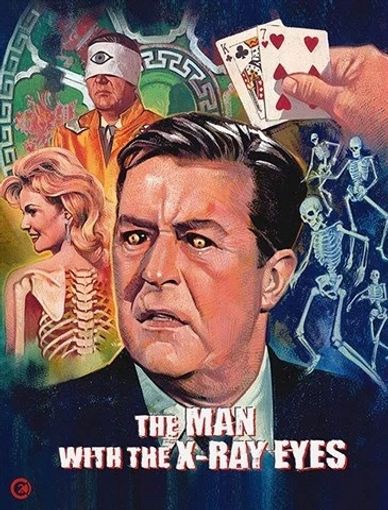
Starring: Ray Milland, Diana Van der Vlis, Harold J. Stone, John Hoyt, Don Rickles.
Directed by Roger Corman
Secon Sight Films
April 2020
James Xavier (Ray Milland) is a scientist working on opening the human mind to the complete light spectrum, of which only 20 percent can be perceived. He develops an enzyme and, when the medical institute threatens to remove his funding, he puts the drops in his own eyes. After initial discomfort, he begins to see through things, and even saves a girl’s life after she is wrongly diagnosed. More drops have a cumulative effect, but he suffers regular debilitating headaches and sensitivity to light. He is accused of murder after an accident results in his friend Dr Brandt falling through the flimsiest window I’ve ever seen. On the run, he uses his inconsistent talent as a sideshow act, and then as an illicit diagnosis doctor under an unscrupulous agent. When his friend and prospective partner, Diane Fairfax from the hospital, tracks him down they leave, only for the angry agent to set the police on their trail. On the run, they head for Las Vegas; however, events are about to come to a head for James, as he asks himself if man can cope with seeing the ultimate truth...
Director Roger Corman had a good career during the 1950s, 1960s and beyond with a mixed bag of B-movies and low budget projects. Who remembers Attack of the Crab Monsters, Not of this Earth, The Little Shop of Horrors, and countless others? By the time he was working in colour his reputation improved tenfold, with Edgar Allan Poe adaptations such as House of Usher, The Pit and the Pendulum, Tales of Terror, and The Masque of the Red Death – all solid pieces of work.
The Man With X-Ray Eyes is from 1963. In fact, only the trailers and promotion show the full title; the film print itself just shows “X”. Although this was another low budget film, everything was in place: a well-known name in the central role, a very Poe-like story, and a backdrop of psychedelic images before psychedelia was actually a thing.
Ray Milland plays Xavier with an upright and constantly serious bearing, showing that he has intensity and is driven to the point of obsession. This comes across as convincing, but why Diane even gives him the time of day is beyond me. He doesn’t seem to have friends so much as colleagues. That doesn’t mean we aren’t treated to a humorous scene.
In an attempt to have him relax and destress, Diane invites him to a party at someone’s house. The guests are all dancing the Twist, and he is invited to dance by a beautiful young woman. As he struggles unsuccessfully to fit in, his x-ray vision kicks-in and he sees everyone’s bare legs. The camera then moves upwards to the point we see that everyone is naked to his eyes. As Corman and his contemporaries were not allowed to screen nudity at the time, each partygoer is conveniently turned away when we see them.
The most expensive aspect of the movie was the special effects. Although it was fine at the time with what was achievable, it amounted to images fanned-out into four separate colours. The music not quite aiding its otherworldliness. Of course, to journey with him we have to see what Xavier is seeing, but these scenes are prolonged to the point of being a little tiresome. Perhaps something different could have been attempted as Xavier’s vision saw deeper and wider into the spectrum. Today’s CGI would be able to do justice to what’s required, so I would suggest, rather than remake what is already a solid film, that ‘branching’ special effects could have been offered on this release – where you can choose the original or new effects with the film.
Extras include an enjoyable Roger Corman Interview, an Introduction by author and Diabolique Editor Kat Ellinger, An Audio Commentary by Roger Corman, an Audio Commentary by Tim Lucas, the Original Prologue, ‘Trailers From Hell’ with Mick Garris (best known for several Stephen King adaptations), and a Trailer. Joe Dante talking about The Man With X-Ray Eyes is far too short – and I spent most of the time staring at the excellent Piranha artwork on the wall behind him. The Limited Edition set also includes a Slipcase featuring new artwork by Graham Humphreys, a Reversible Poster with original and new artwork, and a Soft Cover Book with new features by Jon Towlson and Allan Bryce.
Verdict: 7 out of 10
(Review originally written by Ty Power for sci-fi-online 2020)
The Swarm (1978) 2003 DVD Release
The Man With the X-Ray Eyes (1963) 2020 Limited Ed. Blu-ray Release
Q The Winged Serpent (1982) 2005 DVD Release
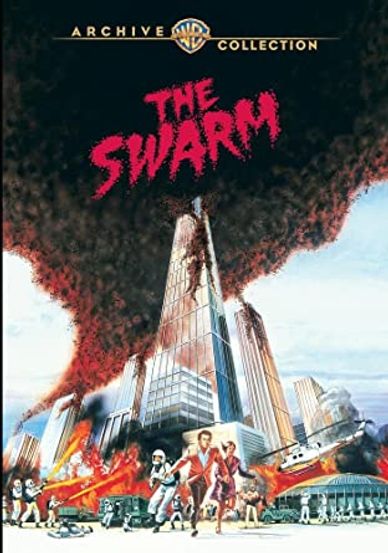
Starring: Michael Caine, Olivia De Havilland & Richard Chamberlain.
Directed by Irwin Allen
Warner Home Video
February 2003
When a military establishment is attacked by a huge swarm of African killer bees, scientist Crane leads the fight to combat the threat before it reaches Houston. However, that's easier said than done when the bees act with an intelligent hive mind, and thwart each attempt to stop them. Meanwhile the swarm is growing in size...
With more big names than you can shake a script at, you would expect a good film with strong performances. Wouldn't you? The first third is instantly forgettable; the plot crawls along on its hands and knees, pleading for some life to be pumped into it, and the dialogue is stilted as if nobody quite knows what to do with themselves.
Just when you begin to despair, the pace picks up. Richard Widmark stomps up and down trying to look important, and Michael Caine, sounding exactly as he does in every other film, finally gains a purpose. You just long for him to say, "You're only supposed to blow up the bloody bees!"
The slow motion swimming impressions seen when the bees attack the first small town is hilarious. Richard Chamberlain goes one step further with his Saturday Night Fever disco dance when the bees find their way into a nuclear power station. Although comical, it's also sad; Chamberlain is a marvellous actor woefully under-utilised here.
This is the second movie in succession I have reviewed where flame-throwers have come into play. In this one, it is decided by officialdom to set Houston ablaze after it has been evacuated and the bees have arrived. Budgetary restraints means this consists of a dozen men torching a single car and waving the flame-throwers aimlessly in the air. When the bees infiltrate the Houston building in which our heroes lie, the flame-throwers are again brought into action, this time inside, causing pandemonium as people are accidentally set ablaze and, in their panic, bump into others, so spreading the conflagration. I didn't know whether to laugh at this scene or be horrified.
There's a nice little scene between Caine and Fonda about beer and pizza, but most of the film's dialogue is cringe-worthy and inspires laughter for the wrong reasons. "Can we really count on a scientist who prays?" a character enquires of Widmark. "I wouldn't count on one who doesn't," is the reply. Apparently the movie had a dialogue coach; I'll bet it was a 32-seater.
I seem to be giving the impression The Swarm is unworthy of consideration, when that's really not the case. It's just that with director Irwin Allen's pedigree of The Poseidon Adventure and The Towering Inferno, you can't help wondering how much better it might have been.
The piece de resistance comes when the final credits roll. A disclaimer in case the honey bee wants to take the film makers to court for defamation of character: "The African killer bee portrayed in this film bears absolutely no relationship to the industrious, hardworking American honey bee to which we are indebted for pollinating vital crops that feed our nation." How about that for political correctness before its time!
Verdict: 5 out of 10
(Review originally written by Ty Power for sci-fi-online 2003)
Q The Winged Serpent (1982) 2005 DVD Release
The Man With the X-Ray Eyes (1963) 2020 Limited Ed. Blu-ray Release
Q The Winged Serpent (1982) 2005 DVD Release
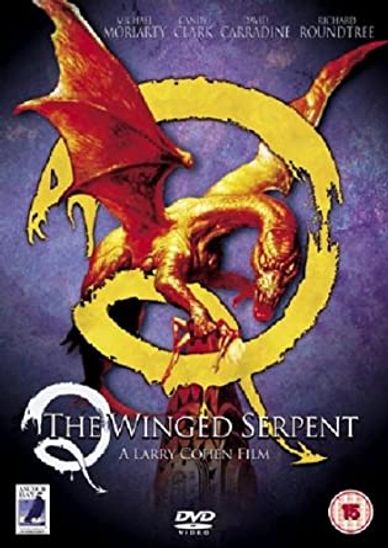
Starring: Michael Moriarty, David Carradine and Richard Roundtree.
Directed by Larry Cohen
Anchor Bay Entertainment UK
June 2005
Jimmy Quinn (Michael Moriarty) is a small-time crook who gets mixed-up with two unsavoury characters. They threaten him into taking part in an armed robbery. Whilst the others are caught Jimmy escapes with the cash, only to lose it under a truck after an accident. Guessing that the gang will give his name to the police, he flees and finally takes refuge in the uppermost roof pinnacle of the Chrysler Building (like you do!). Here he finds a dead body, but instead of screaming and getting the hell out (as his cowardly portrayal would surely do) he climbs the ladder into the cone itself. Inside, he discovers a nest with what looks like a large egg. Meanwhile, Detective Shepard (David Carradine) is investigating a series of mutilated bodies. When too many witnesses to ignore report having seen a giant bird, Jimmy soon realises he has bargaining power with the police. His long-suffering girlfriend and Shepard try to persuade him to do the right thing, but Jimmy has to learn the hard way that not everything is about him...
Q The Winged Serpent is a monster movie from the '80s which is still fondly remembered by some people. It comes from writer, producer and director Larry Cohen, who was also responsible (yes, that is the right word) for the It's Alive Trilogy. Just like those films this seems to be based in some strange unreality. Yes, it's about a giant man-eating bird that might be an Aztec god, but any supernatural subject should be set in a solid natural environment to work properly, and sadly this falls short in that respect.
I suppose the makers should be commended for attempting a giant bird on the big screen, but when seen in full the creation just makes me cringe and pretend I hadn't noticed. Much more effective are the aerial shots, the shadows on passing skyscrapers and the super-fast glimpses as the bird attacks. Clash of the Titans, released around this time, was much more successful with its fantasy creations. Possibly it was due to the increased number of Ray Harryhausen stop-motion and special effects dropped into a Greece of myths and legends.
Typecasting is alive and well, too. Even now, I can't watch David Carradine without thinking of his Grasshopper character from the excellent seventies series Kung Fu. The Kill Bill films have made that situation worse rather than better, because in them he uses a multitude of martial arts! Do what you do well, that's what I say.
The extras on the DVD at first glance seem better than they are. A commentary is only joined by two trailers, biographies & film notes, a gallery and Q Memorabilia via DVD ROM content.
In short, Q The Winged Serpent isn't quite good enough that I would recommend you get out of bed to buy it, and it isn't quite bad enough that you can enjoy it as a B-Movie. It floats somewhere in between. A sort of flying turkey.
Verdict: 4 out of 10
(Review originally written by Ty Power for sci-fi-online 2005)
Mothra (1961) 2020 Blu-Ray Special Edition
Prophecy (1979) 2021 Blu-ray Special Edition
Prophecy (1979) 2021 Blu-ray Special Edition
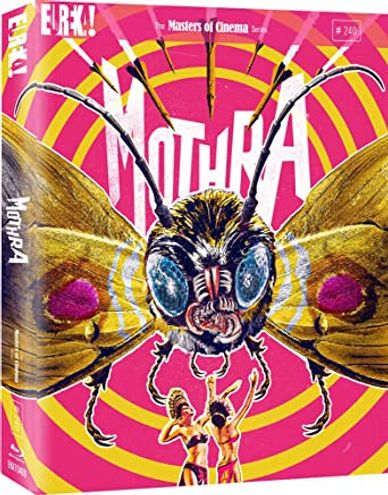
Starring: Frankie Sakai, Hiroshi Koizumi, Kyōko Kagawa and The Peanuts.
Directed by Ishiro Honda
Eureka Entertainment
November 2020
A major storm in Japanese waters causes a ship to run aground as they send a Mayday. Rescue teams search for bodies, but discover four survivors on an island which had been a testing site for atomic bombs and is considered a dangerous radioactive hazard. The survivors are tested and found to be completely healthy, apparently tended by unknown natives. A private expedition is arranged to return to the island. Here, they find two minute fairy-like women, but are warned away by the natives. The expedition returns with the agreement to mention nothing of the ‘Tiny Beauties’; however, the unscrupulous Mr Nelson captures them and returns to Tokyo to announce his money-making show. A reporter who had helped to keep the story quiet sneaks into the show to attempt to help the islanders. The ‘Tiny Beauties’ sing and dance in the show, but they are strong telepaths and in reality sending a distress signal asking Mothra for help. On the island, the natives perform their own ritual dance in front of a gigantic egg, which begins to hatch. Mothra emerges and is soon making its way across the sea towards Tokyo, and allowing nothing to stand in its way or block progress – including a ship and a fleet of bombers. It causes destruction in the city, before being cornered at Tokyo Tower. Here, it cocoons itself and is thought dead by the populace after Atomic Heat Canons are used. However, the now more powerful winged Mothra emerges. Can the journalist save the ‘Tiny Beauties’ known as Shobijin, catch the perpetrator and save Tokyo before the city is totally destroyed...?
I am a big fan of 1950s and 1960s Monster B-Movies. This Japanese Creature Feature emerged in 1961 to acclaim which has steadily grown over the years to cult status and inevitable sequels. You would expect it to be good considering it was directed by Ishiro Honda who made The Mysterians and the original Godzilla – and in fact, it’s better than good, it’s a classic of the genre.
Honda’s movies are well known for his model work, but if anything he excels himself in the dramatic destruction elements. The disturbance caused by Mothra’s beating wings not only causes cars and even tanks to be blasted down the streets like the toys they are, but actually causes vibrations which break-up the buildings and then cause them to fall onto everything else. The set pieces are quite stunning for their time: the scenes at sea, the breaking-up of the dam, the streets of Tokyo, and the destruction at Rolisica (effectively a fictitious stand-in for America and Russia) are all very impressive. Only the tanks are a little bit jerky in their movements.
However, this film is not simply about scenes of disaster. It has a certain psychedelia about it, which is highlighted by the fact it’s in colour. On the island, in particular, there are vivid colours and a nice choreography of distance shots showing the dancing tribal coordination of the natives. There is a nice structure to the movie, which incorporates many more aspects than a simple monster fest. I have to say that the Mothra song sticks in your head for some time after the experience. The song brings the beast, but it is a protector rather than a destructor. So Mothra has a theme which makes you root for it even more. The ritual singing and dancing makes at least a part of this movie a musical – strange as that seems.
I have seen this film several times over the years, the last time being as part of the excellent Killer B’ Movie collection. Each successive viewing seems to improve my opinion of it. This Eureka Entertainment release as part of their Masters of Cinema collection is Mothra’s first outing on Blu-ray. There is a Limited Edition set of only 4000 copies in a Hardbound Case, with a 60-Page Perfect Bound Collector’s Book, and Reversible Poster showing the Japanese or US artwork.
You have the choice of viewing the Japanese Version with English Subtitles (yes) or the shorter English Dubbed Version (no). There is an Audio Commentary with Film Historian and Writer David Kalat; an Audio Commentary with Authors and Japanese Sci-Fi Historians Steve Ryfle and Ed Godziszewski; the entertaining Kim Newman on Mothra – an Interview with the Film Critic and Author; and Stills Galleries. A thoroughly entertaining film. Buy it.
Verdict: 10 out of 10
(Review originally written by Ty Power for sci-fi-online 2020)
Prophecy (1979) 2021 Blu-ray Special Edition
Prophecy (1979) 2021 Blu-ray Special Edition
Prophecy (1979) 2021 Blu-ray Special Edition
Starring: Robert Foxworth, Talia Shire, Armand Assante.
Directed by John Frankenheimer
Eureka Entertainment
August 2021
Maggie Verne is a woman attempting to find the right time to inform her husband that she is pregnant. Robert is a busy doctor trying to make a difference in the run-down tenements of a poor district when, due to his people skills, he is invited (with his wife) to mediate in a dispute between the timber trade and the local American Indians. There has already been a number of incidents – including back-packers being killed – for which the Indians are being blamed. When the incidents become increasingly more gristly they soon discover there is a creature in the woods… An unwitting creation of man with no intent except destruction...
As part of their classics range, Eureka Entertainment presents Prophecy on high definition Blu-ray for the first time in the UK. The first print run of 2000 copies incorporates a limited edition O-card slipcase featuring new artwork by Darren Wheeling, and a collector’s booklet featuring new writing by Craig Ian Mann and an archival interview. Standard extras include a new feature length commentary by Richard Harland Smith; a new feature length commentary by film writers Lee Gambin and Emma Westwood; a new interview with screenwriter David Seltzer; a new interview with mime artist Tom McLoughlin; and the theatrical trailer. Film stills can be downloaded.
Prophecy (1979) is directed by the award winning John Frankenheimer (best known for The Manchurian Candidate, and Ronin), and stars Robert Foxworth of Falcon Crest, and the Oscar-Nominated Talia Shire of The Godfather and Rocky (all together now: “Adrian!”). The acting is on the whole pretty good, but the pregnancy story is rather dragged-out before being revealed. Mercury in the water is responsible for attacking the foetuses of animals and deforming them at different stages of their growth. There was a similar real event in Japan and the scriptwriter used this premise for his environmental monster movie.
You may be wondering why there is an interview with a mime artist on the special features. Mom McLoughlin – who at one stage was miming on the streets for cash before finding his way into film via Woody Allen’s Sleeper - plays the Indian legend Katahdin, the ultimate mutated animal. The interview is informative, and includes the information that the original sketches for the creature were rejected in favour of a horribly mutated bipedal bear. In this instance, the creature is supposed to be made up of every other creature in nature, but there is little evidence of this apart from the scene wherein it utilises its gills to walk under the water to the other side.
There are some nice action scenes, with horror and blood enough to satisfy most enthusiasts. I will just say that the reveal at the end is unnecessary, and that Maggie’s storyline is not played-out. At the end of the film she is still pregnant and we the audience have no idea if she will have to have an abortion or will give birth to a twisted, mutated killer. Even taking into account that missed opportunity this is a pretty good retro creature feature.
Verdict: 7 out of 10
(Review originally written by Ty Power for sci-fi-online 2021)
Swamp Thing (1982) 2003 DVD Release
Prophecy (1979) 2021 Blu-ray Special Edition
Invasion of the Body Snatchers (1955 )
Starring: Louis Jourdan, Ray Wise, Adrienne Barbeau and Don Knight.
Directed by Wes Craven
MGM
June 2003
A scientist working on plant growth deep in swamp land, makes a startling discovery. A power-mad businessman gatecrashes the celebrations, steals the formula and kills everyone involved in the project. The scientist is dumped in the swamp, but explosive reactions with the newly discovered chemical causes a metamorphosis into a creature, part plant, part human...
Although I'm certain the cast realised Swamp Thing was supposed to be tongue-in-cheek, this is not so evident as it is in the sequel. The impression is given that the attempt here was to emulate a 1950s B-movie for a more modern age. The story is adapted from an old D.C. Comics series, but more closely follows the style of the horror E.C. Comics.
Just in case the viewing audience doesn't get it, the humour is occasionally exaggerated. The scientist creature stands in the swamp and gives it plenty of "Grruarghh!!" to no one in particular. There's dialogue like, "Some of the men think it's one of them abdominal snowmens." When the unscrupulous businessman tests the formula on one of his henchmen, the individual transmogrifies into a rabid version of the Doormouse from Alice in Wonderland. But he soon gets his comeuppance when he tries the potion himself and turns into a fanged furry biped. Very dangerous he is too; anyone who sees him would surely die laughing.
Adrienne Barbeau, who was great as the sultry-voiced lighthouse D.J. in John Carpenter's The Fog, Plays Cable, sent to the swamp laboratory to observe progress - although it's never quite explained in what capacity. When the others are killed, she escapes, only to be recaptured, escape, captured, escape and captured. As an encore, she escapes again. Did I mention she gets captured? Well, you get the picture.
The purpose of all this nonsense is so that our vegetarian hero can rear-up and throw a few men around. Cable spends the final scenes running around in her underwear, trying not to bubble-over - if you get my drift.
You don't exactly have to be among Mensa's elite to follow the plot; in fact, you'll be hard-pressed to find one. That's fine; the film achieves exactly what it set out to, finding its niche and pushing no boundaries.
Swamp Thing was written and directed by one Wes Craven, who moved on to better things with A Nightmare on Elm Street, and Scream, to name but two. It's probably telling that there's no interview or commentary from the man himself; he's probably trying to forget it ever happened.
Fans of Friday the 13th may be interested to know that Harry Manfredini handles the music score here.
There is a brand new 2026 4K & Blu-ray release of this movie, and very nice it is too. As well as the enhanced picture and sound quality, the package includes both the 'Unrated' and 'Rated' versions of the film - along with the following extras: The Movie that Started everything! - An Interview with Actress Mimi Craven;
Swamp Screen: Designing DC's Main monster - An Interview with Production Designer Robb Wilson King; From Krug to Comics: How the Mainstream Shaped a Radical Genre Voice - Interview with Critic Kim Newman; Original Theatrical Trailer.
Verdict: 5 out of 10
(Review originally written by Ty Power for sci-fi-online 2003 - Updated 2026)
Invasion of the Body Snatchers (1955 )
Invasion of the Body Snatchers (1955 )
Invasion of the Body Snatchers (1955 )
Starring: Kevin McCarthy, Dana Wynter, King Donovan and Carolyn Jones.
In Black & White
Directed by Don Siegel
Story & Script by: Daniel Mainwaring & Jack Finney
Doctor Bennel returns to his home town of Santa Mira from a convention and immediately notices that subtle changes have taken place. A normally reliable friend insists that her uncle is not really her uncle, and an hysterical little boy says the same about his mother. They look and act the same but are somehow different. The local psychiatrist assures him that the town's inhabitants are just undergoing a form of mass hysteria, but the doctor isn't convinced. One moment his appointments schedule is booked solid, and the very next day, it seems, they have cancelled, forgetting their previous ailments. A couple of corpses are discovered with no fingerprints and incomplete facial features. However, they bear an uncanny resemblance to known people. When the doctor discovers large, husk-producing pods in his greenhouse, he soon realises the town's population is being replaced by duplicates...
The 1950s was a curious decade for science fiction space or monster movies. Most were B-movie turkeys, some of these so bad they're good, and others hardly worthy of anyone's attention. But out of this same period emerged a handful of bona fide classics of the genre, such as The Day the Earth Stood Still, The Incredible Shrinking Man, Village of the Damned... and Invasion of the Body Snatchers.
All the elements are in place to make this a memorable viewing experience. Firstly, the original source material by Jack Finney, but more importantly here the extremely tight and competent screenplay from Daniel Manwairing. Even by today's standards the plot moves along at a cracking pace. Each scene is edited concisely, and that means it still remains exciting to watch fifty years later.
Two slight nit-picks. The music score is typically over-dramatic for this era, with the effect of a host of violinists attempting to fiddle their way out of a cupboard under the stairs, and a duck walking up and down the keys of a grand piano. Becky, the love interest for the doctor, has the effect of an early Doctor Who assistant, hanging on his every word and action, asking questions like "What's happening?" and "What can we do?" However, this is merely a product of the time, events moving on too quickly for the weak female to become too obvious.
As with the recent release of The Thing From Another World, this DVD offers us the choice of watching the film in its original black and white or as a newly colourised version. This attention to detail is commendable but obviously included to make it a more attractive sale to a sometimes somewhat short-sighted American viewing public. My advice is don't fix what isn't broken; watch it in its original monochrome and enjoy. This is a genuine old classic.
Verdict: 9 out of 10
(Review originally written by Ty Power for sci-fi-online 2007)
Godzilla (1954)
Invasion of the Body Snatchers (1955 )
Monster on the Campus (1958)
Starring: Akira Takarada, Momoko Kochi, Akihiko Harata, Takashi Shimura.
In Black & White
Directed by Ishiro Honda
Screenplay by Takeo Murada & Ishiro Honda
Story by Shigeru Kayama
A ship appears to explode in the water near Japanese Odo Island. A nearby fishing boat is sent to investigate, but it mysteriously sinks, too. There is a news media frenzy. Was it an undersea volcano or earthquake? Some people on the island believe it is a bad omen, and even speculate that it is Godzilla (Gojira), a legendary sea beast – particularly because fish supplies in the area are extremely depleted. The old ones say Godzilla will come to land to prey on men in retribution.
Fierce storms batter the island and many homes are destroyed. Representatives from Odo Island give evidence on the mainland, resulting in a research party being sent to the island. Some of the water wells are found to be radioactive, and a thought-to-be extinct trilobite is found. Someone sounds the alarm and the people scramble up the hills to high ground. Heavy footfalls are heard, followed by the shocking sight of a huge Jurassic monster appearing over the high ground. The people flee in terror. But then it turns and leaves the island from the other side, leaving huge footprints in the sand.
A palaeontologist gives a lecture explaining that it’s two millions years old (happy birthday!) and 150 feet tall. He says that H-Bomb testing in the South Pacific has disturbed its peace. Radioactivity found in its wake means it has been irradiated – or at least carries traces on its body. There is a fierce debate over whether this information should be released or kept from the public. A Counter-Godzilla headquarters is set up. They release depth charges in the area where the monster is thought to be. Doctor Yamane, the palaeontologist wants to preserve and learn from the creature, rather than kill it.
A reporter drafts Yamane’s daughter into introducing him to Doctor Serizawa for an interview. He tells the reporter nothing, but shows the woman, Emiko, his laboratory and something that frightens her. She is sworn to secrecy. A siren sounds signifying Godzilla’s return. It pulls down high tension wires, destroys a bridge and causes a train to derail and crash. Ninety foot barbed wire barriers are erected, as families are evacuated. Godzilla is moving towards Tokyo. It melts the electrified barriers with it’s breath (I suggest a mint) and moves on, breathing fire on to buildings. Tokyo burns.
Godzilla returns to the sea, attacked along the way by ineffective fighter planes. Emiko witnesses the devastation and breaks her promise, revealing what Serizawa is working on – a device which removes oxygen from water and decimates whatever is in the locality. Serizawa will not give it up to anyone else, as it will surely be used by governments as a terrible weapon. Eventually, he agrees to use it once on Godzilla, but destroys all his research papers. No one will be able to make any more. He dives down into the sea with the oxygen destroyer, locates the creature and deploys the device. Godzilla sinks to the depths, and Serizawa cuts his own lines so he can’t be used to repeat the experiment. Doctor Yamane speculates on there being more than one Godzilla, and that if we continue to experiment with H-Bombs and other devastating weapons we could well get another visit.
This classic Japanese film has received a very nice make-over from the British Film Institute. Upon its first release in America it was severely cut and, quite illogically, had a new sequence inserted wherein an American journalist became a main character. It was also dubbed into English and had the anti-nuclear message of the film removed. The original version (pictured above) is fully restored to how it was, including Japanese language and English subtitles. It also has special features: A full voice-over commentary, Designing Godzilla featurette, Story Evolution featurette, The Japanese Fishermen short, Original Japanese Trailer, The US Trailer for the altered Godzilla: King of the Monsters! There’s a Gallery of Posters, Storyboards and Original Artwork. A fully illustrated booklet. The sound is in Dolby Digital Mono.
This film is really quite powerful considering how silly it could have looked if they had got it wrong. Godzilla itself looks pretty impressive. Its rampage of destruction destroys intricately constructed models. The falling building, toppling telegraph towers and raging fires look very real as the film is slowed and the appropriate sound effects added. There is a very strong anti-nuclear message here. Fish stocks are depleted as a result of testing in the South Pacific, and the waking of Godzilla – a monster from the past – acts as a cipher for God’s retribution to man’s foolishness.
Serizawa has morals as a scientist. He hates what he has discovered, and therefore takes it upon himself to destroy his own work and die with the last oxygen destroyer weapon. When it proves successful there is no real celebration. The expressions of those on the boat, accompanied with the melancholy music, describes the feeling that defeating this magnificent creature was not wanted, but it was necessary.
Godzilla has spawned more sequels than any other film in history, with more than 28 films in the franchise.
Verdict: 9 out of 10
(original review Ty Power 2018)
Monster on the Campus (1958)
Invasion of the Body Snatchers (1955 )
Monster on the Campus (1958)
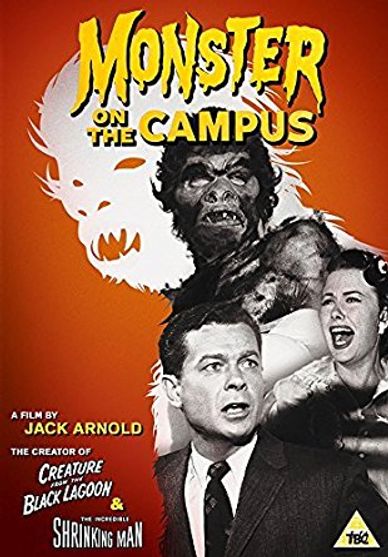
Starring: Arthur Franz, Joanna Moore, Nancy Walters, Troy Donahue, Whit Bissell.
In Black & White
Directed by Jack Arnold
Story and Screenplay by David Duncan
Produced by Joseph Gershenson
When a frozen but rapidly thawing large prehistoric fish is delivered to a scientist and lecturer at a university, it instigates a series of horrific events. A normally friendly and docile dog turns temporarily feral. The scientist's female assistant is found dead during a period in which he himself blacked-out. The police initially suspect the scientist, but outlandish hand prints found seem to exonerate him. But the dog had turned after drinking some of the melted ice from the new arrival, and the scientist had cut his hand on the fish's teeth.
This is a Jekyll and Hyde story... of sorts. For a learned man, our hero/villain is a little slow on the uptake. When some drops from a specimen fall into his pipe, he lights it and, even though it doesn't smell or taste right, he smokes it anyway. This turns him into what I think is supposed to be an earlier form of man, but looks more like an early movie werewolf.
He grows hair over his body (at least from the waist up; I don't think the make-up department fancied the prospect of removing his trousers!), his hands become misshapen, and he springs-off on the prowl.
He doesn't realise he's the monster at first, but then he sets up an experiment to catch it on camera and we witness the full horror of the transformation: a floppy gorilla mask and shoulders the like of which haven't seen the light of day since the era of Dynasty and Dallas. After emitting an "Arrgghhh!" or two - and loosely swinging an axe - he finally does the noble thing before anyone else is hurt.
It seems the fish had been bombarded with gamma rays to slow its degradation prior to transportation, but as the film is in black and white I'm unable to confirm if it is green and angry!
Monster on the Campus is a little far-fetched, as you would expect. Pseudo science is the order of the day in these films. What makes movies like this one fun is the fact they are played straight; that is part of what makes the creature so ludicrous and lovingly hilarious.
The acting is pretty okay in this one... All except the scientist's fiancé. Her reaction to every event is wooden to the point of blasé - like she doesn't care about anything except her actor's pay cheque (and I use the word 'actor' advisedly). This was directed by Jack Arnold, who made many much better movies around this time, such as The Incredible Shrinking Man and Creature From the Black Lagoon.
The mask and make-up for the monster was originally much better, and can be seen in publicity photos. However, for some reason it was decided to change the design to something more laclustre. Strange are the ways of man - especially prehistoric man.
Verdict: 5 out of 10
(original review Ty Power 2020)
It Came From The Desert (2017) 2018 DVD

Starring: Vanessa Grasse, Mark Arnold and Harry Lister Smith.
Directed by Marko Mäkilaakso
Thunderbird Releasing
June 2018
Brian and his friend Lukos travel to the New Mexico desert for a party at which they will get to meet their B-Movie action hero. Brian’s dream girl is there, but he doesn’t believe he has a chance. When he despondently wanders off, Lukos finds him and the two friends happen across a cave which leads into an abandoned research facility for military application. They are shocked, to say the least, to be attacked by a giant ant, and are embarrassingly saved by the girl Lisa. This ant, it turns out, is just one of many. They need ethanol in order to breed, and the nearby party has it in abundance: alcohol. Ants can lay hundreds of eggs at a time. Our heroes know they can’t allow them to hatch and spread further afield. Three people against a colony of giant ants is not exactly a fair fight. But Brian isn’t known as the brainy geek for nothing, and he has a crazy plan that might just work...
It seems that an asteroid hit this region during the 1950s. Alien DNA was discovered and mixed with that of ants and spiders. Why this would make them giant-sized is anyone’s guess – although it is in keeping with the myriad giant creature flicks from that time of uncertainty.
This is effectively a modern-made 1950s Monster B-Movie. In fact, the story is based on the premise of a 1980s video game, but to all intents and purposes it’s a homage to those classic and so-bad-they’re-good black and white low budget science fiction movies of the atomic age. Our reluctant heroes learn that the research centre’s experiments were called Project: Them! There’s no more tribute they could have paid than to give a big nod to the excellent giant ants movie of the 1950s. In that long gone era these genre films were played straight, which makes the mistakes in many of them so funny. I love those films, but how does a contemporary version compare? Films such as this one and Big Ass Spider, for example, purposefully inject humour from the start, so they are not taken seriously and ridiculed. So it’s like a tribute to those films such as Them! and it’s ilk, but at the same time it’s saying "we know you might think this film is rubbish, so we’re getting in first and sending it up before you do."
What makes this work is the fact the humour comes entirely through the dialogue, and in particular the main character’s reactions to events and each other. This is very difficult to get right without coming across as being really silly. The humour for me is spot on, natural, and seems spontaneous. Lukos’ first terrified reaction to seeing a giant ant is, "This is straight up Jurassic Park shit!" Another good example is when the two friends are looking for weapons. One comes up with a spatula, the other a frying pan – inducing the exchange: "What are you going to do with that? Swat it to death?!" "What are you going to do with that? Cook it breakfast?!" As the first of the ants reaches the party, prior to the massacre, a clearly inebriated guy greets it with, "Squirrel dudes, I come in peace!"
The action hero film clip that Brian is watching at the beginning is purposefully made to look particularly cheap and wooden and that, of course, makes it amusing. The B-Movie hero they are supposed to meet at the party, turns up at the end trying to look cool. I’m sure you can guess his reaction as soon as he sees an ant. Are they basing this character on Bruce Campbell, and in particular My Name Is Bruce?
Curiously, It Came From the Desert was filmed in Spain and Finland. Director Marko Makilaakso has achieved something a little special here. It’s a load of old nonsense, but it’s a thoroughly enjoyable load of old nonsense. The only thing that lets down this release is the lack of substantial extra features. There is only a Special FX Comparison. However, you still need this fun film in your collection.
Verdict: 8 out of 10
(Review originally written by Ty Power for sci-fi-online 2018)
Infestation (2009) 2009 Blu-ray

Starring: Chris Marquette, Brooke Nevin and Ray Wise.
Directed by Kyle Rankin
Icon Home Entertainment
September 2009
Cooper Flynn is an immature joker who shirks his professional responsibilities. He is in the process of being dismissed by his unimpressed boss when everything changes. The next thing he knows he is waking up wrapped tightly in a cobweb-like substance. All of his office colleagues are similarly cocooned. An astonished Cooper is attacked by a giant black bug, and soon discovers that everyone in the streets has been stored for future food. After waking a few individuals, including Sara, his former employer’s attractive daughter, Cooper ventures outside with the group. The plan is to track down their loved ones and find a safe haven, but the huge and violent bugs are everywhere, and when a crowd of angry flying beetle-like bugs swoops down and grabs Sara, Cooper determines to recover her safely - his normally non-existent courage and chivalry coming to the fore. But to tackle the queen bug he requires the help of his ex-military father. The father he hates. The father who is slowly turning into a human-bug hybrid...
Although the frequency with which Cooper makes silly and inappropriate remarks does reach a point where it begins to grate, Infestation as a whole is immense fun. The idea of the carefree protagonist wanting only to run away and find a safe place to hide up until his potential girlfriend is taken, rings naturally true to character. At which point his testosterone rises to the surface and the reluctant hero leads a rag-tag group towards the main nest for a confrontation with the queen.
Writer/director Kyle Rankin sensibly goes for the humorous element, with the monster horror, whilst initially looking somewhat over-the-top, being played down in favour of comic situations. In short, it’s not frightening, but you do find yourself laughing frequently at the absurdity of it all. The special effects are much better than you might expect (particularly the inter-species hybrids and flying bugs) without seeming to be in your face, and you even get a sense of the gravity of a wide-spread disaster, even though only a few streets and surrounding areas are actually seen.
Essentially, the name of the game here is fun, and that works admirably. After all, in the real world if somebody is pestered by a wasp or has a spider drop down on their head, our first thought is to laugh at their reaction. The format is very much in the vein of a 1950s B-movie such as Them, or a more contemporary variation like Eight-Legged Freaks and Slither. A very enjoyable popcorn movie. The only disappointment is a severe lack of extras, with only a Making of… documentary present.
Verdict: 8 out of 10
(Review originally written by Ty Power for sci-fi-online 2009)
Sand Sharks (2011) 2012 DVD

Starring: Corin Nemec, Gina Holden, Julie Berman, Brooke Hogan, Nick Hogan and Vanessa Lee Evigan.
Directed by Mark Atkins
Chelsea Films
January 2012
On the small island of White Sands the head of a dune biker is found. Evidence points strongly to a shark attack, but it is too far up the beach. A shark expert is called in, and the sheriff wants to close the beach. However, the deputy sheriff’s ex-boyfriend turns up with a proposal to put White Sands back on the map. He wants to hold a huge beach party, inviting teens country wide. In reality, he wants to make money to pay the mobsters on his trail, but the mayor sanctions his plans, and it helps when the mayor is your own father. Even when he witnesses a sand shark consume his financial aid, he fails to warn anyone, seeing only dollar signs behind his eyes. Pretty soon the party is underway, and the vibrations caused by the loud music attract a hoard of sand sharks who have now tasted blood. No one takes any notice of the grizzled old timer, but he may be their only salvation...
Sand Sharks wobbles unsteadily on top of the fence between horror B-movie and farce. The promotional blurb says it has its tongue firmly in cheek, although sometimes it tries too hard to be straight Jaws-type mainstream horror. This is where it trips up and becomes extremely cliched. I think the director should have planned an all-out spoof from the beginning, because the action has a lot going for it in that respect.
Stereotypical characters like the old codger who says he can help, but who everyone ignores reminds me of many past examples of film village loons who step out suddenly and say, “Don go thar! Strange things be ‘appening.” The funniest moment - and even now I’m not certain if it was intended to be humorous - involved the first shark attack on the partygoers. There are no more than fifty-odd teens on the beach, but when a shark emerges from the sand they spend an age screaming and running in different directions in what looks like a blatant attempt to make it seem as if there are considerably more people involved.
The composite rendering of the sharks is somewhat cartoony, but thankfully no shot is dwelled upon long enough for you to sit there and note its more intricate faults.
Much as I’ve pointed out the shortcomings of Sand Sharks, it is a fun viewing experience in the manner that you might enjoy a 1950s B-movie, warts and all.
Verdict: 6 out of 10
(Review originally written by Ty Power for sci-fi-online 2012)
The Fly (1958 )
Creature From The Black Lagoon (1954)
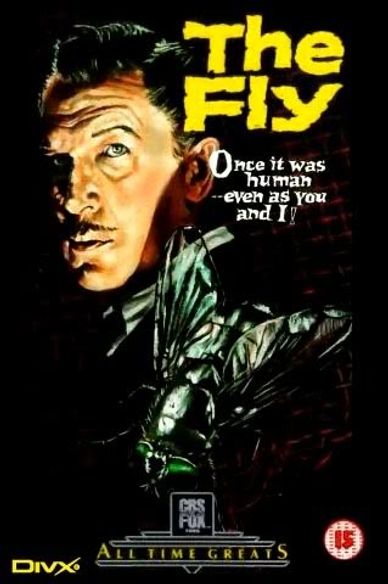
Starring: Vincent Price, Herbert Marshall, Al Hedison, Patricia Owens.
In Colour
Produced & Directed by Kurt Neumann
Based on a story by George Lange Laan
Andre Delambre is a scientist who invents a matter transmitter, running a series of tests on inanimate objects, and a live guinea pig. The process breaks down the subject to its constituent atoms and reassembles them in an identical booth on the other side of the laboratory. After a failure with the family cat (we hear its haunting meow), he perfects the procedure, deciding to use himself as the ultimate organic test. Unfortunately, a fly is trapped in the booth with him causing their atoms to mix. The confusing outcome of this is he now possesses a human-size fly head and one arm like the appendage of the insect.
As the presence of the fly causes unnatural and confusing thoughts and he feels his humanity slipping away, he communicates the urgency of finding the white-headed fly. Only by putting himself and the fly through the matter transmitter can he hope to reverse the process (eh?). However, although his wife Helene and son Philippe see the fly on a number of occasions they fail to catch it (although Philippe had it in a matchbox before he knew it was important). The only thing left to do is destroy all trace of the experiment... and that includes himself.
Although this sounds like a load of old nonsense, it carries a lot of emotional gravitas, which is in part down to the excellent screenplay by James Clavell (Shogun). In fact, the bigwigs were so impressed by it they not only raised the budget but decided to film in colour when it was initially intended to be black and white. In effect, it became an A-film.
The Fly's story is uncovered retrospectively, with Helene being accused of murder, and reluctantly relaying what had gone before. In this respect it works quite well, and allows more airtime to Vincent Price who plays the scientist's brother, Francois, and isn't part of the main story. Al Hedison is particularly good as the conscientious scientist, and Herbert Marshall's Charas is the most laid back police detective I think I've ever seen.
The lab set is impressive without being pretentiously over-the-top. But it is the final scene that steals the show. After disbelieving Helene's crazy story, Price and Marshall see the human-headed fly trapped in a web and about to be devoured by a spider. The little cries of 'Help me!' stay with you.
Of course, you can always pick holes in a movie like this. When Patricia Owens goes manic in a room over the white-headed fly it's actually very comical to behold. Likewise, when Al Hedison's fly limb keeps on exerting a life of its own and has to be grabbed by his human hand. There is no logical way to assume that putting himself through the matter transmitter with the fly again would undo what had happened before. Why is the fly head human size, and the human head fly size? Wouldn't they materialise as one creature, part human, part fly? And how has Andre retained any human thought and reasoning with an entirely insectoid head?
Nevertheless, this is one of the better sci-fi horror movies of the 1950s. Not a classic but certainly memorable. It is one of those examples when you're more than happy to suspend your disbelief.
Verdict: 8 out of 10
(Original Review Ty Power 2017)
Creature From The Black Lagoon (1954)
Creature From The Black Lagoon (1954)
Creature From The Black Lagoon (1954)
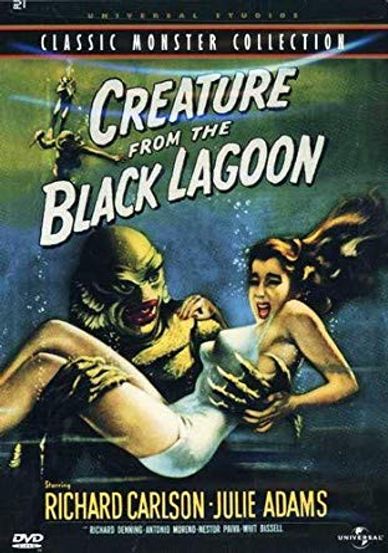
Starring: Richard Carlson, Julia Adams, Richard Denning, Antonio Moreno, Whit Bissell, Nestor Paiva.
In Black & White
Directed by Jack Arnold
Underwater Sequences Directed by James C. Havens
Screenplay by Harry Essex & Arthur Ross. Story by Maurice Zimm
Narration instructs us on the ‘Miracle of Life’ in all it various forms. Our story begins in the Amazon (does it do free delivery?). A large fossilised claw is found in the rock and is taken to the Marine Institute, where two young marine scientists, David Reed and Kay, who are a couple, greet Dr Thompson like an old friend. An expedition is arranged and they head back to the location on a local’s boat. The native who was left to watch the site is found dead in his tent, having been viciously attacked – it is presumed by a jaguar. Excavation of the rock does not reveal any more of the mysterious creature’s skeleton. Lucas, the boatman, tells them there is a secluded lagoon down river, which is known as the Black Lagoon. The scientists theorise that the rest of the bones could have been washed down river and into the lagoon.
The boat squeezes into the creepy and atmospheric lagoon, which then opens out. David Reed and Mark Williams (the greedy leader of the expedition) dive for rock samples, and are watched all the time by a man-sized prehistoric amphibian creature. Once back on the boat the men all go below deck to study the samples, leaving the young woman, Kay, to go swimming. Under the water the creature swims out towards her, mirroring some of her movements below the surface, before moving back into hiding at the bottom. But when she swims back to the boat the creature shadows her movements. As she is pulled on to the boat by helping hands, the boat lurches. Something big is caught in the net which has been cast from the boat. They attempt to winch it up but the supporting beam begins to crack. They are just about to cut the line when it goes slack. The net is brought up and they find a large hole has been torn in it. They also find a single talon-like nail which matches the claw they had found.
Reed and Williams take a camera under the water, spotting the creature. Williams shoots it with a spear. With the spear still sticking out of its back, it flees into deeper, darker waters. While they are below deck on the boat, hoping for a picture of the creature, their new foe kills one of the locals on deck, and just as quickly disappears into the inky black water again. Lucas tells of a way of catching fish by spreading a powder of the surface of the water. It sends them to sleep and they float to the top. They use the method to try to catch the creature. When it fails they sink it down lower. But the creature has left the water. It attempts to climb on to the boat but is spotted and returns to the water. Reed speculates that if it is drugged it could suffocate. He and Williams dive under the water and come up in a cave.
They follow the creature’s footprints, but the creature returns to the land and attempts to carry off Kay. However, the drug has weakened it. The creature falls unconscious. Reed prevents Williams killing it, but they do cage it in the water. Once fully recovered it easily escapes, attacking Doctor Thompson who is guarding it. Kay throws an oil lamp which sets the creature on fire, causing it to quickly return to the water. Against Williams’ protestations, Reed instructs that they head back, but an obstruction has been placed to prevent them leaving the location of the lagoon.
After another fight between the two men, Reed dives beneath the boat to see if he can free the way. Williams arrives with his harpoon gun and, again, spears the creature, but it grabs him and fights him to the bottom. Reed tries to help but Williams is already dead and the creature gets away. They still need to free the way to escape, so they liquidise the tranquilising power and use it in a gas canister, like a spray gun. A line is fixed under the obstruction and it is dragged clear. However, the creature is aboard the boat and leaps into the water with Kay. In the cave Reed tails the creature and finds her, but the creature appears and attacks him. He is saved by two men from the boat, who shoot it. However, Reed stops them and allows it to return to the water. Our final image is of the unmoving creature sinking to the depths. But with two sequels to follow, we know that the creature will return.
The outright star of this show is the underwater sequences. It’s no exaggeration to call these beautiful. When you consider this was the 1950s, it’s probably the best camerawork of its type. If I seem to be harking on about it, it really does have to be seen to be believed. Giving it additional credence is the stunning costume design, which is truly iconic. The creature’s movements in the water are artistic and filmed in fluid and sometimes quick movements, just like a fish. What more can I say other than it’s quite stunning.
This movie was so successful for Universal Films – after the golden age of the 1930s had all but died out – that it spawned two sequels: Revenge of the Creature, and The Creature Walks Among Us. The design style of the Creature has been copied in a handful of films, most notably in Guillermo Del Toro’s Oscar-winning The Shape of the Water. Whilst seemingly a monster romp, Creature From the Black Lagoon satisfies on all counts. It has science, character, conflict, sympathy for the monster (a la Frankenstein), and a leading lady who screams at every opportunity! Enjoy.
Verdict: 9 out of 10
(original review Ty Power 2018)
The Beast From 20,000 Fathoms (1953)
Creature From The Black Lagoon (1954)
Creature From The Black Lagoon (1954)
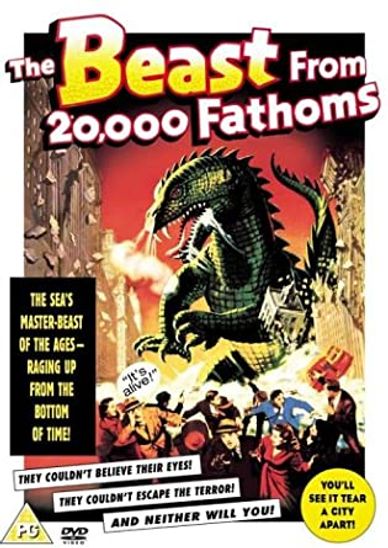
Starring: Paul Christian, Paula Raymond, Cecil Kellaway, Kenneth Tobey, Lee Van Cleef.
In Black & White
Directed by Eugene Lourie
Screenplay by Lou Morheim & Fred Freiberger (Story & screenplay by Ray Bradbury)
Produced by Hal Chester & Jack Dietz (Technical Effects by Ray Harryhausen)
An Atomic bomb is tested near the Arctic Circle. Tom Nesbit is one of many who are monitoring the effects of the environment in the surrounding area. After an avalanche of snow injures a colleague, he witnesses the astounding sight of a huge prehistoric creature. Of course, afterwards nobody believes him. He visits Thurgood Elson, the world's leading paleontologist, who tells him the beast he describes couldn't possibly exist today. However, the man's beautiful assistant, Lee Hunter, produces dozens of drawings of dinosaurs from different eras and Nesbitt finally picks out what he saw. Of course, there is no other confirmation until a fishing vessel is destroyed at sea and the sole survivor identifies the same picture - a rhedosaurus.
A pattern of other incidents at sea lead the professor and his experts to conclude that the creature is making for New York, which is the location of the rhedosaurus ancestral breeding grounds. Initially telling the world the US Navy is on active manoeuvres to keep enquiring ships away, they are finally obliged to reveal the truth. Professor Elson and a Navy operator are lowered in a diving bell to get a closer look at the creature. They communicate that they can see the magnificent beast, before the radio goes dead and the complete diving bell and its two occupants are consumed by the beast.
Emerging in Manhattan, the colossal beast rampages through the streets, destroying buildings and cars. There are a couple of dry moments in this sequence, as a uniform cop seems to think he can take on the monster with one small pistol and, consequently, soon learns the error of his ways. In a barber shop the patrons simply stare as crowds of panic-stricken people flee past the shopfront window. The beast eventually returns to the sea, only to emerge again at Coney Island. The wounded beast drops blood which, through some kind of a virus, incapacitates many of the police and troops. They realise then that they can't use explosives on it through fear of spreading the virus through the air.
The beast ends up entangled in a roller coaster - itself like the bones of an old dinosaur. The creature's movements cause part of the structure to break and fall. Nesbitt and a crack marksman (played by Lee Van Cleef, best known for his Spaghetti Westerns with Clint Eastwood) ride a roller coaster car to the top with a radioactive isotope. The marksman fires the isotope into a would on the creature, and it writhes around in anger and pain preparatory to collapsing and dying.
Unfortunately, this thrashing causes the coaster cars and part of the track to fall, and the two men are obliged to gingerly climb down the unsteady structure to the ground. Lee falls into Nesbitt's arms, as the women often do in these films, but there is no mention of the radioactive and viral hazard of the dead creature.
This was stop-motion effects genius Ray Harryhausen's first film with full control, and timeless writer Ray Bradbury's first screen adaptation of one of his stories. Bradbury was brought in my the director to tighten and improve an existing script, only to find that it was very much like his short story The Fog Horn. It was realised the story had been inadvertently stolen and so Bradbury was quickly employed to make the script his own. This was a dream come true for both Bradbury and Harryhausen, who had first met when Bradbury was introduced as a boy and they had been close friends for a number of years.
The film was made to tap in on the 1952 re-release of King Kong, and to create their own 'monster on the loose'. In the same manner that John Carpenter unknowingly set the template for subsequent Slasher Horror movies, Ray Harryhausen and Ray Bradbury set the standard for a multitude of monster B-Movies that would follow. It was easy for a multitude of low budget enterprises to serve-up giant animals, insects, bygone creatures, and even humans. There would be an authoritative hero (usually an officer from the armed forces), a professor (an expert in the required field), and the professor's beautiful daughter or assistant (a love interest for our hero).
Although this film came before and had a lower budget than It Came From Beneath the Sea, it is in my humble opinion the better of the two movies. The Beast From 20,000 Fathoms features a monster none of us have knowledge of (unlike the octopus of ICFBTS), and there are more and better set-pieces encompassing the monster of the piece: the Arctic appearance, the attacks on the ships and the diving bell, the impressive stomp through the streets of New York and snacking on some dockers, and the climatic scene with the rollercoaster. It should not be forgotten, however, that the central core of Bradbury's sad and poetic short story - the lighthouse itself - features in this movie, although to a much lesser extent.
Anyone with knowledge of Ray Harryhausen's output will tell you that, to all intents and purposes, he was the director of each film he worked on. To ensure that his high standard of work would mesh properly with live action, he also spend a lot of time with the actors on location, telling them in great detail what their characters were seeing and making sure at all times they looked in the right places and reacted accordingly. Sometimes this would mean running around with a ball on a long stick to show the eye-level of the beast.
This is a very enjoyable movie. There are some nice extras on the DVD release, too, with two good documentaries: The Rhedosaurus and The Roller Coaster: Making the Beast, and Harryhausen & Bradbury: An Unfathomable Friendship. There is also a Hidden Extra, and 4 Trailers.
Verdict: 8 out of 10
(original review Ty Power 2018)
Them! (1954)
The Incredible Shrinking Man (1957)
The Incredible Shrinking Man (1957)
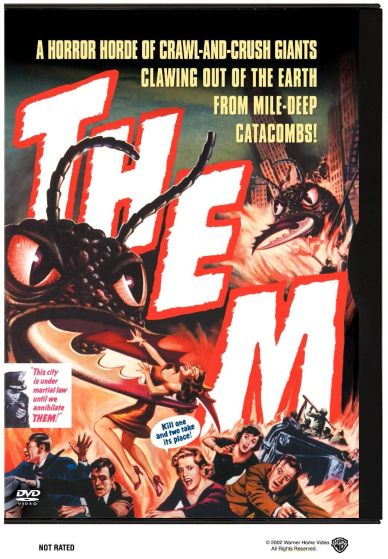
Starring: James Whitmore, Edmund Gwenn, Joan Weldon, James Arness, Onslow Stevens.
In Black & White
Directed by Gordon Douglass
Screenplay by Ted Sherdeman (Adapted by Russell Hughes)
Story by George Worthing Yates. Produced by David Weisbart
Two policemen in a patrol car find a catatonic little girl walking through the desert. Down the road is a wrecked trailer. The general store is in a similar state. Here they find a dead body and spilt containers of sugar. They split up, and the cop who is left behind is killed by something outside. As an F.B.I. guy turns up to lend a hand, the medical examiner reports that the body was pumped full of formic acid.
Peterson the cop and Graham the F.B.I. man meet Dr Medford at an airfield. Medford is an expert on agriculture. He introduces his beautiful daughter and assistant, Patricia (Pat). One of the atomic explosions nine years before was in the area, and Medford has a theory. He manages to bring the little girl out of her catatonic state by waving a glass of formic acid under her nose. The girl screams "Them!" and attempts to hide.
A visit to the desert reveals several prints. A giant ant appears near Pat and her screams bring the others. They shoot the antennae, which disables its senses, and then manage to kill it. "And there shall be destruction and darkness come up on creation, and the beasts shall reign over the earth."
They fly in helicopters over the area and discover the nest. However, Medford stops them from destroying it. They must wait until the hottest part of the next day, when all the ants should be inside to keep cool. They can then flood the nest or 'fire' it to drive them further down inside, and then drop cyanide to kill them. Descending into the nest they find lots of dead giant ants, and a live one which attacks them from another chamber. In the queen's chamber they find two empty eggs. These would have been winged ants... new queens which can hatch thousands of eggs. The priority is to find the queens before they can establish their colonies and lay their eggs. If they don't, mankind will be displaced as the dominant species within a year.
The S.S. Viking sends an S.O.S. that it is being attacked by flying ants, and is purposefully sunk to prevent any eggs hatching. In Los Angeles, a 40 ton sugar load goes missing. At the same time, a man is found with his arm severed and other hideous fatal injuries. His two children are missing. A drunken witness says he saw giant ants near the river, and a search is intensified in sewer drainage system.
Cue convoys of troop-carrying trucks and army jeeps (many of them the same ones!) enforcing a curfew on the streets and guarding storm drains, attentive for activity. The search is on for the two missing children. A jeep driver crawls through the tunnel after hearing noises. Ants are attempting to get to the two boys, and the ceiling is falling in. He flames two ants and attempts to escape with the boys. He pushes them into a crawl tunnel, but is caught and killed himself by a new arrival. The army turns up and kills a number of ants. The objective from Professor Medford is to find the egg chamber and discover if any new queens have hatched. The nest is quickly found with two new queens. They are torched with flame throwers before they can escape and lay new eggs.
Them! is commonly remembered as 'the one with the giant ants' - but it deserves a lot more recognition. It's played straight and with conviction, the only real humour being when the drunk is questioned about seeing a giant ant. Of course, the ants themselves are realised in the best way they can be considering the restriction of the budget. The antennae are floppy and the eyes bulbous. One victim is obliged to literally throw himself into the mandibles of an attacking ant, just to make it look more convincing. Yes, it has its restrictions, but Them! is a well-made movie, which was successful and impactful enough to spawn a multitude of other giant creature features from a host of production companies.
Again, the mutations are the result of atomic testing in the Nevada Desert. Professor Medford speculates on what other monstrosities might have been created by subsequent testing. There are some nice quotes in this film. When a discussion between scientists and the military gets bogged-down in technicalities, we get: "Why don't we all talk English, then we'd have a basis for an understanding." Perhaps the best quote is: "We haven't seen the end of Them. We've only had a close view of the beginning of what could be the end of us."
The DVD extras include some test footage of the ants. Great stuff! The picture is nicely cleaned-up, too. One of the crisper-looking films from the period.
Verdict: 8 out of 10
(Original Review Ty Power 2017)
The Incredible Shrinking Man (1957)
The Incredible Shrinking Man (1957)
The Incredible Shrinking Man (1957)
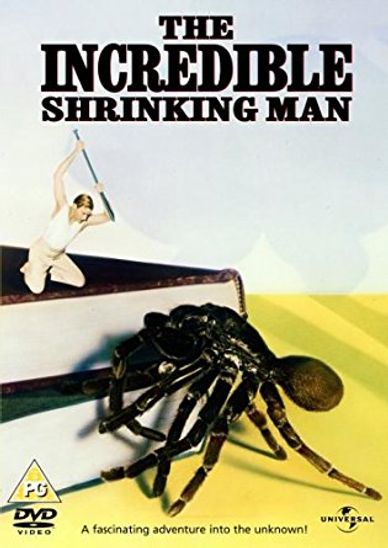
Starring: Grant Williams, Randy Stuart, Paul Langton, April Kent.
In Black & White
Directed by Jack Arnold
Screenplay by Richard Matheson, based on his novel 'The Shrinking Man'
Scott Carey is on the deck of a small boat when a strange mist emerges from nowhere and passes overhead, coating him in a rather fetching party glitter. But Scott doesn’t even get the chance to show off down the disco (not that discos have been invented yet). Barely six months later he notices he is losing weight. He and his wife suspect he has a debilitating illness, so he visits the doctor to get checked out. One of the many tests involves his height; he appears to be shorter, but the doctor declares this an impossible mistake (why? Many people shrink with old age). Subsequent examinations convince the doctor of the truth, and he finally refers Scott to hospital experts who desperately attempt to halt the process.
However, as time goes on it seems to be accelerating. We are soon met with the shocking but impressive image of Scott sitting in an armchair opposite his wife but, like a small child, only taking up a fraction of the seat. This shot is nicely set up with the viewer initially seeing only his wife talking, before the camera pans out to reveal the reality of the matter. Word leaks out of this curious phenomenon and pretty soon the press is camped outside the house desperate for a glimpse of the ‘freak’. There is a very nice sequence wherein Scott, who is going stir crazy cooped-up in the house, decides to sneak out at night. He finds himself on the edge of a carnival where he is approached by a beautiful midget woman, April, who rebuilds his confidence. They strike up a friendship. Scott now has a more positive outlook on life, bolstered by the news from the hospital that his shrinking might have halted. However, when he next meets the lady he finds he is now shorter than her.
The next thing we see is Scott descending a staircase. The bannister and stair rods shake like a cheap piece of set scenery, but this is all part of the masterplan. Again, some deft camerawork reveals the fact Scott is now tiny and living in a doll’s house. His wife leaves the main house to pick up supplies, inadvertently shutting in the cat. The cat tries desperately to reach Scott through the windows, and while the animal is distracted he makes a desperate dash from the doll’s house across the seemingly vast stretch of carpet in the full-size room. He hides behind the door to the cellar, but the cat pushes it open, causing Scott to fall into a basket at the bottom of the cellar steps. His wife thinks the cat ate him and grieves for his death.
Now trapped in the cellar, the shrinking man gets water from a drip beneath a water heater, and utilises an empty matchbox for shelter. But he is driven by hunger; more so when the cheese he knocks from a mouse trap falls through a grating. He spots what looks like cake next to a spider web high up on top of a unit. He watches wide-eyed as a spider appears and crosses the floor of the basement. Removing a pin from a pin cushion, Scott secures it around his waist, before fashioning a grappling hook by bending another pin and attaching cotton thread as rope. With great effort he makes it to the top. He eats some of the cake before finding a grate looking out into the infinite jungle of the garden. The spider suddenly returns, prompting Scott to hide in the matchbox. However, there will be a reckoning. The leak in the basement turns to a flood when the water heater releases its tank. Scott’s wife and brother turn off the gas and water before they leave the house, but he is too small to be seen or heard by either of them. He survives by hanging on to a pencil like a raft. Scott soon realises his only source of food is up by the spider web. Facing the spider is inevitable.
What can I say about this film except it is a true bonefide classic. For a 1950s film it still has the power to keep you on the edge of your seat. As Scott fights for survival in a world of normally mundane monsters and vast spaces, the tension is ratcheted-up with a series of life threatening set pieces. The attack by the house cat, scaling the heights to the cake, the flood, and the ultimate confrontation with the spider which he manages to kill with the pin sword.
The effects are excellent compared with other giant man/creature movies from the same period because they are kept to a minimum. Many of the sets and props, particularly in the cellar, were built large to make the actor look according small. Grant Williams (also in The Monolith Monsters and The Leech Woman) acts the part very well, but it is the source material here that really shines. Richard Matheson was a master storyteller with seminal works such as Nightmare at 20,000 Feet, Hell House, Duel, and The Shrinking Man (the ‘Incredible’ was added for the film). The fact he wrote the screenplay makes the piece all the more coherent.
Scott begins by writing his day-to-day story in a journal, but from the point he is in the cellar we actually hear his thoughts in the past tense. There is a poignant ending, as he moves between the bars of the vent and into the garden. He is like the smallest insect now and accepts that his connection with the universe has changed. He is still significant … but for his new prospective in a different world. He speculates if it is God’s plan and wonders if this is the future for humanity. He finally accepts his place in existence.
Verdict: 10 out of 10
(Original Review Ty Power 2018)
The Blob (1958)
The Incredible Shrinking Man (1957)
Black Sheep (2006) 2007 DVD Release
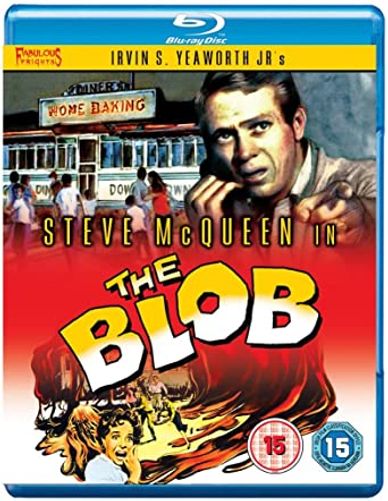
Starring: Steve McQueen, Aneta Corseaut, Earl Rowe, Olin Howlin, Steven Chase, John Benson.
In Colour
Directed by Irvin S. Yeaworth, Jr.
Screenplay by Theodore Simonson & Kate Phillips (original idea by Irvine H. Millgate)
Produced by Jack H. Harris
An old man who lives in a shack in the woods outside of town finds a meteor rock which has just fallen from space. When he prods it with a stick a gelatinous substance engulfs his hand. He runs across the road and is nearly hit by teenager Steve Anderson and his girlfriend Jane. They drive him to the doctor, who later watches helplessly as the substance totally takes over the old man until there is nothing left. His nurse is similarly consumed, forcing the doc to lock himself in an adjoining room.
The teens return from looking for clues at the scene of the meteor and the old man's house, to find the doctor's surgery in darkness. Rushing around the side, Steve sees through the window as the 'Blob' envelops the helpless doctor. When they report the incident, all that the sheriff's office find is a mess in a locked room. With no proof, the teens are accused of a prank. They are sent back to their respective parents until the next day.
Steve and Jane sneak out of their respective houses in the middle of the night (Steve making enough noise to wake the street, and Jane having a loud conversation of the stairs with her young brother). They ask for help from some other teens, but no one will take them seriously.
Steve and Jane find the Blob in a food store and are backed into a storage room. It starts to come under the door before conveniently retreating. Perhaps that's why they call them convenience stores! The teens set off horns and sirens to bring out the town's people. They think the Blob is in the store, but it is in the cinema, and it's grown very big. The people run screaming into the streets from the cinema.
Our heroes are trapped in the dinner, which is completely enveloped by the creature. The police attempt to electrocute the thing with power cables, but it doesn't work and the diner erupts in flames. In the cellar, the survivors realise Co2 extinguishers keep the Blob at bay with the cold. The local school is raided by the police and other teens for the extinguishers, and they manage to freeze the thing as Steve and the others escape the cellar.
It is not dead. No one knows if it can be killed. The inert Blob is dropped in the remote and extreme cold of the Arctic. We are safe... as long as the Arctic remains cold.
The Blob was supposed to be the B-Movie to a B-Movie. In other words, it was released as a double-bill with I Married a Monster from Outer Space, but test screenings proved The Blob to be the more popular of the two films. At this point the outlay for promotion was increased. Over the years it has garnered fond memories and familiarity with fans of films from this period. Every year in July cult film fans flock to Pheonixville in the US for Blobfest, a three-day film festival where they re-enact the scene from the movie when the audience flees in terror from the cinema.
Although Steve McQueen looks like the oldest teenager in history, this movie helped launch his career, and the career of music composer Burt Bacharach. The title song for the film, 'The Blob' was co-written by Bacharach and appears on his album, Look of Love: The Burt Bacharach Collection. Because the teens themselves look like adults, the authority figures of the police, doctor and parents are made to look even older.
The Blob itself is well-realised. The effects are kept to a minimum so that, although there are plenty of moving images of the creature, it is made in the way that you think you see more than you actually do, in terms of people being attacked and engulfed. The film has heart, and shows off its quaintness and quirkiness. A remake in 1988 achieved nothing in capturing these moods. These B-Movies exist in their bubble of the 1950s and 1960s wherein they are king. It is only now with films like Big Ass Spider and It Came from the Desert that young filmmakers are creating their own B-Movies in this style.
In a discussion with evolutionary biologist Richard Dawkins, astrophysicist Neil Degasse Tyson stated that among all Hollywood aliens The Blob was his favourite and most plausible alien character in science fiction.
Verdict: 8 out of 10
(Original Review Ty Power 2020)
Black Sheep (2006) 2007 DVD Release
Orca: The Killer Whale (1977) 2014 DVD Release
Black Sheep (2006) 2007 DVD Release
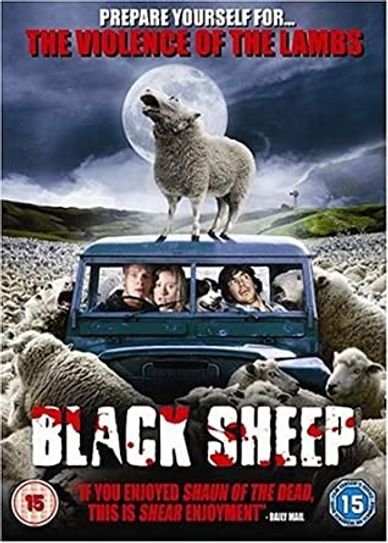
Starring: Matthew Chamberlain, Tammy Davis, Oliver Driver and Peter Feeney.
Directed by Jonathan King
Distributor: Icon Home Entertainment
October 2007
As the result of a twisted boyhood prank, Henry has an irrational fear of sheep; not very practical when you live on a sheep farm in New Zealand. Years later, he returns to the land he jointly owns with the intention of selling his half to his brother Angus. However, he soon discovers that Angus has been up to some more than questionable experimentation involving genetically altered sheep. When a couple of environmental activists break into the lab and escape with a lamb, it bites one of them and pretty soon not only is the victim undergoing some seriously weird bodily changes, but the majority of the sheep turn into viscous zombies. Of course, this is Henry's worst nightmare and, with the help of the other activist, he is obliged to stop the outbreak spreading from the farm and wrestle control of the farm from his scheming brother. But Angus, having undergone a change into a weresheep, is proving to be a formidable opponent...
This is the type of film that you enjoy rather more in retrospect than you do at the time. That's not to say that it's unworthy of consideration - far from it. It's simply that the set pieces and one-liners will stick in your head and perhaps become a valid talking point, so consequentially the popularity or otherwise of Black Sheep is likely to spread through word of mouth. For example, mint sauce acts like holy water on vampires and burns, a victim throws his bitten-off leg at an attacking sheep, sheepskin car seat covers are utilised as a disguise (with a ram trying to mount the person), and there's a novel solution to events near the conclusion.
This very much has the feeling of a little film with a big heart. The acting is mediocre at best, with nobody particularly proficient in their role (if somebody has a lifelong fear of sheep they would be a gibbering wreck at the prospect of woolly zombies). The strength of Black Sheep lies in the comic situations. The special effects are well-handled (particularly the human-to-sheep-and-back-again transformation) so that helps, but clever close-up and sometimes frantic camera work helps to cover certain shortcomings. It would have been amusing if the writer had included in his script the repercussions of zombie lamb meat getting in to the food chain.
None of this really matters though, as the film serves its purpose and works well. I've never forgotten a flock of sheep chasing me across a field when I was little so, although I was in no way traumatised by the experience (twitch), the idea of normally docile sheep 'turning' like the proverbial worm doesn't seem like a huge leap of fiction. But zombies... well, that's another matter. There are some laugh-out-loud moments (or at least those that inspire a sheepish grin) that will make you remember this film, even if you have no inclination to watch it again.
Extras include a Director's Commentary (Jonathan King is also the writer, which often makes for a more enthusiastic dialogue), a Making of Documentary, Deleted Scenes and a frankly unfunny and therefore superfluous Blooper Reel.
Verdict: 5 out of 10
(Review originally written by Ty Power for sci-fi-online 2008)
Big Ass Spider! (2013) 2013 DVD Release
Orca: The Killer Whale (1977) 2014 DVD Release
Orca: The Killer Whale (1977) 2014 DVD Release
Starring: Greg Grunbert, Lombardo Boyar and Ray Wise.
Directed by Mike Mendez
Distributor: StudioCanal
December 2013
Alex is a professional pest exterminator who, through a client’s carelessness, gets bitten by a poisonous spider. Whilst being treated at hospital, he becomes embroiled in a sudden panic of staff. A cadaver in the morgue has split open and a huge predatory spider has emerged. The Black Ops – National Security team arrives, led by a sour-faced Major (Ray Wise), and seals-off the hospital. Alex convinces one of them to have a hospital security guard show him to the morgue to study the arachnid, but they have to track it, via the blood and devastation, to the furnace room. Here they discover the creature is quadrupling in size every few hours. It turns out this was a military experiment to cross microscopic DNA discovered in Martian rocks with Earth insect DNA (I know, spiders aren’t insects, but someone should have informed the writer of this). When the by now gigantic spider gets out into the city of Los Angeles, there is a very real danger of not only potentially many deaths, but the spider laying its eggs. When it climbs a skyscraper and begins to lay its eggs on the top floor, the Major calls an air strike. But there is a female military officer that Alex has taken a shine to, and she is cocooned in the building as ready food for the hatching spiders. He and the security guard have twenty-five minutes to rescue her and exit the building again. Can his professional knowledge help him win the day...?
The film starts just before the final scene. Everything is in slow motion. Alex comes round after being knocked unconscious and walks determinedly towards the skyscraper, whilst all around people are fleeing the other way in terror, masonry falling constantly from the huge spider’s movements. This effect has been done in movies before and can be quite tedious. However, there’s something quite compelling about the sequence. Before we know it, we have jumped back twelve hours to when Alex is making a house call on a dotty old lady. Big Ass Spider! has the structure of a B-movie, but a good one. The monster, the military, the hero, the victims and the damsel in distress are all in place; the difference is this film is both made and acted with conviction and warmth. Real heart comes through in the viewing.
There is great humour present but, unlike many movies, it doesn’t feel forced. It’s not a comedy, but the humour is allowed to evolve through the situations. The pairing of Alex (Greg Grunberg) and Jose (Lombardo Boyar) is excellent. Hospital security guard Jose attaches himself to the exterminator, scared but not wanting to miss out on the action. He calls himself the Mexican Robin to Alex’s Batman. The character of Alex is friendly to everyone but also very determined in his work. Jose cleverly deadpans reactionary comments, and the two seem like they’ve been together forever, to the extent that you’d like to see their characters progress in other stories. One of the best partnership pairings in a film since the first Tremors.
Of course, this isn’t going to win any major awards, but I think most people will enjoy Big Ass Spider! significantly more than the Hollywood nonsense that was the Hollywood Godzilla film of a few years back. It’s probably the best of the spider movies to arrive so far (Arachnophobia, Eight-Legged Freaks, Spiders, Tarantula, etc.) Characterisation and plot should come first in any story, and this one has it just right. A feel good popcorn movie.
Verdict: 7 out of 10
(Review originally written by Ty Power for sci-fi-online 2013)
Orca: The Killer Whale (1977) 2014 DVD Release
Orca: The Killer Whale (1977) 2014 DVD Release
Orca: The Killer Whale (1977) 2014 DVD Release
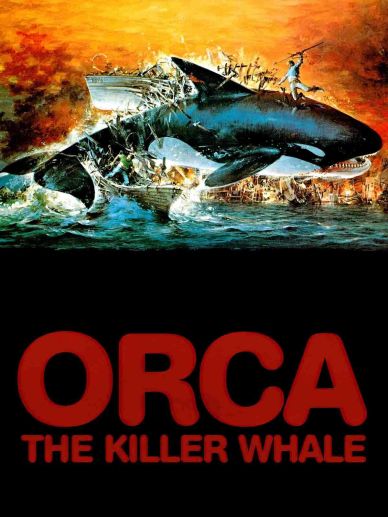
Starring: Richard Harris, Charlotte Rampling, Will Sampson, Bo Derek, Keenan Wynn, Robert Carradine.
Directed by Michael Anderson
Distributor: Studiocanal
April 2014
Captain Nolan is an Irishman living in Canada. He has inherited his father’s old fishing boat, and is attempting to catch various marine life in a bid to pay off the mortgage on the boat, so that he can return home. Whilst striving to catch a Great White shark, the shark is attacked and killed by a killer whale. Nolan immediately has the notion that an Orca will net him a lot more money. However, he misses the male, instead spearing a female. It is winched on board, badly injured, only for Nolan to discover it is pregnant. The baby is lost, enraging the male so that it attacks the vessel. Nolan orders the female cut loose, but it is fatally hurt. The male sees Nolan on board, and the captain is told by an expert that killer whales are highly vengeful creatures, as they are intelligent and very family-oriented. He learns this first-hand when the whale follows his boat back, and terrorises the fishing port – destroying other boats, and even causing fires. The townsfolk know the only way the attacks will cease is if Nolan leaves. And the bitterly sorry Nolan realises the only way he will get any peace is to put to sea and face the beast in its own territory...
To all intents and purposes this is Moby Dick for the 1970s. Not a lot has changed in the telling of this story except, perhaps, less allusions to religion and much more to morality. To be really pedantic here, a killer whale isn’t a whale. It’s basically a dolphin, by which I mean it belongs to the same family group. However, it is the perfect choice for the purposes of this story, because it is the ocean’s biggest killer, thinking nothing of attacking a shark – even a Great White. It is also highly intelligent, and carries certain human traits such as vengeance, and is scheming or calculating in its methods. It has been known to drive prospective prey hundreds of miles away from their comfort zones, and so it’s not too much of a stretch to accept the male in this film luring our more contemporary Captain Ahab into the ice fields for the final confrontation. I did wonder, however, how it managed to blow-up virtually the whole town just by breaking a water pipe in the harbour. The attack might have achieved very little at all, but instead has a domino effect which explodes a refinery.
Producer Dino De Laurentis was known for his prolific output of films, rather than their quality, which tended to range between the perfectly sound and the cringe-worthy low budget affair. Perhaps this explains why Orca: The Killer Whale seems like an amalgamation of the two. Without the stellar cast of the time, I rather think this movie would have unfairly been dismissed as below consideration. Shakespearean actor Richard Harris plays Captain Nolan with a briefly selfish but then repenting air. He spends the majority of the film regretting his actions, and it seems pretty early on that he has decided to meet the beast and die.
Charlotte Rampling is an unusual actress to watch. She’s like the female version of Roger Moore; whether she’s supposed to be sad, angry, determined or upset, she wears the same expression. Bo Derek, sporting a plaster-cast leg, and then no leg at all (!), works well as the required eye candy. And music from established spaghetti western maestro Ennio Morricone lifts this film into the major release bracket.
Nevertheless, it’s one of those films which, even from the start, you watch thinking it’s sort of okay, but nothing special.
Verdict: 5 out of 10
(Review originally written by Ty Power for sci-fi-online 2014)
It Came From Outer Space (1953 - 2020 Re-Issue)
It Came From Outer Space (1953 - 2020 Re-Issue)
It Came From Outer Space (1953 - 2020 Re-Issue)
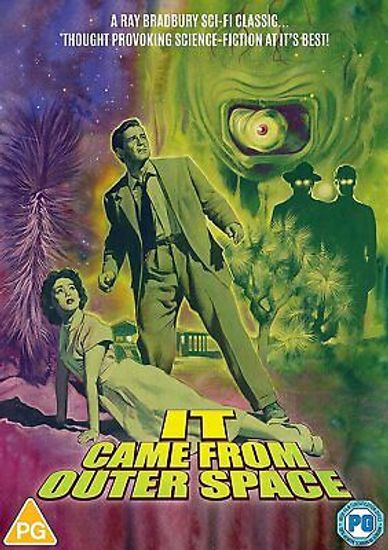
Starring: Starring: Richard Carlson, Barbara Rush, Charles Drake, Russell Johnson, Joe Sawyer and Kathleen Hug.
In Colour
Directed by Jack Arnold
Story by Ray Bradbury. Screenplay by Harry Essex
Produced by William Alland
Amateur astronomer John Putnam witnesses a comet pass over his remote desert home and strike the ground. Along with his fiancé Helen Fields and his friend George, he goes to investigate. Alone, he ventures into the crater where he finds a spacecraft. The hatch is open, offering a brief glimpse inside before it slams shut, causing a rock fall. The craft is completely buried so that neither of his companions believe his revelation. Undeterred, John informs the sheriff. Word soon spreads and news crews show up at the site. However, no one wants to spend the time or money removing the tonnes of rock. When John has a later run-in with the craft’s occupant he is told the buried ship is being repaired, and that it will be leaving soon. But to aid the work required on the damaged craft the alien occupant copies some of the local inhabitants, including John’s friend George, telephone engineer Frank (who looks every bit the cold, alien-possessed automaton) and, later, Barbara herself...
I absolutely adore watching the 1950s and 1960s SF Monster B-Movies. They are so much fun. Just disengage your logic circuits and go along for the ride. This one from 1953, directed by Jack Arnold, finds it difficult to sustain itself over the running time. Arnold went on to make better movies, such as Creature From the Black Lagoon, and The Incredible Shrinking Man. What this film does have going for it is the phenomenal writing skills of the sadly missed Ray Bradbury. The screenplay is credited to Harry Essex, who wrote Creature From the Black Lagoon, but the truth of the matter is that the finished product incorporates the whole of Bradbury’s script and the dialogue as written. In fact, he had put forward two proposals for the alien – one wherein it is malicious and the other benign – and was pleased when the latter option was chosen. This decision ultimately influenced Steven Spielberg when he made Close Encounters of the Third Kind.
There is an uncredited music soundtrack by Irving Gertz, Herman Stein and in particular Henry Mancini, the winner of four Academy Awards, a Golden Globe, twenty Grammy Awards, and a Posthumous Grammy Lifetime Achievement Award. As one of many ‘firsts’ in this film an electronic theremin is utilised for the weird moments. And talking of awards, the actors are pretty solid in their roles (you have to remember this is 1953 and attitudes were different). Ironically, my instinct is that Barbara Rush’s portrayal of Ellen is the weakest, and yet in 1954 she won a Golden Globe for most promising female newcomer for her role in the film. So, what do I know?
As in most low-budget films from this era, there are a couple of humorous moments. When John Putnam first encounters the spacecraft he hears what sounds like snoring. No wonder the ship crashed; the alien obviously fell asleep at the wheel. Sight of the creature in the desert scares the wildlife, including an owl who, bizarrely, does a backflip. John’s car obviously does good miles to the gallon, too, because he spends most of the film driving back and forth across the desert between his house or the town and the crash site or mine entrance. For me, the spookiest moment of the movie doesn’t involve the alien – which, let’s face it, is pretty basic and added as an afterthought – but when John comes across George and Frank, the first two men to be copied in a darkened doorway. In this version, they have actually left in the Intermission screenshot, too.
It is obvious that It Came From Outer Space was filmed for 3D cinema, as many of the shots not only have movement coming towards the camera, but incorporate mid-screen movement, with striking foreground and depth-of-view in the background. It was also the first of these films to have the alien’s perspective. It’s not a classic, but it is certainly worth a look. It has some of the most convincing dialogue of this genre. I have been asked if there is a dream sequence featuring John seeing the missing Helen as he remembered her, but I can confirm that there is only the appearance of the copied Helen who he follows to the mine entrance.
Extras include a Feature Commentary by Film Historian Tom Weaver; The Universe According to Universal: An Original Documentary on It Came From Outer Space (this is quite a basic featurette, which shows more clips of This Island Earth than ICFOS; Theatrical Trailers in 2D and 3D; and Poster Gallery.
Verdict: 7 out of 10
(Original Review Ty Power 2020)
Attack of the 50ft Woman (1958)
It Came From Outer Space (1953 - 2020 Re-Issue)
It Came From Outer Space (1953 - 2020 Re-Issue)
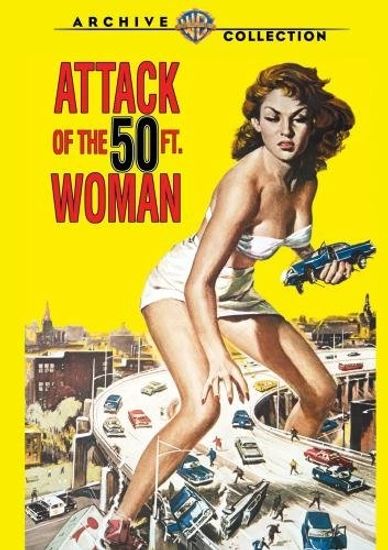
Starring: Allison Hayes, William Hudson, Yvette Vickers.
In Black & White
Directed by Nathan Hertz
Written by Mark Hanna
Mrs Nancy Archer witnesses a large sphere descend from space (on wires) and a 30 foot giant emerge. But Mrs Archer has previously been in a sanatorium and has been known to hit the bottle.
Meanwhile, her husband Harry is playing away (more of an away score draw). Harry wants her recommitted, but Nancy’s butler is loyal to the end. Nancy convinces Harry to drive them into the hills in an attempt to find the ‘satellite’. He hopes she will finally admit she is crazy and have herself committed. Harry and his illicit girlfriend Honey are after her fortune. However, when they come across not only the sphere but the giant occupant, she is elated.
The dirty little coward Harry flees in the car, leaving Nancy at the mercy of the giant. But Mrs Archer is found on the roof of her house and put to bed. It seems she has had some contact with radiation. A nurse gives her periodic injections, and this gives Harry and Honey the idea of slipping her an overdose. But before he gets the chance to give her the needle (so to speak) the resident nurse puts on the light to reveal the giant form of Nancy.
The sheriff and the faithful butler are following giant footprints. In the sphere spacecraft they find Mrs Archer’s Star of India diamond which, along with other gems, appears to help power the craft. The giant man arrives, looking for all the world like a reject from a re-enactment of the Battle of Hastings (complete with tunic and coat of arms). After being shot at by the sheriff a few times, he returns to the sphere and speeds off.
There isn’t enough morphine to keep Nancy unconscious. She’s awake, a giant, and taking a Sunday afternoon casual stroll to town to exact her revenge. As in all of these films only the guilty seem to get killed. It’s a touching naivety. Honey gets her just desserts from falling timber, and Harry is swept-up in one hand (a la King Kong and Fay Wray) and doesn’t survive the experience.
I like the way these films just end suddenly; there’s no aftermath and no outstaying its welcome. Big Nancy (or is that a different film!) is brought down by electrocution, but her eyelashes flutter. Is she still alive, or just a bad actress. I guess we’ll never know.
Comic relief comes from the sheriff and his deputy; a sort of Abbott and Costello double-act. When they’re searching the garden the sheriff asks for a boost-up on to a chest-high roof. He kneels on the top and says, ‘There’s nothing up here.’ The deputy looks across from a lower height and states, ‘I can see that from here.’ When they find what is obviously a giant bare footprint the deputy asks, ‘What do you suppose it is?’ The sheriff replies, ‘Whatever it is it wasn’t made by a Japanese gardener.’
When speaking of 1950s science fiction monster movies, the titles people usually quote are Plan 9 From Outer Space, The Incredible Shrinking Man, and Attack of the 50 Ft. Woman. Let’s just say it’s memorable but not a classic.
Verdict: 6 out of 10
(Original Review Ty Power 2017)
Tarantula! (1955)
It Came From Outer Space (1953 - 2020 Re-Issue)
Arachnoquake (1982) 2012 DVD Release
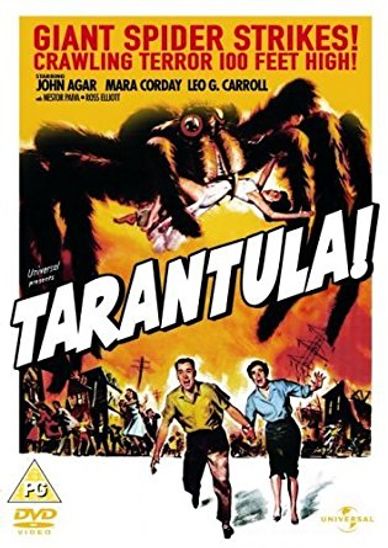
Starring: Starring: John Agar, Mara Corday, Leo G. Carroll, Netor Palva.
In Black & White
Directed by Jack Arnold
Story by Jack Arnold & Robert M. Fresco
Screenplay by Robert M. Fresco & Martin Berkeley
A deformed man is found dead in the desert. He is diagnosed as having an ageing disease but, impossibly, it has accelerated beyond any previously recorded case. The local doctor, Matt Hastings, encounters an attractive young woman, Stephanie ‘Steve’ Clayton, who has arrived in town. Steve is the new assistant to Professor Gerald Deemer, who is working on a growth serum for animals in an attempt to alleviate the ‘fast growing’ population’s food shortage. The professor has his own problems. His previous assistant – the dead man – had injected himself with the serum , hoping to hurry along a successful outcome. However, the ageing disease sent him mad and much of the laboratory is burnt out and the test subjects lost. Two factors are as yet unknown to the doctor and Steve: the assistant had attacked the professor and injected him with the isotope-affected serum, and one of the test subjects – a tarantula – escaped and continues to grow.
Doctor Hastings bumps into Steve in town and offers to drive her back. They stop to waste a bit of time admiring a rock formation and are nearly caught in a polystyrene rock fall. As they drive away the giant tarantula waves a hairy leg over the area where the rock fall began. Meanwhile, Spidey stomps around, mainly at night, sucking the meat from the bones of cattle and horses. In fact, the scene wherein the huge spider comes over a hill and bears-down on a corral of terrified horses looks very impressive. Of course, it still takes the doctor and the pretty useless sheriff an age to put together the clues of growth serum, animal subjects, dead cattle (and later, people) and large pools of arachnid venom, and theorise about what might be happening.
The spider has an ulterior motive, it seems; after hiding over the horizon until our hero guesses what the danger is, it decides to take its gigantism woes out on the by now badly deformed professor. Or perhaps it just wants to go home and returns to its cage. Either way, it destroys the house. Steve escapes and is driven away by the doctor. They team-up with the sheriff’s men, but the not-so-Incy-Wincy spider is hot on their trail – and he’s about to get hotter.
When boxes of exploding dynamite doesn’t even slow it, the air force is called in and, when conventional missiles have no effect, napalm is used. Our monster of the piece goes out in a blaze of glory.
Anyone who has seen this movie will surely remember the iconic climatic scene where we see our heroes standing in the centre of town watching the spider approaching from the desert. It’s all done in the same shot and looks tremendous. Also, unlike some of the early films showcasing giant people or animals, this one doesn’t have the look of transparency. A solid man-playing-God monster movie.
Verdict: 7 out of 10
(Original Review Ty Power 2018)
Arachnoquake (1982) 2012 DVD Release
Arachnoquake (1982) 2012 DVD Release
Arachnoquake (1982) 2012 DVD Release
Starring: Starring: Tracey Gold, Edward Furlong, Bug Hall, Ethan Phillips and Megan Adelle.
Directed by Griff Furst
Distributor: Signature Entertainment
October 2012
A brother and sister work with their father on the river but, as a consequence of unreliability, the brother is demoted to driving a trolley bus full of tourists through the city. However, after only just starting his first run, he comes across a huge pit in the road. It seems that an earthquake has released an until now undiscovered species of spider. They are large (some of them gigantic), they can jump high, run on water, and even breathe fire. Furthermore, they are predators. The spiders are over-running the city, but a small group of survivors has found the queen. Kill this spider and you kill them all. But that’s easier said than done, as it appears impervious to gunfire or explosions...
I don’t recall having seen a spider horror film since the release of Eight-Legged Freaks. Arachnoquake is to all intents and purposes a modern day B-movie. I have to say the spiders don’t look entirely real. It probably wasn’t a very good idea to make them pink. Then there’s the cartoonish CGI aspect, which also extends to any scenes with flame or fire. If a spider is light enough to spread its centre of gravity, it could stand or float on water. Some of these spiders are almost the size of a boat, and yet they can run on water and chase a boat! I think the writer here has mixed arachnids up with ants or bees, because in this movie we have a queen who supposedly controls all the other spiders - they can’t survive without her. Which is a convenient plot device to rid the city of the monsters.
The cast do their best to attempt to convince us the spiders are really there. When you’re watching huge, pink, water-skiing, fire-breathing arachnids, you’re obliged to suspend your disbelief quite a bit. You might recognise Edward Furlong from Terminator 2, and Ethan Phillips from Star Trek: Voyager.
It might sound like I’ve completely pulled this film to pieces, but the truth is it works fine if you treat it in the spirit it is intended. No, it’s not thought-provoking, or intricately plot woven, or strong on characterisation. Or even particularly scary. This is a fun popcorn movie, pure and simple. So, sit down, turn off your I.Q. and enjoy.
Verdict: 6 out of 10
(Review originally written by Ty Power for sci-fi-online 2012)
Frogs (1972) 2016 DVD Release
Arachnoquake (1982) 2012 DVD Release
Ghost Shark (2013) 2013 DVD Release
Starring: Ray Milland, Sam Elliot, Adam Roarke, Joan Van Ark.
Directed by George McCowan
Distributor: 88 Films
October 2016
Jason Crockett is an old man who invites his whole family to his island estate to celebrate both his birthday and 4th July. A nature photographer and journalist is also present, as the family's speedboat has caused damage and left him stranded. However, Crockett is disrespectful of nature, spawning nature's revenge which turns every local creature of land, air or water against the family. It is left to the only innocent party to attempt an escape. But when nature conspires together is there any hope of rescue?
I’ve never had the opportunity to see this film from 1972 before, so judging by the DVD cover I was fully expecting huge man-eating frogs to appear at some stage. It seemed logical considering the opening scenes of pollutants being dumped into the waters in and around the island, and also the early montage of camera snaps of human rubbish. Instead the inference is that the resultant process has made frogs not only slightly larger and much more widespread than is normal, but also somehow self-aware. This cognizance takes the form of, presumably, telepathic abilities, as they not only organise themselves in numbers but possibly other animals and insects that would, in most cases, stay well clear of mankind. Other than that, the only explanation is that nature itself has rallied its troops.
It’s nice that each representation of the animal kingdom we see is real. We view whichever creature is relevant, moving purposefully forward and massing, but the attacks are more inferred than seen. We do experience a character wrestling with a crocodile, and the approach of what resembles a huge false turtle, and every now and then a frog is thrown into frame if the others are looking a little laid back.
The acting is fine and thankfully payed straight. There is a little more money spent on this one than most retro monster movies. In fact, the premise is a little like Long Weekend, only nowhere near as tedious. Ray Milland is the star here, and he’s just as grumpy as he is in many of his other roles. He’s the head of the family (and presumably the island); his purpose primarily to boss everyone else around. What we wait for on these occasions is for the villain to get his comeuppance and, like the captain of a sinking ship, he is determined to hold-out until the end. It’s no surprise that he doesn’t last very long once the survivors make themselves scarce.
This genre of film is known as a eco-horror. The 88 Films new HD transfer is very nice and sharp. A fitting tribute to an unusual celluloid contribution. Extras include Today the Pond, Tomorrow the World: An Interview with David Gilliam; Stills Gallery, Original Trailer, and Reversible Cover.
Verdict: 6 out of 10
(Original Review Ty Power 2021)
Ghost Shark (2013) 2013 DVD Release
Arachnoquake (1982) 2012 DVD Release
Ghost Shark (2013) 2013 DVD Release
Starring: Mackenzie Rosman and Dave Randolph-Mayhem Davis.
Directed by Griff Furst
Distributor: Signature Entertainment
October 2013
A Great White shark attacks a fishing boat, when it is repeatedly shot at. It kills two of the three individuals on board, before slowly moving off to a nearby cave to die. Soon afterward, a group of teenagers witness a horrific attack in the sea close to the shore of a small community called Harmony. A girl is torn apart by what appears to be a glowing, translucent shark. Nobody believes them, least of all the mayor, who just wants to play down any troubles with the forthcoming 4th July celebrations. One person who does believe them is the old drunken hermit who lives in the lighthouse. He knows the power of the cave, and has his own reasons for keeping people away...
There is a very obvious attempt here to emulate an amalgamation of Jaws and the remake of Piranha. Of course, you’ll notice immediately this has a lot lower budget, particularly in terms of special effects. Producing a wavering blue glow in the basic shape of a Great White shark, and telling everyone it is a ghost, is a more than convenient way of covering up the shortfalls of the movie, and specifically a rubbish monster threat. The fact that the shark becomes a vengeful spirit within the first minutes of the film – with little or no explanation, apart from dying in a plastic-looking cave with symbols on the walls – paves the way for a series of ridiculous situations for the creature to make its appearances and coat the respective locations in blood and body parts. It not only materialises in its natural habitat of the sea, but anywhere else there is water present: through a fire hydrant, garden sprinklers, a swimming pool, a sink trap, and even an office water dispenser. I had to laugh when kids began water-sliding along a mat and through the inflatable head of a shark. It was a foregone conclusion what would happen next!
The plot (and I use the word advisedly) is extremely hackneyed, and the characters very much stereotyped. Nobody believes the teenagers’ story. The sheriff is controlled by the mayor, who is only concerned about the upcoming elections (ring any bells?). The key character is a sensible girl, balanced by a younger wayward sister. There is a budding boyfriend, and a son of the mayor. Then – wait for it – there is the old crazy man, who warns the authorities in vain, and conveniently knows how to see off the monster. As you would expect, there are lots of bikini-clad eighteen year-olds; in fact, the little sea shanty town seems to be full of them. It’s rather strange, there’re no fat and ugly fifty year-old women in existence. Perhaps the major has fed them all to the shark. Now, there’s a plot!
So, move along, please. There’s nothing (new) to see here...
Verdict: 4 out of 10
(Review originally written by Ty Power for sci-fi-online 2013)